

How does fire risk assessment differ for listed or heritage buildings?
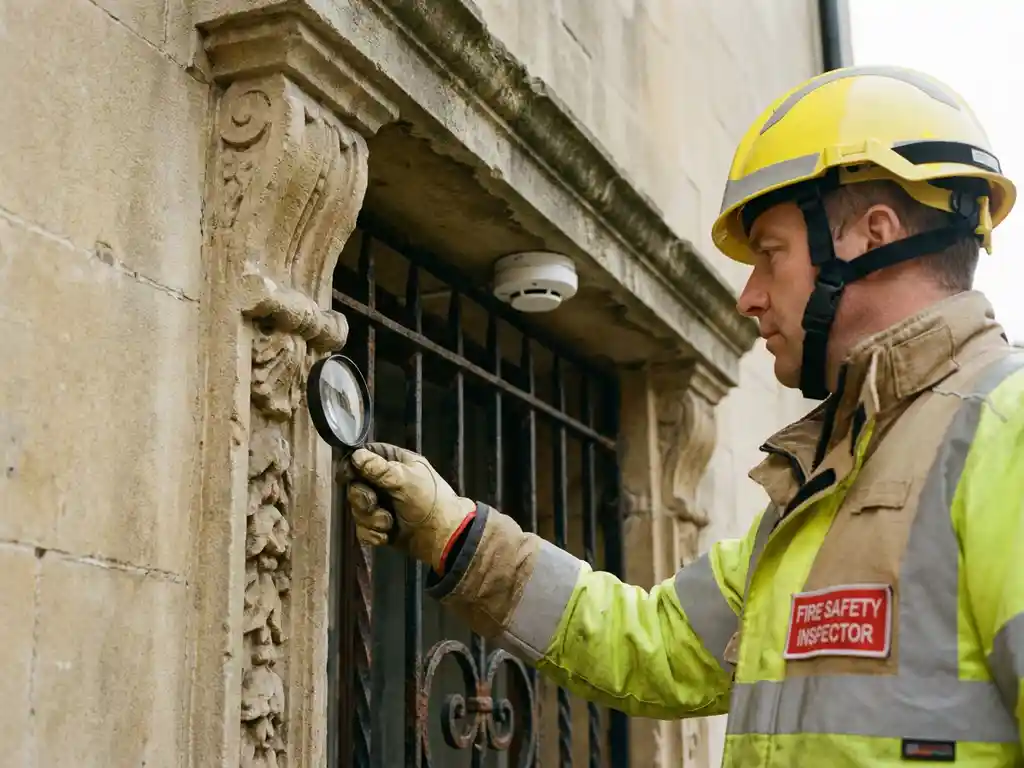
Fire risk assessment in listed or heritage buildings is more complex than in standard properties because any fire safety measures must balance genuine protection with the legal duty to preserve the building’s historic fabric. Owners and managers cannot simply install modern suppression systems without considering planning consent, conservation requirements, and the irreplaceable nature of original materials. The sections below address the most important questions surrounding fire safety in historic structures.
What makes fire risk assessment more complex in listed buildings?
Fire risk assessment in listed buildings is more complex because every protective measure must be evaluated against its potential impact on the building’s historic character, original materials, and architectural integrity. Standard fire safety solutions designed for modern construction may be inappropriate, impractical, or even legally prohibited in a heritage context.
In a conventional building, the assessor’s primary concern is identifying hazards and selecting the most effective suppression or detection method. In a listed building, that decision-making process gains an additional layer: will this intervention damage original fabric, require intrusive installation, or alter the character of a protected space? Drilling through historic stonework to route pipework, for example, may be technically effective but damaging to heritage in practice.
The construction methods used in historic buildings also create genuine fire safety challenges that differ from modern structures. Timber frames, open roof voids, unlined cavities, and interconnected spaces allow fire to travel rapidly and unpredictably. Many heritage buildings also lack the compartmentation that modern building regulations require, meaning a small fire can escalate quickly before detection systems have time to respond.
Finally, the sheer variety of listed buildings adds complexity. A Georgian townhouse, a Victorian industrial mill, and a medieval church each present entirely different structural risks, occupancy patterns, and conservation requirements. There is no single template for fire risk assessment in historic structures, and assessors must approach each building on its own terms.
What legal obligations apply to fire safety in heritage buildings?
Listed and heritage buildings are subject to the same core fire safety legislation as any other property, including the Regulatory Reform (Fire Safety) Order 2005 in England and Wales, but they must simultaneously comply with listed building consent requirements that restrict physical alterations. This dual obligation is what makes compliance particularly demanding.
Under fire safety law, the responsible person for any non-domestic premises must carry out a suitable and sufficient fire risk assessment, implement appropriate fire safety measures, and keep those measures under review. Heritage status does not exempt a building from these duties. If anything, the standard of care is higher, because the consequences of fire in a building containing irreplaceable historic fabric are especially severe.
At the same time, any physical alterations to a listed building, including the installation of fire detection, suppression, or escape route signage, may require listed building consent from the local planning authority. Works carried out without consent can result in enforcement action, and in serious cases, criminal prosecution. The local Historic Environment Officer or conservation officer is a key contact when planning any fire safety installation in a protected structure.
In practice, this means that the fire risk assessment process for a heritage building should involve early engagement with both the fire authority and the conservation authority, rather than treating the two as separate processes. Many local authorities and fire services have specialist heritage advisers who can help identify solutions that satisfy both sets of obligations.
What are the biggest fire risks specific to historic structures?
The biggest fire risks in historic structures stem from original construction materials, ageing services, limited compartmentation, and the presence of large volumes of combustible material that cannot easily be removed or replaced. These factors combine to make fire spread faster and suppression harder than in modern buildings.
Timber is the dominant structural material in many heritage buildings, and it burns readily once ignited. Roof spaces, floor voids, and wall cavities in older buildings are often unlined and interconnected, creating hidden pathways through which fire and smoke can travel before any visible sign appears at occupant level. This hidden spread is one of the most dangerous characteristics of historic building fires.
Electrical installations present another significant risk. Many historic buildings contain wiring that has been added, modified, or extended over decades without full rewiring, and ageing insulation increases the likelihood of electrical faults. Overloaded circuits, poor earthing, and inadequate protection are common findings during fire risk assessments in older properties.
Decorative and furnishing materials in heritage interiors, including historic textiles, wooden panelling, and oil-based paints, can contribute to rapid fire development. Arson and accidental ignition during maintenance or construction work are also disproportionately common causes of heritage building fires, particularly when a building is partially unoccupied or undergoing renovation.
How does fire suppression work in a listed or heritage building?
Fire suppression in a listed or heritage building must be selected and installed in a way that minimises physical intervention in the historic fabric while still providing effective protection. This typically means favouring systems with a small installation footprint, clean suppression agents, and the ability to protect specific high-value areas or enclosures rather than flooding entire spaces.
Traditional water-based sprinkler systems, while effective, require extensive pipework and can cause significant water damage to irreplaceable contents and fabric. For many heritage settings, this makes them unsuitable or at least undesirable as a primary solution. Gaseous suppression systems offer an alternative, but the choice of agent matters greatly. Systems based on inert gases, such as nitrogen, extinguish fire by reducing oxygen levels without leaving chemical residues, making them well suited to environments where damage to sensitive materials must be avoided.
For specific enclosures within a heritage building, such as electrical cabinets, server racks, or control equipment housed within a historic structure, object-level suppression provides targeted protection without requiring any modification to the surrounding fabric. These systems act at the source of ignition, stopping a fire before it can spread to the building itself. This approach is particularly valuable in heritage contexts where early intervention is critical and large-scale suppression would be both intrusive and damaging.
The installation method is as important as the suppression agent. Any fixings, penetrations, or surface contact with historic material should be kept to the absolute minimum, and reversible fixing methods are preferred wherever possible. Conservation-led installation guidance should inform every stage of the process.
Should a heritage building use a different fire detection approach?
Yes. Heritage buildings benefit significantly from early-warning fire detection systems, particularly aspirating smoke detection, which can identify the earliest traces of combustion before visible smoke or flame develops. Early detection is especially important in historic structures because the speed of fire spread through unlined voids and timber construction leaves very little time to respond once a fire is established.
Conventional point detectors mounted on ceilings may be adequate for some spaces, but they are often poorly suited to heritage environments. High ceilings, complex roof geometries, and the desire to avoid surface-mounted hardware in sensitive interiors all limit the usefulness of standard detectors. Aspirating systems draw air samples through a network of small-bore sampling pipes to a central detector unit, meaning the detection hardware itself can be concealed or located remotely from the protected space.
In heritage buildings with high-value electrical or electronic equipment, combining aspirating detection with suppression at the object level creates a particularly effective approach. The detection system identifies smoke at the earliest possible stage, and suppression activates directly within the enclosure where the fault has originated, before any heat or flame can reach the surrounding historic fabric.
Whichever detection technology is selected, the system design should account for the specific airflow patterns, occupancy characteristics, and heritage sensitivities of each space. A detection strategy that works well in a modern open-plan office will rarely translate directly to a historic building without significant adaptation.
Who should carry out a fire risk assessment for a listed building?
A fire risk assessment for a listed or heritage building should be carried out by a competent assessor with specific experience in historic structures. General fire risk assessment competence is not sufficient on its own, because heritage buildings present technical, legal, and conservation challenges that require specialist knowledge to navigate correctly.
The assessor should understand the construction methods and materials typical of the building’s period, be familiar with listed building consent requirements, and have experience working alongside conservation officers and heritage advisers. In practice, this may mean commissioning a specialist heritage fire risk assessor, or ensuring that a standard assessor works in close collaboration with a conservation professional throughout the process.
Professional accreditation bodies such as the Institute of Fire Engineers and the Fire Protection Association publish guidance on competence for fire risk assessment, and some have specific resources relating to heritage buildings. Historic England guidance on fire safety in historic buildings is also a widely used reference point for assessors working in this sector in England.
For larger or more complex heritage properties, a multi-disciplinary approach is often the most effective. Bringing together fire engineers, conservation architects, structural specialists, and local authority advisers at the outset produces a more coherent and defensible assessment than treating each discipline in isolation. The fire risk assessment should be reviewed whenever significant changes are made to the building, its use, or its occupancy.
How ExxFire helps with fire protection in heritage buildings
Protecting mission-critical equipment housed within listed or heritage buildings requires a fire suppression approach that is both highly effective and minimally invasive. ExxFire’s integrated fire detection and suppression systems are designed precisely for this kind of sensitive environment.
- Non-pressurised nitrogen suppression: ExxFire’s Cool Gas Generator produces clean inert nitrogen gas that extinguishes fire at the source without leaving chemical residues, protecting sensitive electronics and historic contents alike.
- Aspirating smoke detection: Early-stage smoke detection activates suppression before fire can spread to surrounding historic fabric, giving operators maximum response time.
- Minimal installation footprint: Systems are designed for closed enclosures such as server racks and electrical cabinets, requiring no large-scale pipework or structural penetrations.
- PFAS-free and environmentally responsible: ExxFire’s technology is a clean alternative to PFAS-containing suppression agents, aligning with both conservation values and modern environmental standards.
- Tested and certified: Systems are independently tested and certified by CNPP in France and DMT, part of TÜV Nord in Germany, providing the documented evidence that heritage and compliance-driven environments require.
For organisations managing electrical infrastructure, ICT equipment, or energy systems within historic buildings, ExxFire provides object-level protection that safeguards both the equipment and the building around it. Explore ExxFire’s fire suppression solutions to find the right approach for your heritage environment.