

Why is nitrogen used as a fire suppression agent?
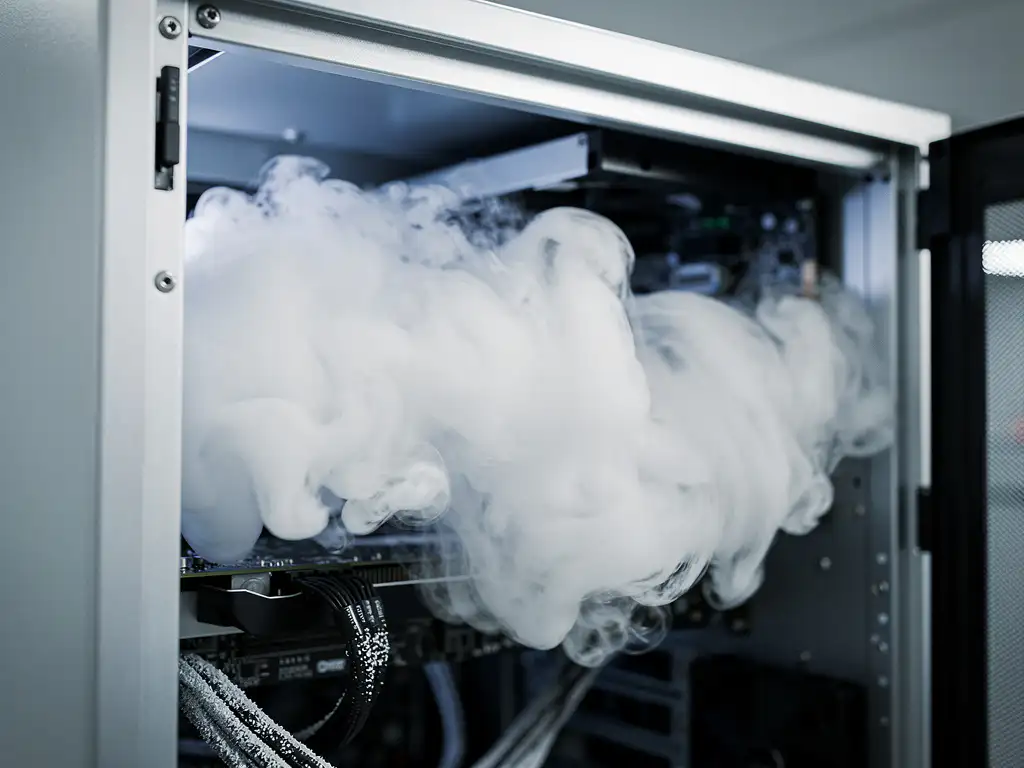
Nitrogen is used as a fire suppression agent because it reduces the oxygen concentration in an enclosed space below the level needed to sustain combustion, effectively smothering a fire without using water, foam, or chemical agents. As a naturally abundant inert gas, nitrogen is non-toxic, leaves no residue, and causes no damage to sensitive equipment. The sections below answer the most common questions about how nitrogen fire suppression works, where it excels, and where its limits lie.
How does nitrogen actually extinguish a fire?
Nitrogen extinguishes a fire by displacing oxygen within an enclosed space. Combustion requires oxygen to sustain itself, typically above a 15% concentration. When nitrogen is introduced into a protected enclosure, it dilutes the oxygen level below that threshold, starving the fire of the element it needs to continue burning. No chemical reaction is involved — the process is purely physical.
This mechanism is known as oxygen displacement or inerting. Because nitrogen makes up approximately 78% of the air we breathe, introducing additional nitrogen into a closed enclosure is a controlled extension of what already exists in the atmosphere. The fire does not need to be doused or chemically neutralized — it simply cannot continue once the oxygen concentration drops sufficiently.
For this reason, nitrogen fire suppression is particularly effective in sealed or semi-sealed enclosures such as electrical cabinets, server racks, and battery storage units. The tighter the enclosure, the more efficiently nitrogen can reduce oxygen levels and maintain suppression long enough to prevent reignition.
What makes nitrogen safer than other fire suppression gases?
Nitrogen is safer than many alternative suppression gases because it is chemically inert, non-toxic at the concentrations used in fire suppression, and produces no harmful byproducts during or after discharge. Unlike halon or certain synthetic gases, nitrogen does not decompose into toxic compounds when exposed to heat or flames.
Several properties contribute to its strong safety profile:
- No chemical residue: Nitrogen leaves nothing behind after discharge. There is no powder, foam, or liquid to clean up, and no corrosive or toxic film that could damage electronics or harm personnel.
- No ozone depletion potential: Nitrogen has zero ozone depletion potential and a global warming potential of zero, making it fundamentally different from fluorinated gases or halon-based agents.
- Naturally present in air: Because nitrogen already dominates the atmosphere, its use in suppression does not introduce a foreign substance into the environment — it simply changes the local concentration temporarily.
- No secondary damage to equipment: Sensitive electronics, precision instruments, and high-value hardware are unaffected by nitrogen exposure, which is critical in environments where the cost of equipment damage can far exceed the cost of the fire itself.
It is worth noting that at very high concentrations, nitrogen can create an oxygen-deficient atmosphere that is unsafe for people to breathe. This is why nitrogen fire suppression systems are designed for enclosed equipment spaces rather than occupied rooms, and why proper signage and safety interlocks are standard practice in any responsible installation.
Is nitrogen fire suppression environmentally friendly?
Yes, nitrogen fire suppression is one of the most environmentally friendly options available. Nitrogen is a naturally occurring element that makes up the vast majority of the atmosphere. It carries no global warming potential, no ozone depletion potential, and introduces no synthetic chemicals into the environment when discharged.
This stands in sharp contrast to many legacy fire suppression agents. Halon, which was widely used for decades, was banned under the Montreal Protocol due to its severe ozone-depleting effects. Many of the hydrofluorocarbon (HFC) and perfluorocarbon (PFC) gases that replaced halon carry significant global warming potential. More recently, PFAS-containing fire suppression agents — including certain aqueous film-forming foams and some fluorinated gases — have come under intense regulatory scrutiny due to their persistence in the environment and potential health effects.
Nitrogen-based suppression avoids all of these concerns entirely. As regulatory pressure on PFAS-containing and high-GWP suppression agents continues to grow across Europe and globally, nitrogen stands out as a future-proof choice that meets both current and anticipated environmental compliance requirements.
What types of equipment can nitrogen suppress fires in?
Nitrogen fire suppression is best suited to enclosed or semi-enclosed equipment spaces where oxygen concentration can be reliably reduced. It is widely used to protect electrical cabinets, switchgear enclosures, ICT and server racks, telecommunications infrastructure, battery energy storage systems (BESS), and high-voltage cabinets.
The common thread across all these applications is that the protected object is a discrete enclosure with limited air exchange. This allows nitrogen to build up to suppression-level concentrations quickly and hold them long enough to prevent reignition. The more tightly sealed the enclosure, the more efficiently nitrogen performs.
Nitrogen is not typically used for open-area or room-level suppression in the same way that some other inert gas systems are deployed, because maintaining suppression concentration in a large, unsealed space requires significantly more gas volume. Its strength lies in targeted, object-level protection — securing the specific asset at risk rather than flooding an entire room.
This makes nitrogen fire suppression particularly valuable in industries where the protected equipment is high-value, sensitive to residue or moisture, and where downtime carries serious operational or financial consequences. Data centers, energy infrastructure, industrial manufacturing environments, and healthcare facilities are among the most common use cases.
How does nitrogen fire suppression compare to CO2 systems?
Nitrogen and CO2 are both inert gas suppression agents that work by reducing available oxygen, but they differ significantly in safety profile, environmental impact, and suitability for different environments. The key distinction is that CO2 is acutely dangerous to people at suppression concentrations, while nitrogen poses a lower acute risk at equivalent effectiveness levels.
Safety for personnel
CO2 suppresses fire at concentrations that are immediately life-threatening to humans — typically around 34% CO2 by volume, which causes rapid loss of consciousness and can be fatal within minutes. Nitrogen, by contrast, reduces oxygen to suppression levels through dilution, and the resulting atmosphere, while not safe for prolonged occupancy, is less immediately lethal than a CO2-flooded space. This makes nitrogen a more appropriate choice in environments where accidental human exposure is a realistic concern.
Environmental impact
CO2 is a greenhouse gas with a global warming potential of 1 — which, while lower than many synthetic agents, still represents a direct contribution to atmospheric warming when discharged. Nitrogen has a global warming potential of zero. For organizations with sustainability mandates or environmental compliance requirements, this distinction matters when selecting a fire suppression solution.
Equipment compatibility
Both agents leave no liquid or chemical residue, making them preferable to water or foam systems in electronics-rich environments. However, CO2 discharge can cause rapid temperature drops and condensation, which may affect sensitive components. Nitrogen discharge does not produce the same thermal shock, making it a gentler option for protecting precision equipment.
What are the limitations of nitrogen fire suppression?
Nitrogen fire suppression is highly effective within its intended application range, but it does have limitations. The most significant is its dependence on enclosure integrity — nitrogen can only suppress a fire if the protected space retains sufficient gas concentration, which requires a reasonably sealed enclosure. In open or poorly sealed environments, nitrogen disperses too quickly to reach or maintain suppression levels.
Other limitations worth understanding include:
- Volume constraints: Nitrogen suppression systems are most practical for discrete enclosures of limited volume. Protecting very large open spaces requires substantial gas volumes and more complex system design.
- Not suitable for all fire classes: Nitrogen is effective against fires involving ordinary combustibles and electrical equipment, but is generally not the agent of choice for fires involving reactive metals or materials that can burn in the absence of oxygen.
- Oxygen-deficient atmosphere: As noted earlier, discharged nitrogen creates an environment temporarily unsafe for human occupancy. Systems must include appropriate safety measures, including warning systems and access controls, to prevent personnel from entering a suppressed space.
- Enclosure-specific design: Each installation requires an assessment of the enclosure’s volume, leakage rate, and fire risk profile to ensure the system is correctly sized. A poorly specified system may fail to achieve or hold suppression concentration.
These limitations do not diminish nitrogen’s value as a suppression agent — they simply define the conditions under which it performs best. For enclosed, equipment-level fire protection in environments with sensitive electronics and sustainability requirements, nitrogen remains one of the most effective and responsible choices available.
How ExxFire uses nitrogen to protect mission-critical equipment
ExxFire’s integrated fire detection and suppression systems are purpose-built around nitrogen as the suppression agent, combining early smoke detection with targeted nitrogen discharge to protect enclosed equipment at the source of risk. The systems are designed specifically for the applications where nitrogen excels, including server racks, electrical cabinets, switchgear enclosures, and battery energy storage systems.
Key features of ExxFire’s approach include:
- Patented Cool Gas Generator technology: Nitrogen is stored in a solid, non-pressurized state and released on demand, eliminating the risks associated with pressurized gas cylinders and simplifying installation.
- Aspirating smoke detection: The integrated detection system identifies smoke at the earliest possible stage, triggering suppression before a fire can develop and cause significant damage.
- PFAS-free and residue-free: ExxFire’s nitrogen-based systems leave no chemical residue, cause no secondary damage to electronics, and comply with current and anticipated environmental regulations.
- Easy self-installation: Systems are pre-engineered for installation without special certification, reducing deployment time and total cost of ownership.
- Certified and tested: All systems are validated by CNPP in France and DMT, part of TÜV Nord in Germany, ensuring compliance and reliability in real-world conditions.
Whether you are protecting a single server rack or a fleet of battery storage units across multiple sites, ExxFire’s nitrogen fire suppression systems offer a clean, certified, and sustainable solution. Contact ExxFire to discuss the right system for your specific equipment and environment.