
What is meant by a certified fire suppression system?
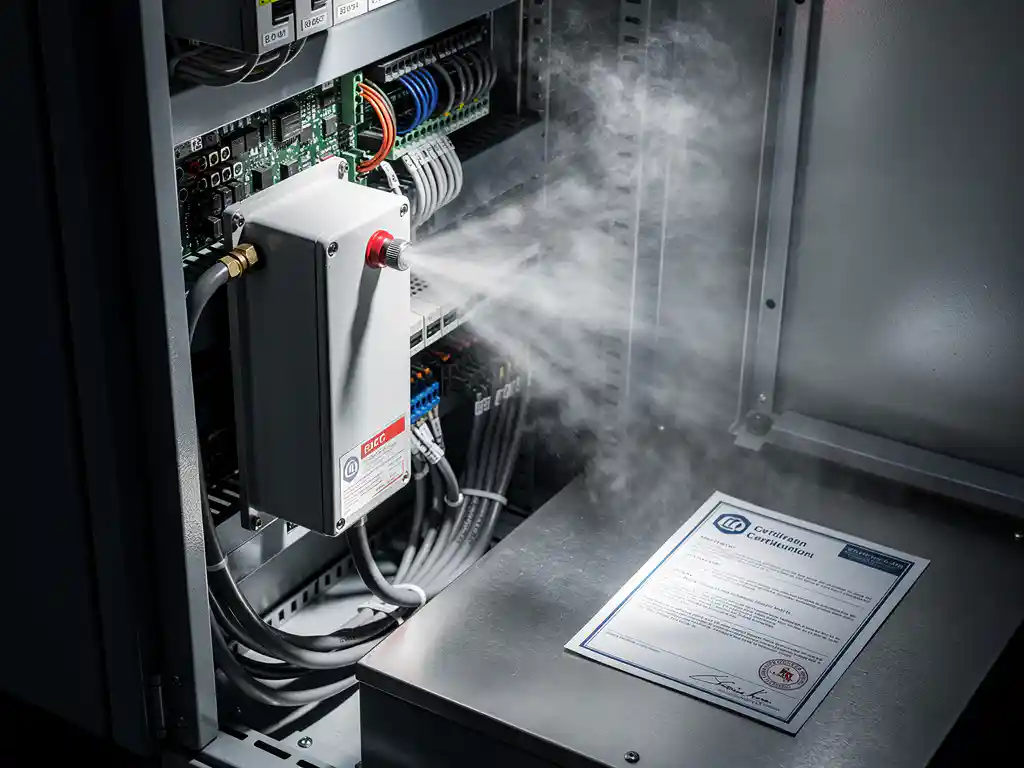
A certified fire suppression system is one that has been independently tested and verified to meet defined performance and safety standards by a recognized third-party body. Certification confirms that the system functions as designed under controlled test conditions and that its components, materials, and installation requirements comply with applicable codes. The sections below unpack what that means in practice, from the bodies that issue certifications to how you can verify a system’s status before purchasing.
What standards and bodies certify fire suppression systems?
Fire suppression systems are certified against standards issued by recognized technical and regulatory bodies, the most influential of which are NFPA, FM Global, UL, and EN (European Norm) standards. These organizations define the test protocols, performance thresholds, and documentation requirements a system must satisfy to earn certification.
The key players differ slightly by region and application:
- NFPA (National Fire Protection Association): Publishes widely adopted fire suppression standards such as NFPA 12 (carbon dioxide systems), NFPA 2001 (clean agent systems), and NFPA 75 (protection of information technology equipment). NFPA standards are reference points globally, not just in the United States.
- FM Global (Factory Mutual): Issues FM Approvals, which are particularly important in industrial and commercial property insurance contexts. FM Global fire suppression approval signals that a system meets stringent loss-prevention criteria.
- UL (Underwriters Laboratories): Tests and lists fire suppression equipment under its own standards, widely recognized in North America and increasingly accepted internationally.
- EN/ISO standards: European Norm standards such as EN 15004 (gaseous suppression systems) govern fire suppression compliance across EU member states and many other countries.
- CNPP (Centre National de Prévention et de Protection): A French testing and certification body recognized across Europe for fire protection equipment, including suppression systems for enclosures and cabinets.
- TÜV Nord / DMT: German technical inspection bodies that provide independent testing and certification, particularly relevant for industrial fire suppression in European markets.
No single global body governs all fire suppression certification. The applicable standard depends on the geography, the industry, and the specific type of system or hazard being protected.
What does the certification process for a fire suppression system actually involve?
The fire suppression certification process involves independent laboratory testing, design review, and ongoing compliance audits conducted by an accredited third-party body. The system must demonstrate that it reliably detects and suppresses fire within defined parameters, using components that meet material and construction requirements.
In practice, the process typically includes the following stages:
- Design and documentation review: The certifying body examines technical specifications, engineering drawings, component datasheets, and installation manuals to confirm the system is designed to the relevant standard.
- Component testing: Individual components such as detection sensors, nozzles, actuators, and agent storage units are tested for performance, durability, and compatibility.
- System-level fire testing: The complete system is tested under controlled fire scenarios representative of its intended application. For enclosure protection systems, this typically means demonstrating suppression within a defined volume and time threshold.
- Environmental and stress testing: Systems may be subjected to temperature extremes, humidity, vibration, and other environmental conditions to verify reliability in real-world deployment.
- Production quality audits: Certification bodies often conduct factory audits to confirm that production processes consistently deliver systems that match the tested design.
- Ongoing surveillance: Certified status is not permanent. Most certification bodies require periodic re-testing or audits to maintain listing or approval status.
The rigor of this process is what distinguishes a genuinely certified fire suppression system from one that is merely marketed using vague compliance language.
What’s the difference between a listed, approved, and certified fire suppression system?
A listed system appears on a recognized testing laboratory’s published list of products that have met its standards. An approved system has been accepted by a specific authority, insurer, or jurisdiction for a defined use. A certified system has been formally verified by an accredited body against a specific standard. The terms overlap in practice but carry distinct meanings in regulatory and procurement contexts.
Understanding the distinction matters when specifying systems for industrial environments:
- Listed: UL listing is the most common example. A listed product has been tested by UL and meets its criteria. Listing is specific to the standard and product category tested.
- Approved: FM Global approval is the clearest example of this term in use. FM Approval means the product has met FM Global’s own technical requirements, which are oriented toward property loss prevention. Insurers or facility owners may require FM-approved equipment.
- Certified: Certification is the broadest term and is used by bodies like CNPP, TÜV, and EN standard bodies. It implies third-party verification against a defined standard, often with factory surveillance included.
In procurement specifications, it is worth confirming exactly which term applies and which body issued the status, because “certified” used loosely by a manufacturer without a named third-party body behind it carries very little technical weight.
Which certifications are required for industrial fire suppression systems?
The certifications required for industrial fire suppression systems depend on the jurisdiction, the hazard type, the industry sector, and the requirements of the facility’s insurer or regulator. There is no single universal certification, but several are consistently required or strongly expected in high-risk industrial environments.
For facilities operating in the European Union or under ATEX regulations, fire suppression equipment used in potentially explosive atmospheres must comply with ATEX directives (Directive 2014/34/EU), which require equipment to be certified for use in classified zones. This is separate from general fire suppression certification and applies specifically to environments with flammable gases, vapors, or dusts.
Beyond ATEX, industrial fire suppression compliance commonly requires:
- Conformance with NFPA standards relevant to the hazard type (e.g., NFPA 2001 for clean agent systems protecting electronics or control rooms)
- FM Approval for facilities where FM Global is the property insurer or risk assessor
- EN 15004 compliance for gaseous suppression systems installed in European jurisdictions
- Local authority having jurisdiction (AHJ) acceptance, which may reference any of the above standards
For systems protecting electrical enclosures, switchgear, or battery energy storage systems, certifications specific to enclosure fire suppression such as those issued by CNPP are increasingly expected alongside broader system-level compliance.
Does certification guarantee a fire suppression system will work in every environment?
No, certification does not guarantee that a fire suppression system will perform effectively in every environment. Certification confirms that a system met defined performance criteria under specific test conditions. If the real-world installation differs significantly from those conditions, the system may not perform as expected, even if it holds a valid certification.
Several factors can create a gap between certified performance and real-world reliability:
- Application scope: A system certified for protecting a server cabinet is not automatically appropriate for an open industrial space or a high-voltage switchroom. Certification is always tied to a defined scope.
- Installation quality: Even a well-certified system can fail if installed incorrectly. Certification covers the product as designed, not every possible installation configuration.
- Environmental conditions: Extreme temperatures, corrosive atmospheres, vibration, or high humidity can degrade components in ways that standard certification tests may not fully replicate.
- Hazard type: Suppression systems are tested against representative fire scenarios. An unusual fuel type or ignition source not covered in the test protocol may produce results outside the certified performance envelope.
This is why certification should be treated as a necessary baseline, not a substitute for proper hazard analysis, system design, and installation verification. A certified fire suppression system installed correctly in its intended application provides a high level of assurance; the same system, when misapplied, provides much less.
How do you verify a fire suppression system’s certification before purchasing?
To verify a fire suppression system’s certification, request the original test reports and certificates from the manufacturer, then cross-reference them against the certifying body’s published listings or registry. Reputable certification bodies maintain publicly accessible databases where you can confirm that a specific product holds current, valid certification status.
Practical steps to take before purchasing:
- Ask for the certificate directly: Request the full certificate document, not a summary or marketing claim. The certificate should name the issuing body, the standard it was tested against, the specific product or system covered, and the certificate’s validity period.
- Check the certifying body’s registry: UL maintains a public product certification directory. FM Global publishes its Approval Guide online. CNPP and TÜV certificates can be verified by contacting those bodies directly.
- Confirm the scope matches your application: Verify that the certification covers the specific configuration, volume, and hazard type relevant to your installation. A certificate for a different product variant or application scope does not transfer.
- Check for currency: Certifications can expire or be withdrawn. Confirm the certificate is still active and that the product has not been modified since certification was granted.
- Consult your AHJ or insurer: Your local authority having jurisdiction or property insurer may have specific requirements about which certifications they recognize. Confirm acceptance before specifying a system.
Treating certification verification as a formal procurement step, rather than an afterthought, reduces the risk of specifying a system that fails inspection or does not satisfy insurance requirements after installation.
How ExxFire supports fire suppression certification requirements
ExxFire’s integrated fire detection and suppression systems are designed to meet the certification expectations that industrial safety managers and compliance teams face in practice. The systems combine aspirating smoke detection with non-pressurized nitrogen gas suppression and are independently tested and certified by CNPP in France, one of Europe’s recognized fire protection certification bodies. Key features that support compliance and procurement confidence include:
- CNPP certification: ExxFire systems are tested and certified by CNPP, providing documented third-party verification against defined fire suppression performance standards for enclosure protection.
- Additional independent testing: Systems have been tested by DMT Dortmund, part of TÜV Nord, giving buyers a second layer of independent technical validation.
- PFAS-free inert gas suppression: ExxFire’s nitrogen-based suppression leaves no chemical residues and avoids PFAS-containing agents, which is increasingly relevant for fire suppression compliance as regulations on fluorinated compounds tighten.
- Pre-engineered for easy installation: Systems are designed for self-installation without specialist certification requirements, reducing installation risk and supporting consistent deployment across multiple sites.
- Built-in reporting to existing fire panels: Relay outputs allow ExxFire systems to integrate with existing fire safety infrastructure, supporting facility-wide compliance documentation.
If you are specifying a certified fire suppression system for electrical cabinets, switchgear, server rooms, or battery energy storage systems, contact ExxFire to discuss your application and request full certification documentation.
Related Articles
- How do you select a fire detection system for a regulated environment?
- How do you ensure a fire suppression system stays compliant after installation?
- How do wildfires start and what can homeowners do to prevent them?
- How does clutter increase the risk of a house fire?
- Why is zero-GWP fire suppression becoming a procurement requirement?