

How do fire safety standards impact the design of electrical enclosures?
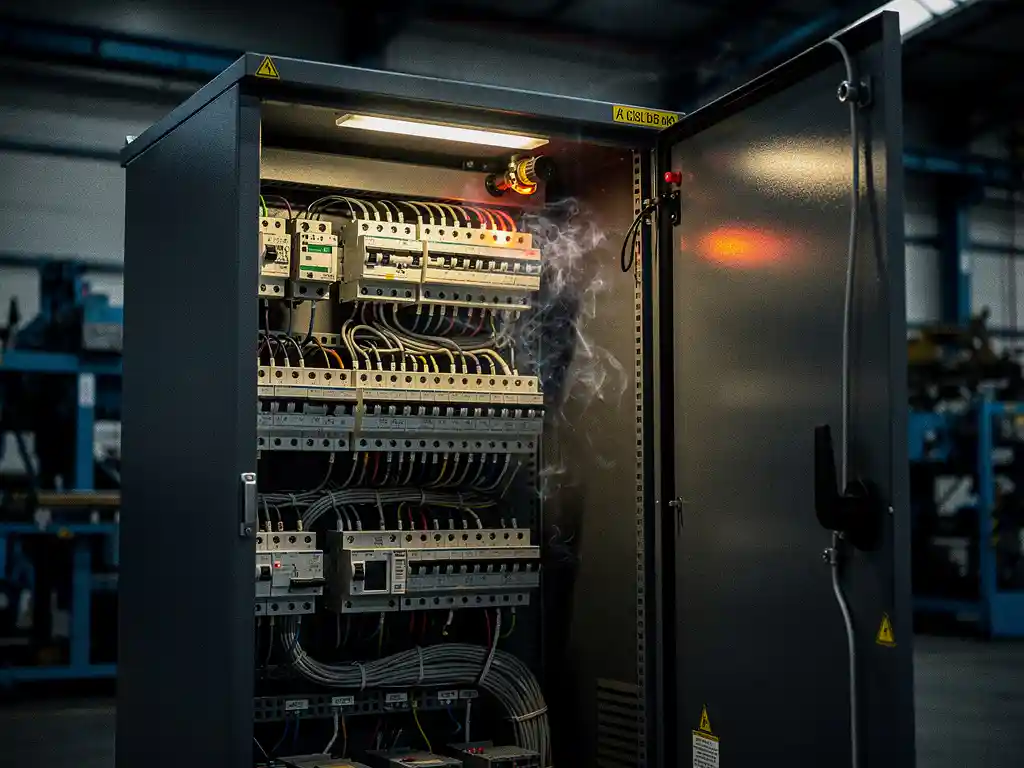
Fire safety standards directly shape the design of electrical enclosures by dictating material choices, construction methods, detection requirements, and suppression capabilities. These standards exist to prevent electrical fires from spreading beyond the enclosure, protecting both personnel and critical equipment. The following sections break down the most important questions safety and compliance managers face when specifying enclosure fire protection.
Which fire safety standards apply to electrical enclosures?
Several international and regional fire safety standards govern electrical enclosures, with the most relevant being IEC 62208, IEC 60529, NFPA 70 (the National Electrical Code), and NFPA 75 for IT equipment. In Europe, EN 60529 and EN 61439 cover enclosure protection ratings and low-voltage switchgear assemblies. Industries operating in hazardous areas must also comply with ATEX directives and IEC 60079 standards for explosion-proof enclosures.
The applicable standard depends on the enclosure type, its contents, and the environment where it is installed. For example, a switchgear cabinet in a petrochemical plant must meet both IEC 61439 for construction and IEC 60079 for hazardous area classification. A data center server rack falls primarily under NFPA 75 and NFPA 76, which address fire protection for telecommunications and IT facilities.
FM Global data sheets, particularly DS 5-32 for electrical equipment, provide additional guidance that is widely adopted in industrial insurance contexts. Safety and compliance managers should treat these standards as a layered framework rather than a single checklist, since most real-world installations require compliance with multiple overlapping requirements.
How do fire safety standards dictate enclosure material and construction?
Fire safety standards require electrical enclosures to be constructed from materials that resist ignition, limit flame spread, and maintain structural integrity under heat. Steel remains the dominant material because it meets the non-combustible requirements in standards such as IEC 62208 and NFPA 70. Polymer-based enclosures must meet specific flammability classifications, typically UL 94 V-0 or V-1, to be code-compliant.
Beyond material selection, construction standards define wall thickness, seam integrity, and cable entry protection. Enclosures must prevent fire from entering or escaping through gaps, which is why standards specify minimum IP (Ingress Protection) ratings. An IP54 or higher rating, as defined by IEC 60529, limits the ingress of dust and moisture that could accelerate internal ignition.
Standards also govern the internal layout of enclosures. Adequate spacing between components, proper cable management, and ventilation design all reduce the risk of thermal runaway or arc flash. NFPA 70E, which addresses electrical safety in the workplace, reinforces these construction requirements by specifying clearance distances and arc flash boundaries that influence how enclosures are physically built and labeled.
What role does early smoke detection play in enclosure fire protection?
Early smoke detection is critical to enclosure fire protection because electrical fires typically begin as slow, smoldering events that produce smoke well before flames appear. Detecting smoke at the earliest stage allows suppression systems to activate before heat causes irreversible damage to components. Standards such as NFPA 72 and EN 54 define performance requirements for detection systems, including sensitivity thresholds and response times.
Aspirating smoke detection (ASD) technology is particularly well-suited to enclosed electrical cabinets because it actively draws air samples from inside the enclosure rather than waiting for smoke to drift to a detector. This approach dramatically reduces detection time compared to conventional point detectors, which is essential in sealed or partially sealed enclosures where airflow is restricted.
For compliance managers specifying protection for high-value switchgear or battery energy storage systems, integrating detection directly inside the enclosure rather than relying solely on room-level detection systems is increasingly considered best practice. Some standards and insurance requirements now explicitly recommend or mandate in-cabinet detection for equipment above certain voltage or criticality thresholds.
How do suppression system requirements shape enclosure design?
Suppression system requirements directly influence enclosure design by establishing the minimum seal integrity, agent compatibility, and discharge volume needed for effective fire knockdown. For gaseous suppression systems, the enclosure must achieve and maintain a minimum agent concentration for a defined hold time, which means enclosures must be designed with controlled leakage rates. Standards such as ISO 14520 and NFPA 2001 specify these design concentration and hold time requirements for clean agent systems.
The choice of suppression agent also shapes design decisions. Inert gas systems, which displace oxygen to extinguish fire, require enclosures that can withstand the pressure transient during discharge. This influences wall thickness, door latching mechanisms, and the placement of pressure relief vents. Chemical clean agents have different requirements around nozzle placement and minimum enclosure volume.
Enclosure designers must also account for agent compatibility with the equipment inside. Some halon alternatives and fluorinated agents can leave residues or cause thermal shock to sensitive electronics. Nitrogen-based systems avoid this problem entirely, making them a practical choice for enclosures containing high-value electronics where contamination after a suppression event would itself cause significant damage.
What are the consequences of non-compliance with enclosure fire standards?
Non-compliance with enclosure fire safety standards can result in regulatory penalties, insurance claim denials, operational shutdowns, and significant liability exposure in the event of a fire. Regulatory bodies in most jurisdictions have the authority to issue stop-work orders or mandate equipment replacement when enclosures fail to meet applicable standards. In hazardous area environments, non-compliant ATEX equipment can expose operators to criminal liability.
From an insurance perspective, FM Global and other industrial insurers routinely conduct site assessments and may refuse coverage or impose exclusions for facilities where electrical enclosures do not meet recognized standards. A fire that originates in a non-compliant enclosure can void property damage and business interruption coverage entirely, leaving organizations to absorb losses that can run into millions.
Beyond financial consequences, non-compliance creates direct safety risks. An enclosure that does not meet fire rating or suppression requirements may allow a localized electrical fire to escalate into a facility-wide event. For industries such as oil and gas, mining, and manufacturing, where electrical enclosures often sit in proximity to flammable materials, this escalation risk makes compliance not just a legal obligation but an operational necessity.
How are enclosure fire safety standards evolving with new technologies?
Enclosure fire safety standards are evolving rapidly in response to new technologies, particularly battery energy storage systems (BESS), high-density computing infrastructure, and the proliferation of electric vehicle charging equipment. Standards bodies including NFPA, IEC, and UL are actively revising and expanding their frameworks to address the unique fire behavior of lithium-ion batteries, which can undergo thermal runaway and produce toxic gases that conventional suppression systems are not designed to handle.
NFPA 855, the standard for stationary energy storage systems, is one of the most significant recent developments. It sets requirements for enclosure spacing, detection, suppression, and ventilation specifically for battery installations, reflecting lessons learned from high-profile BESS fires. IEC is developing parallel guidance within the IEC 62485 series. Compliance managers working with energy storage assets should treat these emerging standards as a priority update to their specification processes in 2026.
Digitalization is also reshaping standards development. Smart enclosures with embedded sensors, real-time monitoring, and remote diagnostics are creating new requirements around data integration with fire alarm control panels. Standards such as NFPA 72 are being updated to accommodate networked detection systems that can report enclosure-level events to building management systems, enabling faster human response and more granular post-incident analysis.
How ExxFire helps protect electrical enclosures from fire
ExxFire’s integrated fire detection and suppression systems are purpose-built to meet the enclosure fire protection requirements that modern standards demand. The systems combine aspirating smoke detection with non-pressurized nitrogen gas suppression, delivering early warning and fast knockdown inside closed electrical cabinets and switchgear enclosures up to 4.5 m³ in volume. Key features that directly support compliance and risk reduction include:
- Aspirating smoke detection: Actively samples air inside the enclosure, detecting smoke at the earliest pre-combustion stage before heat damage occurs.
- Nitrogen suppression: Uses inert nitrogen gas with no chemical residues, ensuring no secondary damage to sensitive electronics or components after a suppression event.
- Non-pressurized storage: The patented Cool Gas Generator technology stores nitrogen in a solid, non-pressurized state, eliminating the pressure transient risks associated with conventional cylinder-based gaseous systems.
- Easy self-installation: Pre-engineered for installation without specialist certification, reducing commissioning costs and downtime.
- Fire panel integration: Built-in relays allow the system to report detection and suppression status to an existing fire alarm control panel, supporting compliance with NFPA 72 and EN 54 reporting requirements.
- Independent testing and certification: Systems are tested and certified by CNPP in France and DMT (TÜV Nord) in Germany, providing the documented third-party validation that insurance and regulatory frameworks require.
If you are specifying fire protection for electrical cabinets or reviewing your compliance posture against current standards, contact ExxFire to discuss how its integrated systems can be configured for your specific enclosure type and risk profile.
Related Articles
- What is the role of technology in fire management in 2026?
- How do you ensure a fire suppression system stays compliant after installation?
- What is the role of fire doors in fire prevention?
- What fire prevention steps should renters take?
- Why is GWP an important factor when selecting a fire suppression system?