
What are the fire risks of overloaded power sockets?
Overloaded power sockets are a genuine fire hazard. When too much electrical current flows through a socket or extension cord, the wiring overheats, insulation degrades, and in the worst cases, ignition follows. This risk is especially serious in environments where multiple high-draw devices share a single outlet or power strip. The sections below break down exactly how this happens, what warning signs to watch for, and what you can do to prevent it.
What happens to wiring when a socket is overloaded?
When a power socket is overloaded, the wiring carrying the excess current heats up beyond its safe operating temperature. Every cable has a rated current capacity, and when that limit is exceeded, the conductor generates heat faster than it can dissipate. Over time, this heat damages the plastic insulation surrounding the wires, causing it to melt, crack, or char.
Once insulation breaks down, bare conductors can come into contact with each other or with nearby flammable materials. The result can be arcing, sparking, or sustained heat buildup that ignites surrounding surfaces. In enclosed spaces such as wall cavities, cable trays, or electrical cabinets, this process can progress undetected for a significant period before a fire becomes visible.
Wiring damage from overloading is also cumulative. A socket that is regularly pushed close to its rated limit will degrade faster than one that operates well within its capacity, even if no single overload event is dramatic enough to cause immediate ignition.
What are the warning signs of an overloaded power socket?
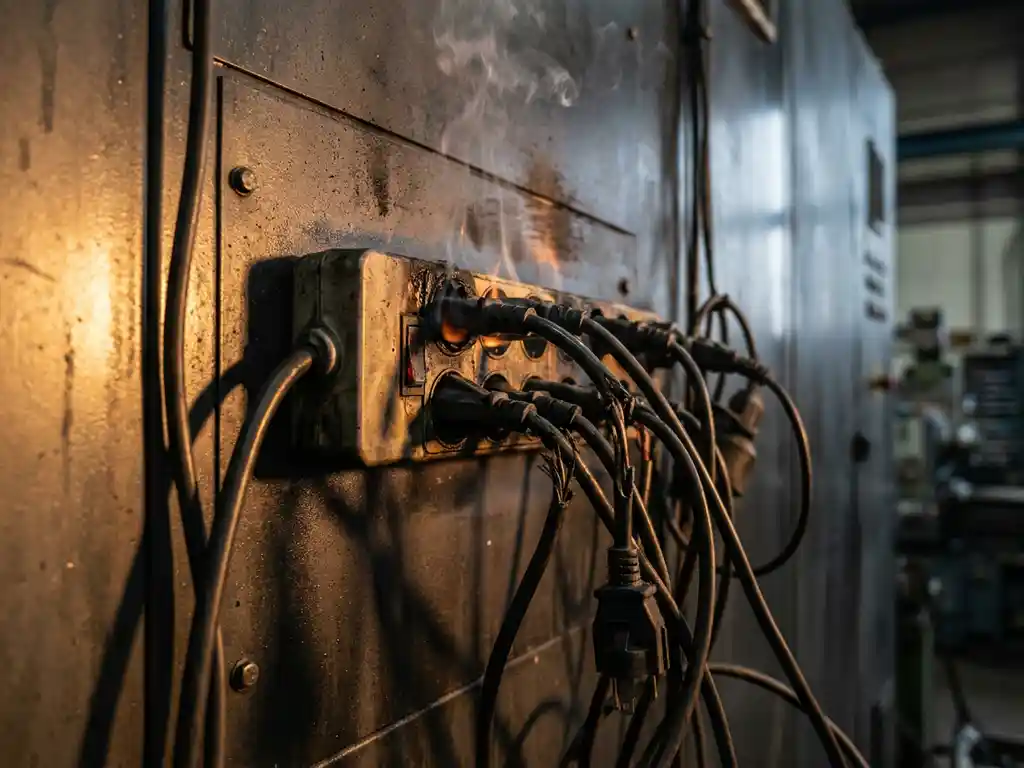
The most common warning signs of an overloaded power socket include warm or hot outlet covers, flickering or dimming lights when devices are switched on, frequently tripping circuit breakers, discoloration or scorch marks around the socket face, and a persistent burning smell near the outlet. Any of these signs should be treated as a serious electrical safety concern.
A warm socket face is one of the earliest indicators. Under normal operating conditions, a socket should remain close to room temperature. If it feels noticeably warm to the touch, the current load is likely too high for the circuit. Similarly, if lights dim or flicker when a high-draw appliance starts up, the circuit is being pushed to its limits.
Discoloration around a socket plate is a more advanced warning sign and suggests that heat damage has already begun. A burning smell without a visible source is particularly serious because it may indicate smoldering inside the wall or within a cable conduit. In either case, the socket should be taken out of use immediately and inspected by a qualified electrician.
Which devices are most likely to overload a socket?
High-wattage appliances are the most likely culprits behind overloaded power sockets. Devices such as electric heaters, kettles, toasters, microwave ovens, tumble dryers, and air conditioning units draw large amounts of current and should always be plugged directly into a dedicated wall socket rather than an extension cord or multi-socket adapter.
In commercial and industrial settings, the risk profile shifts. Uninterruptible power supplies (UPS), server racks, battery charging systems, and large industrial machinery can all draw sustained high currents. The danger increases when multiple units share a single circuit without adequate load planning.
A common mistake is assuming that smaller devices are safe to stack on a single extension cord. Even lower-wattage devices can collectively exceed a socket’s rated capacity when several are plugged in at once. The total load across all connected devices is what matters, not the draw of any single item.
How does electrical overload cause a fire to start?
Electrical overload causes a fire when the heat generated by excess current ignites nearby combustible material. The process typically follows a sequence: excess current heats the conductor, insulation degrades, arcing or sustained heat contact with flammable material begins, and ignition follows. This can happen quickly during a severe overload or slowly over repeated episodes of moderate overloading.
Arcing is a particularly dangerous mechanism. When insulation breaks down and conductors come close to each other or to grounded metal, electrical arcs can reach extremely high temperatures in a fraction of a second. These arcs can ignite insulation, dust, or any other combustible material nearby.
In enclosed electrical environments such as switchgear cabinets, distribution boards, or server racks, the confined space concentrates heat and limits airflow. This means that even a relatively small ignition event can escalate rapidly. Smoke and heat build up inside the enclosure before any external detection system has a chance to respond, making early detection at the object level critically important.
How can you prevent a fire from an overloaded socket?
Preventing a fire from an overloaded socket comes down to staying within rated load limits, using the right equipment for the task, and never relying on a single socket or extension cord to power multiple high-draw devices. Practical steps include calculating the total wattage of devices sharing a circuit, using surge-protected power strips rated for the intended load, and replacing old or damaged sockets promptly.
- Know the rated capacity of your sockets and circuits. Standard domestic sockets in most European countries are rated at 16 amperes. Exceeding this consistently will cause damage over time.
- Avoid daisy-chaining extension cords. Plugging one extension cord into another multiplies the risk of overloading and is a common cause of electrical fires.
- Use dedicated circuits for high-draw equipment. Appliances like heaters, industrial machinery, and server infrastructure should each have their own circuit where possible.
- Inspect wiring and sockets regularly. Discoloration, warmth, or damage should be investigated by a qualified electrician without delay.
- Install residual current devices (RCDs) and circuit breakers. These provide automatic protection by cutting power when a fault is detected, though they are not a substitute for proper load management.
- Address clutter around sockets. Combustible materials stored near sockets or extension cords increase the risk that any heat event escalates into a fire.
In environments where electrical cabinets, server racks, or distribution panels are present, fire prevention should also include object-level protection. Even with the best load management practices in place, faults can still occur, and early suppression at the source limits damage significantly.
How ExxFire helps protect against electrical fire risks
While good electrical practices reduce the likelihood of a fire, they cannot eliminate the risk entirely. ExxFire’s integrated fire detection and suppression systems provide a critical last line of defense for enclosed electrical environments where overload-related fires are most dangerous.
- Early smoke detection: Aspirating smoke detection identifies fire at the earliest possible stage, before flames or significant heat develop inside a cabinet or enclosure.
- Nitrogen-based suppression: The patented Cool Gas Generator suppresses fire using clean, non-pressurized nitrogen gas that leaves no chemical residue, protecting sensitive electronics from both fire and suppression damage.
- No maintenance burden: Once installed and commissioned, ExxFire systems require no further checkups, keeping ongoing costs low and operations uninterrupted.
- Flexible installation: Systems can be installed inside or outside the protected enclosure and interconnected to cover larger volumes, without requiring special certification.
- Fire panel integration: Built-in relays allow the system to report status to an existing fire panel, fitting seamlessly into current safety infrastructure.
For organizations protecting mission-critical equipment from the consequences of electrical overload fire risks, ExxFire offers a tested, certified, and environmentally responsible solution. Contact ExxFire to find out how to protect your electrical infrastructure.
Related Articles
- What are the fire risks in care homes and assisted living facilities?
- How does fire management differ between countries?
- What are the consequences of non-compliance with fire safety standards?
- Why is fire safety certification important for industrial equipment?
- How do you measure the carbon footprint of a fire suppression system?