

What are the fire risks of untreated timber in construction?
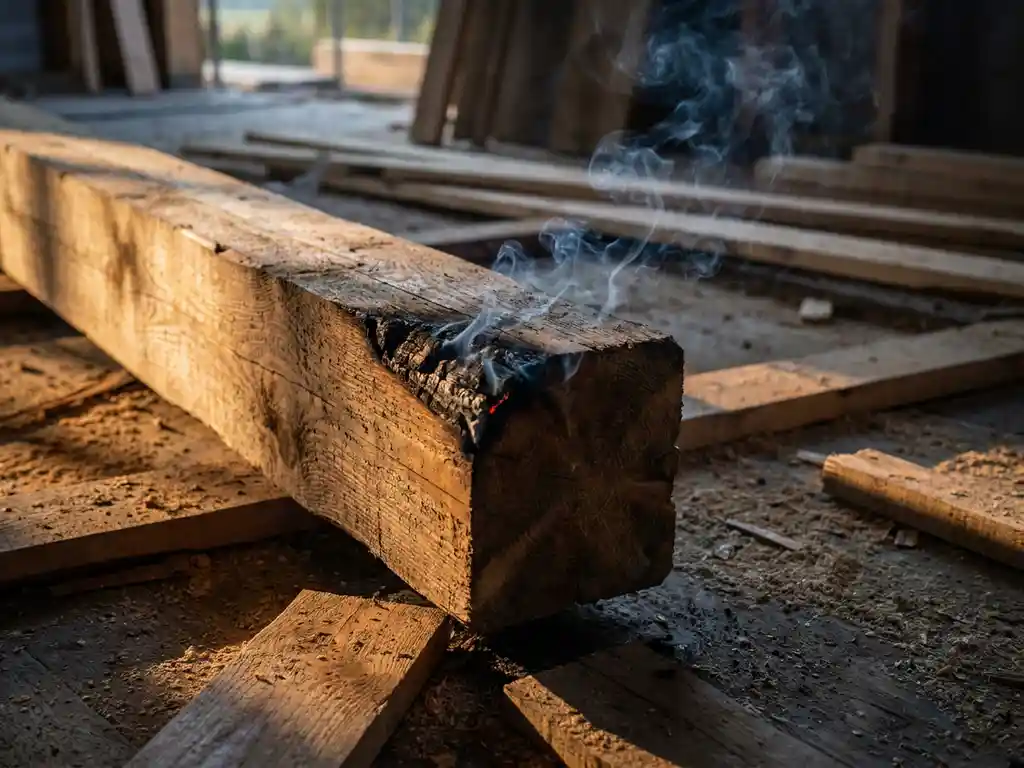
Untreated timber is a highly combustible material that ignites readily and spreads fire rapidly, making it one of the most significant fire hazards in construction. Without fire-retardant treatment, wood burns at temperatures that can compromise structural integrity within minutes, putting occupants, equipment, and entire buildings at serious risk. The sections below address the most pressing questions about untreated timber fire hazards, from ignition speed to protection standards and suppression strategies.
How quickly does untreated timber catch fire and spread flames?
Untreated timber can ignite at temperatures as low as 250 to 300 degrees Celsius, and once burning, it spreads flames rapidly across exposed surfaces. In a typical room with untreated wood elements, fire can transition from a localized ignition to full room involvement in under ten minutes, depending on ventilation conditions and the volume of exposed timber.
Wood combustibility is driven by several factors: moisture content, density, grain orientation, and surface area. Dry, low-density timber with large exposed surfaces burns fastest. Engineered wood products such as oriented strand board (OSB) or particleboard can behave unpredictably under fire conditions because their adhesive binders may accelerate flame spread or cause sudden structural failure.
One of the most dangerous characteristics of untreated wood fire risk is the production of combustible gases during the early pyrolysis phase, before visible flames appear. These gases can accumulate and ignite explosively, dramatically accelerating fire spread. This is why early smoke detection in timber-rich environments is not a luxury but a critical safety requirement.
What structural damage can a timber fire cause in a building?
A fire in untreated timber construction can cause catastrophic structural damage within 15 to 30 minutes of ignition. As wood chars, it progressively loses load-bearing capacity. Beams, joists, and columns weaken from the outside inward, and once the char layer is breached, structural collapse can occur with little warning.
Unlike steel, which deforms predictably under heat, timber fails in ways that are difficult to anticipate during a live fire. Connections between structural members are particularly vulnerable because metal fasteners conduct heat rapidly, weakening joints even when the surrounding timber appears intact. Roof structures and upper floor assemblies are especially susceptible to sudden collapse.
The long-term structural consequences extend beyond the fire itself. Water damage from suppression efforts, combined with smoke infiltration and heat distortion of structural members, often renders a building uninhabitable even when the fire has not fully consumed the structure. Rebuilding costs in timber-frame construction following a significant fire event are consistently higher than in steel or concrete equivalents, reinforcing the importance of proactive timber fire protection.
What are the most fire-prone areas in timber-framed construction?
The most fire-prone areas in timber-framed construction are concealed voids, roof spaces, floor cavities, and areas where electrical systems run through or alongside wooden structural elements. These zones are dangerous because fire can travel undetected through them for extended periods before breaking out visibly.
Concealed roof voids are particularly hazardous. Warm air rises, and if a fire originates at a lower level, heat and combustible gases accumulate in the roof space, which often contains untreated timber and minimal fire compartmentalization. Once ignition occurs in these voids, the fire spreads laterally across the entire building footprint with little obstruction.
Other high-risk zones include:
- Service penetrations where pipes, cables, and ducts pass through timber walls or floors, creating pathways for fire and smoke to bypass compartment boundaries
- Electrical distribution areas where wiring runs through timber framing, combining ignition sources with combustible material
- Storage areas adjacent to timber structural elements, where accumulated materials increase fuel load
- External cladding systems that use timber or combustible insulation in contact with structural wood members
In renovation or retrofit projects, previously undiscovered voids in older timber buildings present an additional risk because their extent is often unknown until a fire exposes them.
How does fire in timber construction threaten electrical and mechanical systems?
Fire in timber construction poses a direct and severe threat to electrical and mechanical systems because these systems are typically routed through or mounted on the very structural elements that burn. When timber ignites, cables lose insulation integrity, switchgear overheats, and control systems fail, often creating secondary ignition sources that accelerate the overall fire.
Electrical cabinets, server racks, and distribution boards installed in timber-framed buildings face a compounded risk. Not only are they exposed to the primary fire, but burning timber produces thick smoke that infiltrates enclosures, coating sensitive components with corrosive residues. Even in cases where equipment survives the fire itself, smoke contamination frequently renders hardware irreparable.
Mechanical systems face similar vulnerabilities. HVAC ductwork running through timber voids can carry smoke and heat to distant parts of a building, effectively transporting the fire beyond its point of origin. Pump rooms, battery storage areas, and generator enclosures located in or adjacent to timber structures are at elevated risk because they combine high-value equipment with potential ignition sources in an environment where the surrounding structure is itself combustible.
For organizations operating mission-critical equipment in timber-framed environments, protecting individual enclosures at the object level is a practical and effective layer of defense, particularly where the building’s structural fire resistance cannot be easily upgraded.
What fire protection standards apply to timber used in construction?
Timber used in construction is subject to fire protection standards that govern its reaction to fire, structural fire resistance, and the use of fire-retardant treatments. In most jurisdictions, building codes classify timber by its fire performance rating, which determines where and how it can be used in a structure based on occupancy type and building height.
Reaction to fire classifications
In Europe, the EN 13501 series provides the primary classification framework. Untreated timber typically falls into Class D or E under the Euroclass system, meaning it contributes significantly to fire growth. Fire-retardant treated timber can achieve Class B or C, substantially reducing its contribution to flame spread and smoke production. In the United States, ASTM E84 governs surface burning characteristics, with Class A, B, and C ratings applied based on flame spread index and smoke development.
Structural fire resistance requirements
Structural fire resistance is measured in minutes and describes how long a structural element maintains its load-bearing function under fire conditions. Building regulations in most countries require timber structural elements to achieve 30, 60, or 90 minutes of fire resistance depending on the building’s use and height. This is typically achieved through a combination of oversized timber sections (which char slowly), protective cladding, and intumescent coatings. Mass timber products such as cross-laminated timber (CLT) have demonstrated predictable charring behavior that supports compliance with these requirements, but untreated light-frame timber construction offers far less inherent resistance.
What fire suppression methods are most effective for timber construction environments?
The most effective fire suppression methods for timber construction environments combine early detection with rapid suppression at both the building level and the object level. Sprinkler systems remain the standard for whole-building protection, but they cannot address the specific risks posed to enclosed electrical and mechanical equipment, which requires targeted object-level suppression.
For building-wide protection, wet pipe sprinkler systems are widely regarded as the most reliable solution in timber-framed structures. They activate quickly in response to heat, delivering water directly to the fire source. However, water-based suppression causes significant collateral damage to electrical systems, server infrastructure, and sensitive equipment, making it unsuitable as a standalone solution where high-value electronics are present.
For enclosed equipment such as electrical cabinets, switchgear, and server racks located within timber-framed buildings, inert gas suppression at the object level offers a clean, targeted alternative. This approach extinguishes fire within the enclosure without damaging the equipment inside, without leaving chemical residues, and without introducing water into sensitive environments.
A layered approach that combines building-wide detection and sprinkler coverage with object-level suppression for critical enclosures provides the most comprehensive protection in timber construction fire safety scenarios.
How ExxFire helps protect critical equipment in timber construction environments
ExxFire provides a targeted object-level fire suppression solution specifically designed for the electrical and mechanical systems that face the highest risk in timber construction environments. Where building-wide fire suppression cannot protect individual enclosures, ExxFire fills the gap with a clean, certified, and easy-to-install system.
- Aspirating smoke detection identifies fire at the earliest possible stage, before flames develop, giving maximum response time
- Non-pressurized nitrogen gas suppression extinguishes fire inside closed enclosures without water, foam, or PFAS-containing agents, leaving no chemical residues on sensitive components
- Patented Cool Gas Generator technology stores nitrogen in a solid, non-pressurized state, eliminating the risks associated with high-pressure gas cylinders in confined spaces
- Simple self-installation without special certification, and maintenance-free operation after commissioning
- Integration with existing fire panels via built-in relays, ensuring compatibility with the broader fire safety infrastructure of the building
- CNPP-certified and TÜV Nord tested, meeting rigorous independent standards for reliability and performance
For facility managers, safety officers, and infrastructure directors operating in timber-framed buildings, ExxFire delivers a proven, PFAS-free layer of protection that safeguards business continuity without compromising equipment or the environment. Explore ExxFire’s solutions to find the right system for your critical enclosures.