

How does fire spread so quickly in a building?
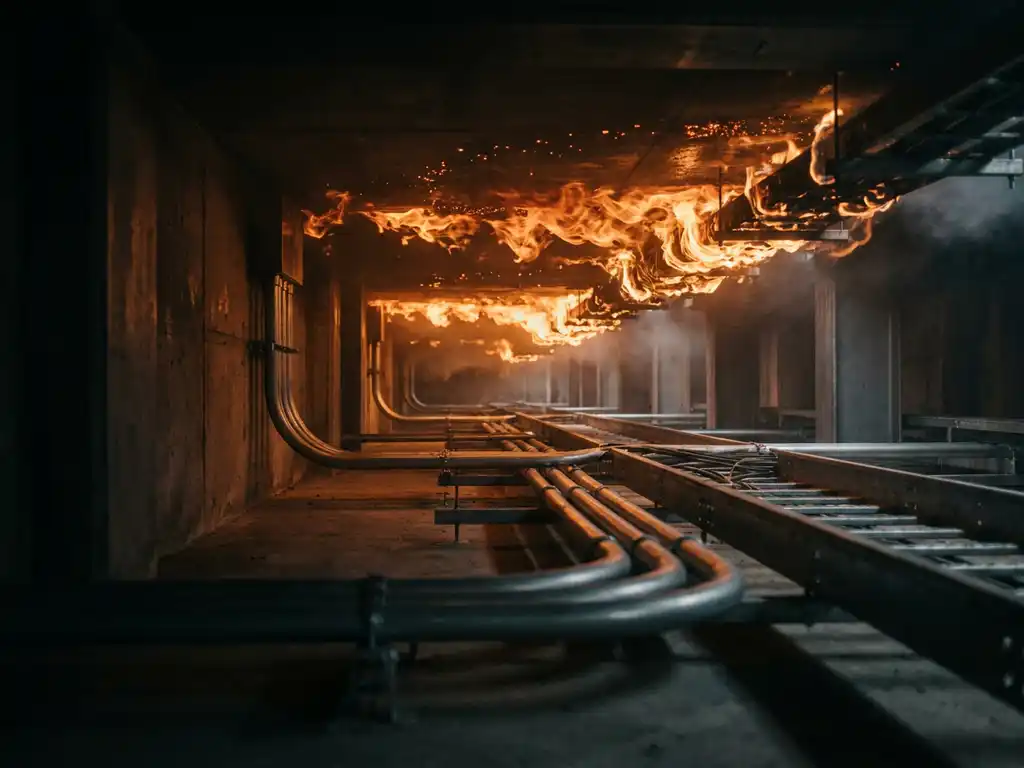
Fire spreads quickly in a building because heat, fuel, and oxygen combine in a self-reinforcing cycle that accelerates as it grows. Once ignition occurs, rising temperatures cause nearby materials to release flammable gases, feeding the fire before it even makes direct contact. Understanding how this process unfolds — and where it is most likely to accelerate — is essential for anyone responsible for protecting a building and the equipment inside it.
What causes fire to spread faster in some buildings than others?
Fire spreads faster in some buildings because of the type and quantity of combustible materials present, the layout of the space, and how well ventilation is controlled. Buildings packed with synthetic materials, open floor plans, or inadequate fire compartmentalization allow flames and heat to travel with far less resistance than well-designed, fire-resistant structures.
The materials used in construction and furnishing play a major role. Synthetic polymers found in insulation, cabling, seating, and wall panels ignite at lower temperatures and burn more intensely than natural materials. In environments like data centers, server rooms, or electrical cabinet installations, dense concentrations of plastic-coated wiring and electronic components create a particularly fuel-rich environment.
Building layout is equally important. Open-plan spaces act like chimneys, allowing hot gases and flames to travel horizontally with little obstruction. In contrast, compartmentalized buildings with fire-rated walls and doors slow the progression significantly by containing heat and cutting off the oxygen supply that sustains combustion.
How does oxygen affect how fast a fire grows?
Oxygen is one of the three elements of the fire triangle, and its availability directly controls how fast a fire grows. A fire in an oxygen-rich environment burns hotter, faster, and more aggressively. Restricting oxygen is one of the most effective ways to suppress fire, which is why inert gas suppression systems work by displacing oxygen below the level needed to sustain combustion.
In enclosed spaces such as electrical cabinets or server racks, oxygen levels can initially limit fire growth. However, once a panel door is opened or a seal fails, a sudden influx of fresh air can cause a rapid escalation in fire behavior. This phenomenon is one reason why fire suppression at the object level — inside the enclosure itself — is more effective than waiting for a room-level response.
Reducing oxygen concentration to roughly 15% or below is generally sufficient to extinguish most fires. Nitrogen-based suppression systems achieve this by flooding the protected space with an inert gas that displaces oxygen without leaving chemical residues or damaging sensitive electronics.
What are the three main ways fire travels through a building?
Fire travels through a building in three main ways: convection, conduction, and radiation. Each mechanism operates differently, and in a real fire, all three typically occur simultaneously, which is why building fire spread can accelerate so rapidly once a blaze takes hold.
- Convection is the most significant driver of fire spread in buildings. Hot gases and smoke rise and travel through corridors, stairwells, ventilation ducts, and ceiling voids, carrying heat to areas far from the original ignition point. This is why upper floors and adjacent rooms can become dangerously hot before flames arrive.
- Conduction occurs when heat transfers through solid materials. Metal structural elements, pipes, and cable trays can conduct heat through walls and floors, igniting materials on the other side of a fire barrier without any visible flame crossing.
- Radiation involves heat energy traveling as electromagnetic waves through the air. A sufficiently intense fire can radiate enough heat to ignite combustible materials several meters away, even without direct contact or airflow connecting the two points.
In practice, convection tends to dominate in the early stages of a building fire, which explains why smoke and toxic gases reach remote areas long before flames do. Controlling convective pathways through proper compartmentalization and early detection is therefore central to any effective fire safety strategy.
Why does smoke spread faster than flames in a fire?
Smoke spreads faster than flames because it travels with hot air currents rather than requiring a continuous fuel source. While flames need direct contact with combustible material to advance, smoke moves freely through any gap, duct, or opening, driven by pressure differences and convective airflow throughout the building.
Smoke is not simply a nuisance — it is a mixture of toxic gases, fine particles, and unburned hydrocarbons that can incapacitate or kill before a person ever encounters flames. Carbon monoxide, hydrogen cyanide, and other combustion byproducts are present in smoke at dangerous concentrations well before visible fire arrives in a room.
In buildings with raised floors, suspended ceilings, or ventilation systems, smoke can travel dozens of meters within minutes. This is particularly relevant in ICT and data center environments, where cable management pathways and cooling airflows can carry smoke — and the particulates that precede visible smoke — across large areas rapidly. Early aspirating smoke detection systems are specifically designed to identify these microscopic particles at concentrations far below what a conventional detector would register, providing critical lead time before fire spread becomes uncontrollable.
Which areas of a building are most vulnerable to rapid fire spread?
The areas most vulnerable to rapid fire spread are vertical shafts, ventilation systems, electrical rooms, and spaces with high concentrations of combustible materials. These locations either accelerate convective movement of heat and smoke or contain the fuel loads that allow fire to intensify quickly.
- Stairwells and elevator shafts act as vertical chimneys, drawing hot gases upward at speed and distributing them across multiple floors.
- Ventilation and HVAC ducts can carry smoke and heat throughout an entire building, bypassing fire-rated walls if dampers fail or are absent.
- Electrical rooms and switchgear cabinets contain dense wiring, insulation materials, and high-voltage components that can sustain intense, fast-moving fires once ignition occurs.
- Server rooms and ICT enclosures combine high heat output, dense cabling, and continuous airflow — conditions that can accelerate fire behavior and spread smoke rapidly through cooling systems.
- Battery energy storage systems (BESS) present a particular risk because lithium-ion thermal runaway can self-sustain even when oxygen is reduced, producing intense heat and toxic gases.
Identifying these vulnerable zones in advance and applying targeted fire suppression at the object level — directly inside or adjacent to the highest-risk enclosures — is far more effective than relying solely on room-level detection and response.
How can early fire detection stop fire from spreading?
Early fire detection stops fire from spreading by triggering suppression before heat and flames reach the point where spread becomes self-sustaining. The earlier a fire is identified — ideally at the pre-ignition or smoldering stage — the smaller the intervention needed to contain it and the lower the risk of damage, downtime, or injury.
Conventional smoke detectors respond to visible smoke, which typically appears after a fire has already been burning for some time. Aspirating smoke detection systems work differently: they actively draw air samples through a pipe network and analyze them for the microscopic particles that precede visible smoke. This approach can detect a developing fire minutes or even hours earlier than point-type detectors, giving suppression systems time to act before fire spread in buildings reaches a critical threshold.
When detection is integrated directly with suppression at the object level, the response time is reduced to seconds. Rather than waiting for a signal to travel to a central panel and then dispatching a response, an integrated system can begin suppression the moment detection thresholds are crossed — containing the fire at its source.
How ExxFire helps protect buildings from rapid fire spread
ExxFire’s integrated systems combine aspirating smoke detection with non-pressurized nitrogen gas suppression to stop fire at its source before it can spread. Key advantages include:
- Early detection: Aspirating detection identifies pre-smoke particles far earlier than conventional detectors, maximizing response time.
- Object-level suppression: Systems are installed directly inside or adjacent to server racks, switchgear, and electrical cabinets, targeting the highest-risk zones identified above.
- Clean nitrogen suppression: Nitrogen displaces oxygen to extinguish fire without chemical residues, protecting sensitive electronics and avoiding secondary damage.
- No pressurized storage: The patented Cool Gas Generator produces nitrogen from a solid chemical block, eliminating the risks associated with high-pressure cylinders.
- Easy installation and zero maintenance: Systems are pre-engineered for straightforward installation and require no ongoing maintenance or check-ups once commissioned.
- Fire panel integration: Built-in relays allow the system to report status directly to an existing fire panel, ensuring seamless compatibility with broader building fire safety infrastructure.
For organizations that cannot afford the downtime, hardware loss, or operational disruption that fire causes, early intervention at the object level is the most effective line of defense. Contact ExxFire to find out which system is right for your environment.
Related Articles
- Should facility managers choose a modular or fixed fire suppression system?
- How do you prevent fires caused by overloaded power strips?
- How do you prevent fires while cooking on a gas stove?
- What is the most overlooked fire hazard in the home?
- What is the ozone depletion potential of common fire suppression agents?