
What are the fire risks in hospitals and healthcare buildings?
Hospitals and healthcare buildings face significant fire risks due to their complex mix of electrical infrastructure, medical equipment, flammable materials, and round-the-clock operations. The combination of high patient density, continuous power demands, and sensitive environments makes fire prevention in hospitals both critical and challenging. This article unpacks the most important fire hazards in healthcare facilities, from the root causes to the areas of highest concern and the practical steps that reduce risk.
What makes hospitals particularly vulnerable to fire?
Hospitals are particularly vulnerable to fire because they combine high electrical loads, large quantities of flammable materials, oxygen-rich environments, and a population that cannot self-evacuate quickly. Unlike commercial office buildings, healthcare facilities operate continuously, house patients with limited mobility, and depend on life-critical equipment that cannot simply be switched off during an emergency.
Several factors compound this vulnerability. Medical oxygen, which is piped throughout wards and stored in cylinders, dramatically accelerates combustion. Operating theaters use flammable anesthetic gases and alcohol-based disinfectants. Laundry rooms, kitchens, and storage areas hold large volumes of combustible materials. And because hospitals never close, maintenance windows are narrow, making it harder to identify and address developing hazards before they become dangerous.
The sheer scale of modern hospital buildings adds another layer of complexity. Long corridors, vertical shafts, and interconnected mechanical systems can allow fire and smoke to spread rapidly if detection and suppression measures are not in place at the source.
What are the most common causes of fires in hospitals?
The most common causes of fires in hospitals are electrical faults, kitchen equipment, laundry operations, and the improper handling of flammable substances. Electrical failures account for a significant proportion of hospital fires globally, particularly in older buildings where wiring and switchgear have not been updated to meet current safety standards.
Kitchen and catering equipment is another leading cause. Hospital kitchens operate at high capacity for long hours, and unattended cooking equipment or accumulated grease creates a persistent ignition risk. Similarly, industrial laundry equipment, which runs continuously to meet hygiene requirements, generates heat and lint buildup that can ignite without warning.
Human behavior also plays a role. Discarded smoking materials near building entrances, misuse of portable heating devices, and improper storage of flammable cleaning chemicals all contribute to the overall risk profile. In clinical areas, the use of alcohol-based hand sanitizers and disinfectants has become standard practice, and while these products are essential for infection control, they introduce flammable liquids into environments that may already carry ignition risks.
Which areas in a hospital carry the highest fire risk?
The highest fire risk areas in a hospital are electrical and mechanical plant rooms, operating theaters, kitchens, laundry facilities, and ICT or server rooms. These locations share common characteristics: concentrated heat sources, flammable or combustible materials, and equipment that operates under sustained load.
Operating theaters carry elevated risk due to the combination of oxygen-enriched atmospheres, flammable anesthetic agents, and electrosurgical equipment that produces sparks. A single ignition source in this environment can escalate rapidly. Kitchens and laundry rooms are high-risk for more conventional reasons, primarily heat accumulation and combustible materials.
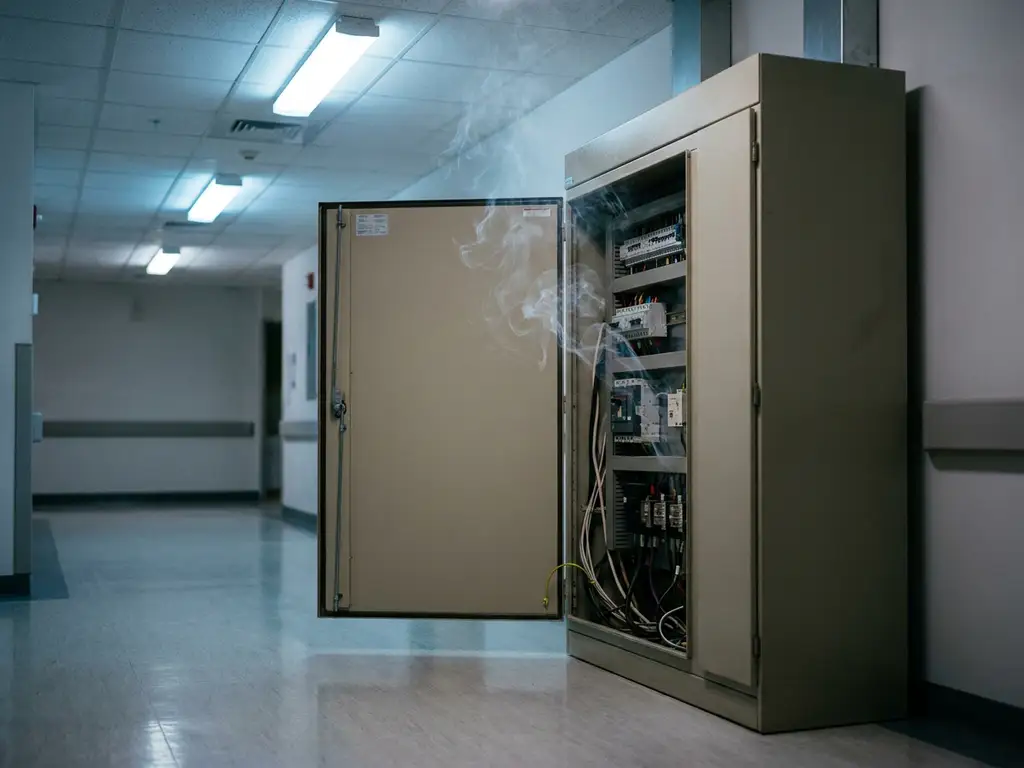
Electrical plant rooms and switchgear cabinets represent a risk that is often underestimated. These spaces house the infrastructure that keeps the entire facility running, and a fire that starts inside a cabinet or distribution panel can disable power to critical wards, life support systems, and emergency lighting simultaneously. Server rooms and ICT cabinets, which manage patient records, monitoring systems, and communications, are equally vulnerable and equally consequential if lost.
How do electrical hazards contribute to hospital fires?
Electrical hazards contribute to hospital fires through overloaded circuits, aging wiring, faulty medical equipment, and heat buildup inside electrical enclosures. Hospitals place enormous demand on their electrical infrastructure, running imaging systems, ventilators, monitoring equipment, and building management systems around the clock, often from installations that were not designed with today’s power loads in mind.
Overloaded distribution boards and switchgear cabinets are a particularly serious concern. When current exceeds the design capacity of a circuit, heat builds up inside the enclosure. If this thermal stress is not detected early, insulation degrades, arcing occurs, and a fire can ignite inside a sealed cabinet where standard room-level detection systems may not respond until the fire has already caused significant damage.
Medical devices themselves introduce additional risk. Equipment that is poorly maintained, improperly stored, or left plugged in when not in use can develop faults that generate heat or sparks. Charging stations for portable equipment, battery-powered devices, and uninterruptible power supply units all carry inherent electrical fire risk if not properly managed and monitored.
What are the consequences of a fire in a healthcare facility?
A fire in a healthcare facility can result in patient fatalities, staff injuries, destruction of irreplaceable medical records, prolonged operational shutdown, and severe reputational and financial damage. The consequences extend far beyond the physical damage to the building, because hospitals provide services that communities depend on and that cannot easily be transferred or replicated at short notice.
Patient safety is the most immediate concern. Patients who are sedated, on life support, or physically unable to move are entirely dependent on staff and building systems to protect them. Smoke inhalation is often more dangerous than the fire itself in a hospital environment, where patients with compromised respiratory function are especially at risk.
Operationally, even a contained fire in a server room or electrical cabinet can force a facility to shut down entire wings or departments. Loss of power to monitoring systems, electronic health records, or communications infrastructure can cascade into a facility-wide crisis. The cost of replacing high-value medical and ICT equipment, combined with the downtime required for restoration, can run into millions and take months to resolve.
How can hospitals reduce fire risk in critical equipment areas?
Hospitals can reduce fire risk in critical equipment areas by combining early smoke detection directly at the source with targeted suppression systems, maintaining electrical infrastructure proactively, and ensuring that fire safety measures are in place at the object level rather than relying solely on room-level detection. The closer detection and suppression are to the potential ignition point, the faster and more effectively a fire can be stopped before it spreads.
Key steps for reducing fire risk in high-value equipment areas include:
- Installing object-level fire detection and suppression inside electrical cabinets, switchgear, server racks, and ICT enclosures to catch fires at their source before they escalate
- Conducting regular electrical inspections to identify overloaded circuits, degraded insulation, and aging components before they become ignition hazards
- Establishing strict protocols for flammable substances, including proper storage, labeling, and disposal of alcohol-based products and cleaning chemicals
- Training staff regularly on fire prevention procedures, emergency response, and the specific risks present in their area of the facility
- Integrating fire safety systems with the facility’s central fire panel to ensure that any detection event triggers an immediate and coordinated response
- Replacing outdated suppression systems that use PFAS-containing agents with cleaner, residue-free alternatives that protect sensitive equipment without causing secondary damage
Proactive risk assessment is equally important. Identifying the highest-consequence equipment areas, such as the rooms that would cause the greatest disruption if lost, allows facility managers to prioritize where additional protection is most needed.
How ExxFire helps protect hospitals against fire risks
ExxFire provides hospitals and healthcare facilities with a purpose-built solution for protecting mission-critical equipment against fire at the object level. The integrated fire detection and suppression systems are designed specifically for enclosed environments such as electrical cabinets, switchgear, and ICT enclosures, where conventional room-level detection often responds too late.
- Aspirating smoke detection identifies fire at the earliest possible stage, before flames or significant heat develop
- Non-pressurized nitrogen suppression extinguishes fire without leaving chemical residues, protecting sensitive medical and ICT equipment from secondary damage
- PFAS-free technology eliminates the environmental and health risks associated with legacy gas suppression agents
- Easy installation and zero maintenance reduce the burden on already stretched facilities management teams
- Built-in relay reporting integrates seamlessly with existing fire panels, ensuring every detection event is communicated to the central system
For healthcare facilities looking to strengthen fire safety in critical areas, ExxFire offers a certified, low-TCO solution that protects equipment, limits downtime, and supports business continuity. Contact ExxFire to find out how the system can be configured for your facility’s specific needs.
Related Articles
- How does fire risk vary between urban and rural properties?
- How does fire prevention training reduce workplace injuries?
- Are inert gas fire suppression systems safe for people?
- What are the long-term costs of using high-GWP fire suppression agents?
- Why are PFAS-containing fire suppression agents being banned?