

What is post-fire management and why is it important?
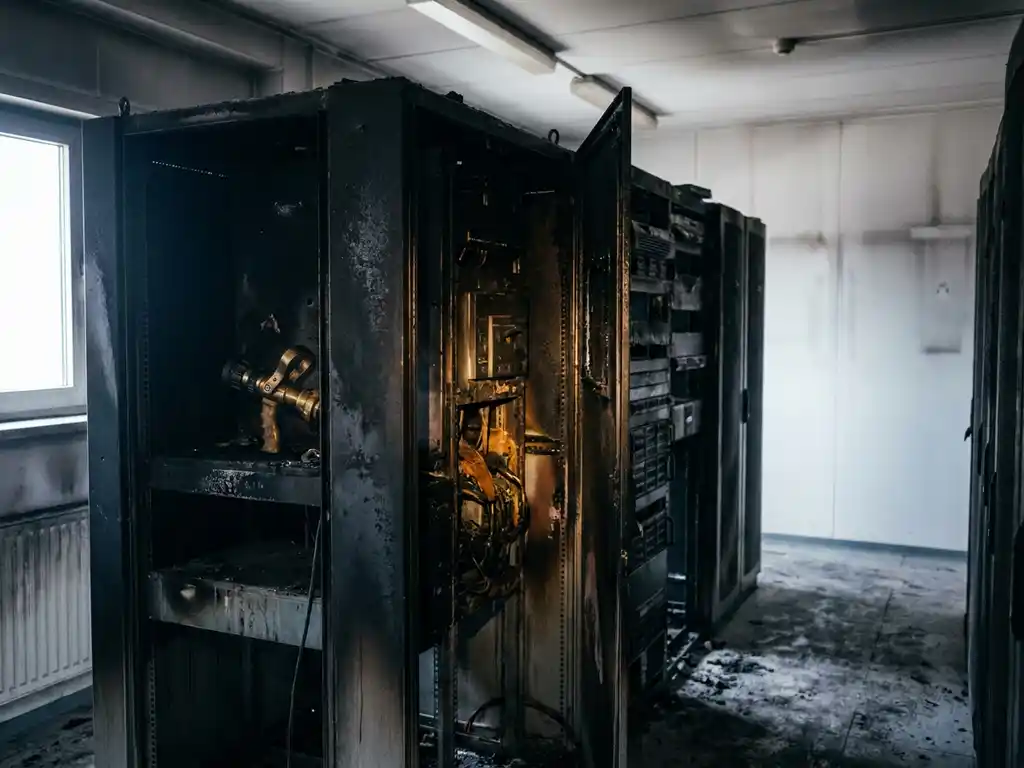
Post-fire management is the structured process of assessing, recovering, and restoring operations after a fire suppression system has activated or a fire incident has occurred. It matters because the period immediately following a fire event determines how quickly an organization can resume normal operations, how much equipment is salvageable, and how well the business protects itself against long-term financial and reputational damage.
For organizations protecting mission-critical equipment, the quality of post-fire management can be just as consequential as the suppression system itself. The sections below address the most important questions surrounding fire damage recovery, from what happens the moment suppression activates to how smarter technology choices reduce the burden of recovery.
What happens to equipment after a fire suppression system activates?
When a fire suppression system activates, the immediate goal has been achieved: the fire is extinguished or contained. However, the equipment inside the protected enclosure now enters a vulnerable window. Depending on the suppression agent used, the equipment may be coated in chemical residue, exposed to moisture, or simply sitting in a low-oxygen environment. The activation itself is not the end of the incident – it is the beginning of the recovery phase.
In the minutes and hours after activation, facility managers and safety officers need to assess whether the suppression agent has left any contamination, whether the fire was fully extinguished, and whether any smoke or heat damage has affected components beyond the immediate suppression zone. Equipment that was not directly touched by flames may still have suffered thermal stress or smoke infiltration, particularly in densely packed environments like server racks or switchgear cabinets.
The type of suppression agent used has a direct bearing on how complex this initial assessment becomes. Chemical agents can leave residues that corrode sensitive electronics, while inert gas systems typically leave the equipment in a cleaner state, simplifying the initial inspection process considerably.
What does post-fire management actually involve?
Post-fire management is the coordinated set of actions taken after a fire incident or suppression activation to assess damage, restore safety, recover equipment, and return operations to normal. It spans immediate incident response, technical assessment, documentation, equipment recovery, and longer-term operational review. It is both a practical process and a governance responsibility.
In practice, post-fire management typically involves the following activities:
- Incident documentation: Recording what triggered the system, when it activated, and what the initial conditions were
- Safety clearance: Confirming the environment is safe for personnel to re-enter and that the fire risk has been fully neutralized
- Equipment inspection: Assessing which components are undamaged, which require cleaning or servicing, and which need replacement
- Suppression system reset: Preparing the fire detection and suppression system for recommissioning
- Root cause analysis: Identifying what caused the fire or smoke event to prevent recurrence
- Operational recovery: Restoring affected systems and resuming normal business operations
- Reporting and compliance: Filing incident reports as required by internal policy or regulatory obligation
Each of these steps requires coordination between facility management, IT or engineering teams, health and safety officers, and potentially insurance providers. The more thorough the post-fire management plan, the faster and more cost-effectively an organization can recover.
Why is post-fire management critical for business continuity?
Post-fire management is critical for business continuity because an unmanaged recovery period extends downtime, increases the risk of secondary damage, and raises the total cost of the incident far beyond the initial fire event. Organizations that treat suppression activation as the end of the incident, rather than the beginning of recovery, routinely face longer outages and higher replacement costs.
For industries where uptime is a commercial or operational necessity, such as data centers, energy infrastructure, or manufacturing, even a few hours of unplanned downtime can translate into significant financial loss. Post-fire management bridges the gap between suppression and restoration, ensuring that every step of recovery is deliberate and documented rather than reactive and ad hoc.
There is also a compliance dimension. Regulatory frameworks in many industries require documented incident response procedures. A structured post-fire management plan ensures that organizations can demonstrate due diligence to auditors, insurers, and regulators. This is particularly relevant for organizations operating in sectors with formal health, safety, and environmental obligations.
How does the type of suppression agent affect post-fire recovery?
The suppression agent used has a significant impact on post-fire recovery complexity, cost, and speed. Chemical suppression agents, including many legacy systems and those containing PFAS compounds, often leave residues that contaminate sensitive electronics, require specialist cleaning, and can cause ongoing corrosion if not addressed promptly. Inert gas systems, by contrast, leave no chemical residue, which substantially reduces the recovery burden.
This distinction matters most in environments where the protected equipment is high-value and sensitive, such as server racks, ICT cabinets, battery energy storage systems, or high-voltage switchgear. When a chemical agent contaminates a server rack, recovery involves not just assessing fire damage but also cleaning or replacing components affected by the agent itself. This adds time, cost, and technical complexity to the recovery process.
Nitrogen-based inert gas suppression works by reducing oxygen levels within the protected enclosure to a point where combustion cannot be sustained. Because nitrogen is a clean, chemically inert gas, it does not react with or deposit residue on electronic components. Once the enclosure is ventilated and oxygen levels return to normal, the equipment can be inspected and, in many cases, returned to service without the additional step of chemical decontamination. This directly shortens the fire incident response timeline and reduces post-fire management costs.
The environmental implications also extend beyond the immediate recovery. PFAS-containing agents present disposal and contamination challenges that continue well after the incident is resolved. Choosing a suppression technology that avoids these compounds reduces both the immediate recovery burden and the longer-term environmental liability.
What are the key steps in a post-fire management plan?
A post-fire management plan should follow a clear sequence of steps that move from immediate safety through to full operational recovery. The key steps are assessment, containment confirmation, documentation, equipment triage, system recommissioning, root cause analysis, and operational restoration.
- Confirm safety: Verify that the fire is fully extinguished, the suppression system has completed its cycle, and the environment is safe for personnel
- Secure the scene: Restrict access to the affected area to prevent secondary incidents and preserve evidence for investigation
- Document the incident: Record the time, location, trigger, and extent of suppression activation with as much detail as possible
- Inspect and triage equipment: Assess which assets are undamaged, which require servicing, and which need replacement
- Engage specialist support if needed: For complex environments, bring in technical specialists to assess damage to electronics, cabling, or structural components
- Recommission the suppression system: Reset or replace the activated suppression unit and verify that detection and suppression functions are fully restored
- Conduct root cause analysis: Investigate the origin of the fire or smoke event to identify corrective actions
- Restore operations: Return affected systems to service in a controlled, prioritized sequence
- File reports and update procedures: Complete all required incident documentation and revise fire safety procedures based on lessons learned
Organizations that document this plan in advance and rehearse it as part of their broader fire safety management framework consistently recover faster than those responding reactively. Having clear ownership of each step, and knowing which contacts to activate, removes decision-making friction at the most critical moment.
How can fire suppression technology reduce post-fire management costs?
The right fire suppression technology reduces post-fire management costs by minimizing damage at the source, leaving equipment in a recoverable state, and simplifying the recommissioning process. Object-level protection that activates early, close to the fire source, limits the spread of heat and smoke to a smaller area, which directly reduces the scope of recovery work required.
Early detection is a key cost driver. Systems that detect smoke at the aspirating stage, before a fire fully develops, can suppress an incident while it is still contained within a single cabinet or enclosure. This prevents damage from propagating to adjacent equipment, which would multiply recovery costs and extend downtime significantly.
Suppression systems that are easy to recommission also reduce the time and cost of restoring fire protection after an incident. Systems that require specialist engineers, complex recertification, or lengthy parts lead times extend the period during which the protected environment is vulnerable. Systems designed for straightforward reset and recommissioning restore the safety layer faster and with lower labor cost.
Finally, low-maintenance suppression technology reduces the ongoing cost burden between incidents. Systems that require frequent inspection, pressure checks, or chemical agent replacement add to the total cost of ownership over time. A suppression system that requires no ongoing maintenance checks after installation keeps the total cost of ownership low while ensuring readiness when it matters most.
How ExxFire supports post-fire management
ExxFire’s combined fire detection and suppression systems are designed to reduce both the likelihood of serious fire damage and the complexity of recovery when an incident does occur. By addressing post-fire management from the technology level up, ExxFire helps organizations protect their assets and restore operations with minimal disruption.
- No chemical residue: Nitrogen-based suppression leaves no contamination on sensitive electronics, removing the decontamination step from post-fire recovery
- Early aspirating smoke detection: Smoke is detected at the earliest possible stage, allowing suppression to activate before fire spreads beyond a single enclosure
- Object-level protection: Suppression is targeted directly at the high-value asset, limiting damage to the smallest possible area
- Easy recommissioning: Systems are designed for straightforward reset after activation, minimizing the time the protected environment is without fire suppression coverage
- Maintenance-free operation: Once installed, ExxFire systems require no ongoing maintenance checks, reducing the total cost of ownership and the administrative burden of fire safety management
- Status reporting via relays: Built-in relays allow the system to report activation and status to an existing fire panel, supporting incident documentation and response coordination
If your organization is reviewing its approach to fire safety management or looking to reduce the cost and complexity of post-fire recovery, contact ExxFire to discuss how its systems can be integrated into your existing infrastructure.
Related Articles
- How do fire safety regulations differ across industries in Europe?
- Why is fire safety certification important for industrial equipment?
- How do you conduct a fire hazard inspection at home?
- How does fire prevention work in residential buildings?
- What is the role of fire suppression in green building certification?