

What is the difference between nitrogen and argon fire suppression?
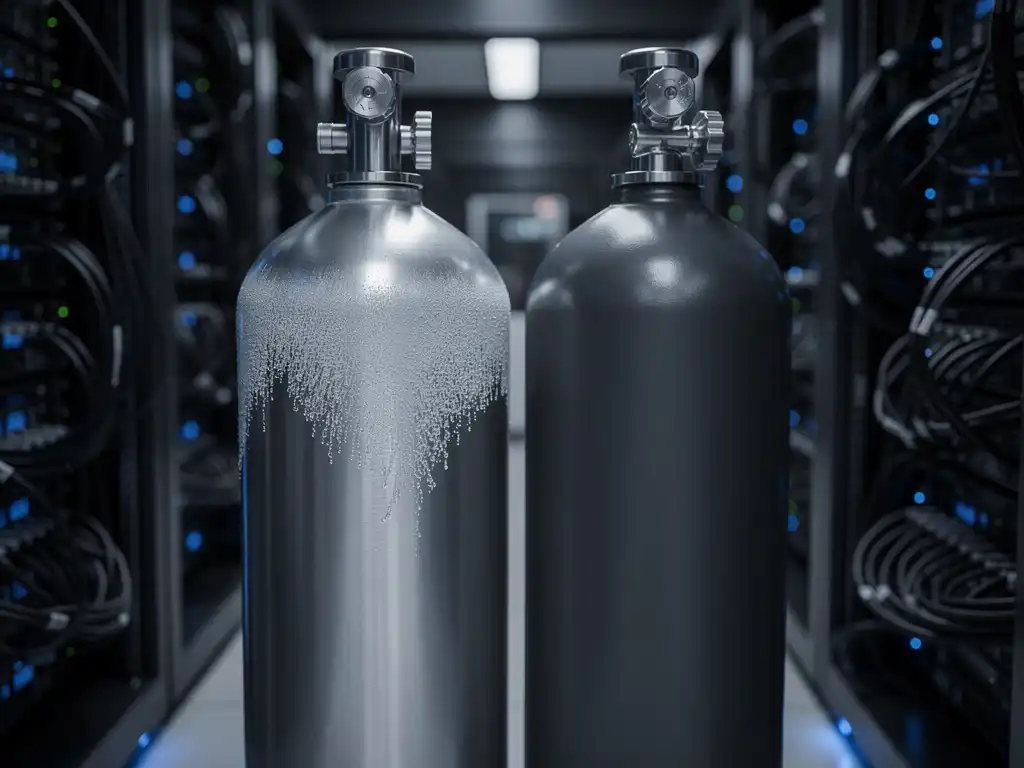
Nitrogen and argon are both effective inert gas fire suppressants, but nitrogen is generally the more practical and widely deployed choice for protecting enclosed, mission-critical equipment. Both gases work by reducing the oxygen concentration in a protected space below the level needed to sustain combustion, without using chemicals or leaving residues. This article unpacks the key differences, safety profiles, environmental impact, and the specific scenarios where one outperforms the other.
Which inert gas is more effective at suppressing fires?
Both nitrogen and argon suppress fires by the same fundamental mechanism: displacing oxygen until the concentration drops below roughly 15%, at which point most fires cannot sustain combustion. Neither gas is chemically reactive, meaning neither interacts with the fuel or the fire itself. In terms of raw suppression effectiveness, the two gases are broadly comparable when used at the correct design concentration.
The practical differences emerge in system design rather than suppression chemistry. Nitrogen is lighter than air, which means it rises and can stratify in a protected space, while argon is slightly heavier than air and tends to settle. For enclosed spaces such as electrical cabinets, server racks, or battery storage units, this behavior affects how the gas distributes and how long it maintains the suppression concentration. In well-sealed enclosures, both gases perform reliably. In larger or less-controlled spaces, argon’s density can be an advantage in some configurations and a disadvantage in others.
What are the key differences between nitrogen and argon as fire suppressants?
The key differences between nitrogen and argon as fire suppressants lie in their physical properties, availability, storage requirements, and cost. Nitrogen makes up roughly 78% of the atmosphere, making it the most abundant and least expensive inert gas to produce. Argon, while also naturally occurring, is far less abundant and more costly to manufacture and supply.
From a storage and system design perspective, both gases are typically stored under high pressure in cylinders. However, some advanced nitrogen-based technologies store nitrogen in a non-pressurized solid state, which eliminates the risks associated with pressurized vessels and simplifies installation significantly. Argon systems almost universally rely on pressurized storage, which requires more stringent handling, installation certification, and ongoing inspection.
Gas behavior in a protected space also differs. Because argon is denser than air, it tends to accumulate at lower levels, which can be useful when protecting floor-level equipment but may require careful discharge nozzle placement to ensure even distribution. Nitrogen, being lighter, disperses more readily throughout a space, which can be advantageous in tightly sealed enclosures where uniform coverage is critical.
Are nitrogen and argon fire suppression systems safe for electronics and people?
Yes, both nitrogen and argon fire suppression systems are safe for sensitive electronics and, with proper design, safe for people. Neither gas is toxic, corrosive, or electrically conductive. When a system discharges, no chemical residue is left behind, meaning equipment can often be returned to service after the fire event without cleaning or decontamination.
For electronics specifically, this residue-free characteristic is critical. Chemical suppression agents can coat circuit boards, corrode contacts, and render hardware permanently unusable. Inert gas suppression, by contrast, leaves no trace, protecting not just the physical structure of the equipment but also the data and operational continuity it supports.
For human safety, the key consideration is oxygen depletion. Both nitrogen and argon will reduce oxygen levels in a protected space during discharge. Modern inert gas systems are designed to maintain oxygen at concentrations that are low enough to suppress fire but not immediately dangerous to a person who must briefly enter the space. Nonetheless, best practice requires that personnel evacuate before discharge and that re-entry is only permitted after the space has been ventilated. Properly designed systems include pre-discharge warnings and time delays to support safe evacuation.
How do nitrogen and argon compare to other clean agent systems like FM-200 or CO2?
Compared to chemical clean agents like FM-200 (HFC-227ea) and halon alternatives, both nitrogen and argon offer a significant advantage: they contain no fluorinated compounds, no synthetic chemicals, and no global warming potential from the agent itself. FM-200, while effective, is a hydrofluorocarbon with a high global warming potential and is subject to increasing regulatory scrutiny under PFAS-related and fluorinated gas legislation in the European Union and beyond.
CO2 is also an inert suppression agent, but it presents a substantially higher risk to human life. CO2 systems typically discharge at concentrations that are immediately dangerous to health, requiring complete evacuation and robust lockout procedures. Nitrogen and argon can be designed to suppress fires at concentrations that are survivable for short durations, giving them a meaningfully better safety profile in occupied or semi-occupied environments.
In terms of system complexity and cost, FM-200 systems are compact because the agent is stored as a liquefied gas at relatively low pressure, requiring smaller cylinders. Inert gas systems require larger storage volumes to hold sufficient gas for the same protected space. However, inert gas systems avoid the regulatory and environmental liabilities now associated with fluorinated agents, and they carry no risk of thermal decomposition byproducts, which FM-200 can produce when discharged into an active fire.
When should you choose nitrogen over argon for a fire suppression system?
Nitrogen is the better choice when cost, availability, storage simplicity, and compatibility with enclosed equipment protection are the primary decision criteria. For most applications involving server racks, electrical switchgear, ICT cabinets, and battery energy storage systems, nitrogen offers a practical and well-proven solution that is easier to source and maintain globally.
Argon may be preferred in specific scenarios where its higher density offers a design advantage, such as protecting low-lying equipment in a room where gas settling is desirable, or in applications where the slightly higher molecular weight improves hold time in a particular enclosure geometry. Some system designers also specify argon in blended inert gas systems, such as Inergen, which combines nitrogen, argon, and CO2 to balance suppression performance with oxygen level management.
For organizations prioritizing low total cost of ownership, straightforward installation, and minimal maintenance, nitrogen-based systems are typically the more accessible and commercially sensible option. The global supply chain for nitrogen is robust, and newer non-pressurized nitrogen technologies further reduce the logistical and safety overhead associated with high-pressure cylinder management.
What environmental impact do nitrogen and argon fire suppression systems have?
Both nitrogen and argon have negligible direct environmental impact as suppression agents. Neither gas contributes to ozone depletion, and neither carries a global warming potential attributable to the agent itself. When discharged, both gases simply return to the atmosphere as naturally occurring components of air. This makes them among the most environmentally responsible options available in the fire suppression systems market.
The environmental comparison becomes more meaningful when set against the alternatives. Fluorinated clean agents such as FM-200 or older halon-based systems carry significant global warming potential and are increasingly regulated or restricted under environmental legislation. PFAS-containing agents present long-term contamination risks to soil and water. Inert gases like nitrogen and argon carry none of these concerns.
The indirect environmental footprint of a suppression system also matters. Systems that prevent fire damage to electronics and infrastructure reduce the need for replacement hardware, which carries its own manufacturing and disposal footprint. By protecting equipment at the source and enabling rapid return to service, inert gas suppression contributes to a lower overall environmental impact across the asset lifecycle.
How ExxFire’s nitrogen suppression technology addresses these differences
ExxFire’s integrated fire detection and suppression systems are built specifically around the advantages of nitrogen as a clean, inert, and environmentally responsible suppression agent. The systems are designed to protect enclosed, mission-critical equipment where fire risk is highest and where chemical residues or pressurized gas hazards are unacceptable. Key features include:
- Non-pressurized nitrogen storage: ExxFire’s patented Cool Gas Generator technology stores nitrogen in a solid, non-pressurized state, eliminating the risks and certification requirements associated with high-pressure cylinders.
- Combined detection and suppression: Aspirating smoke detection is integrated directly with the suppression system, enabling early-stage fire response before flames develop and hardware damage occurs.
- No chemical residues: Pure nitrogen discharge leaves no trace on sensitive electronics, allowing equipment to be returned to service quickly and supporting business continuity.
- PFAS-free and environmentally compliant: The technology contains no fluorinated compounds, positioning it as a future-proof alternative to agents facing regulatory restriction.
- Easy installation and low maintenance: Systems are pre-engineered for self-installation without specialist certification, and are tested and certified by CNPP in France and by DMT, part of TÜV Nord in Germany.
- Scalable protection: Units protect enclosures up to 4.5 m³ and can be interconnected to cover larger volumes, with built-in relays for integration with existing fire detection systems.
If you are evaluating inert gas fire suppression for server rooms, electrical cabinets, battery energy storage systems, or other high-value enclosures, contact ExxFire to discuss which solution fits your specific environment and protection requirements.