

What is the most overlooked fire hazard in the home?
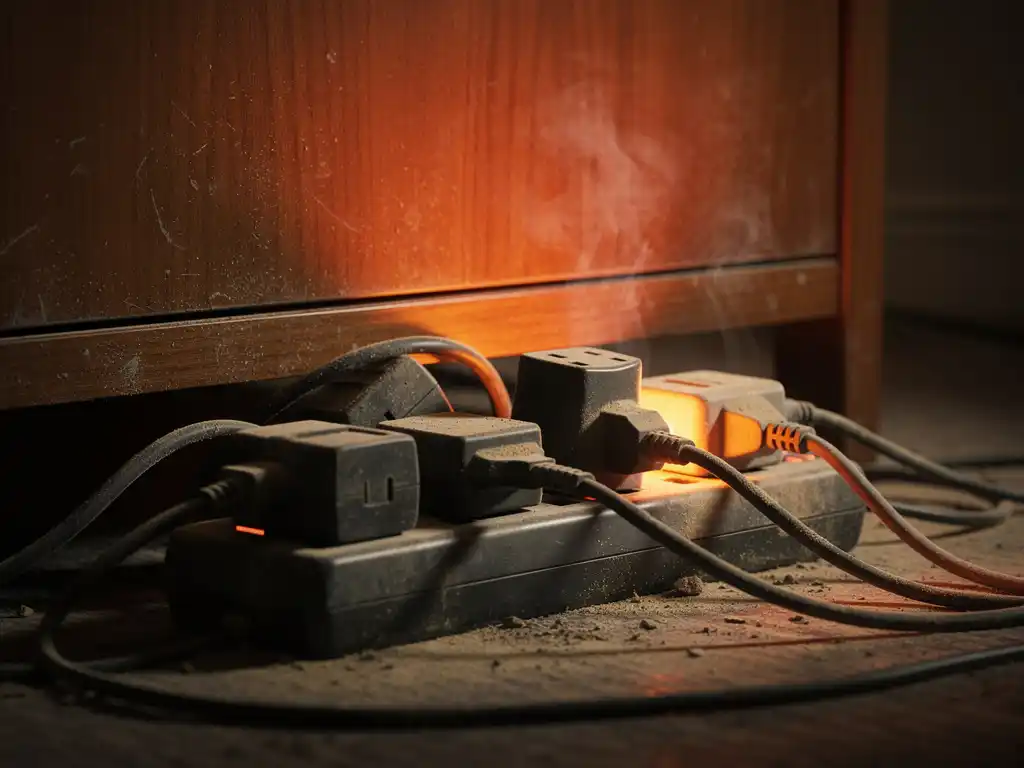
The most overlooked fire hazard in the home is faulty or overloaded electrical wiring and the equipment connected to it. Unlike visible hazards such as candles or cooking flames, electrical fire risks develop silently inside walls, behind panels, and within closed appliances, often giving no warning until a fire is already burning. This article walks through the most common hidden fire risks in homes, explains how fires ignite inside enclosed spaces, and helps you understand when detection and suppression matter most.
Which household hazard causes the most fires people don’t expect?
Electrical faults are the household hazard that causes the most fires people do not expect. Because the risk is invisible, developing inside wiring, junction boxes, and appliance internals, most homeowners never see it coming. Unlike a gas leak or an unattended candle, an electrical fault produces no smell, no visible flame, and no obvious warning sign until the fire has already taken hold.
What makes this hazard so dangerous is the combination of familiarity and invisibility. People use electrical outlets, extension leads, and home appliances every day without incident, which creates a false sense of security. Yet every device that draws current generates heat, and when insulation degrades, connections loosen, or circuits are overloaded, that heat has nowhere to go. The result is a slow build-up of thermal energy inside a closed space, which can eventually ignite surrounding materials.
Appliances left on standby, aging wiring in older homes, and the growing number of devices charging overnight are all contributing factors. The risk is not dramatic or sudden in most cases. It is cumulative, quiet, and easily underestimated.
Why are electrical faults so hard to detect before a fire starts?
Electrical faults are hard to detect before a fire starts because they develop inside enclosed, inaccessible spaces where heat and arcing are not visible to the naked eye. Standard household smoke detectors are positioned on ceilings and walls, far from the source of the problem, which means they only trigger once smoke has already spread into the open air of a room.
The physics of an electrical fault compound the problem. A loose connection or degraded insulation can generate localised heat for weeks or months before combustion occurs. This process, called thermal runaway in battery systems or resistive heating in wiring faults, does not produce enough smoke to reach a ceiling-mounted detector until the fire is already well developed.
There is also a detection gap specific to closed enclosures. Electrical panels, distribution boards, and home battery systems are designed to contain components, which means they also contain the early signs of a fire. Smoke, heat, and gases accumulate inside the cabinet before escaping, giving a ceiling-mounted detector almost no chance to respond at the earliest and most manageable stage.
What are the most common overlooked fire hazards in homes?
The most common overlooked fire hazards in homes are those that combine electrical load with enclosed spaces or unattended operation. These hazards are frequently ignored because they involve everyday objects that feel routine and safe.
- Overloaded extension leads and power strips: Plugging multiple high-draw appliances into a single strip generates heat at the socket level, particularly when the strip is old or the connections are loose.
- Tumble dryers and washing machines: Lint accumulation in dryers and motor faults in washing machines are among the leading causes of domestic appliance fires, especially when these machines run overnight or unattended.
- Lithium-ion battery charging: Smartphones, laptops, e-bikes, and electric scooters all use lithium-ion batteries that can enter thermal runaway if they are faulty, damaged, or charged with incompatible equipment.
- Home electrical panels and distribution boards: Aging consumer units with outdated circuit breakers can fail to trip under fault conditions, allowing overheating to continue unchecked.
- Tumble dryer venting: Blocked or kinked exhaust ducts trap heat inside the machine, dramatically increasing the risk of ignition.
- Recessed lighting: Downlights installed without adequate clearance from insulation materials in ceilings can overheat, and this risk is invisible from inside the living space.
What these hazards share is that they are all part of normal home life. That familiarity is exactly why they are so frequently underestimated as fire safety risks.
How does a fire start inside a closed cabinet or appliance?
A fire starts inside a closed cabinet or appliance when heat generated by an electrical fault, battery degradation, or mechanical friction reaches the ignition point of surrounding materials without being dissipated. The enclosed space accelerates this process by trapping heat and preventing airflow, creating conditions that are far more dangerous than the same fault in an open environment.
The sequence typically follows a predictable pattern. A fault generates localised heat, which warms the air and surrounding components inside the enclosure. As temperature rises, insulation on wiring softens and degrades, which worsens the fault and generates more heat. Combustible materials such as plastic housings, insulation foam, or paper-based components reach their ignition temperature, and a fire begins.
In battery systems, the process can be faster and more volatile. Lithium-ion cells undergoing thermal runaway release flammable gases as they overheat, and those gases can ignite before any visible flame is present. By the time a ceiling-mounted smoke detector responds, the fire inside the cabinet may already be well established.
This is why the location of detection and suppression matters. A system that monitors the air inside the enclosure and delivers suppression directly to the source can intervene at the earliest stage, before the fire has a chance to spread beyond the cabinet.
What’s the difference between smoke detection and fire suppression at the source?
Smoke detection identifies the presence of combustion products and triggers an alarm, while fire suppression at the source delivers an extinguishing agent directly to the point where the fire is developing. Detection warns people; suppression stops the fire. The two functions are most effective when combined in a single system positioned close to the hazard.
A standard ceiling-mounted smoke detector is a room-level device. It responds once smoke has left the source and dispersed into the living space. By that point, significant damage may already have occurred inside the enclosure or appliance where the fire started. Detection at this level is valuable for life safety but does not prevent hardware damage or equipment loss.
Suppression at the source works differently. It places the extinguishing agent inside or immediately adjacent to the at-risk enclosure, so when early-stage smoke is detected within that space, suppression can be triggered before the fire develops into a full-scale event. This approach is particularly relevant for electrical cabinets, home battery systems, and enclosed equipment where fire can develop rapidly in a confined space.
The practical difference is the outcome. Detection alone results in an alarm followed by a fire that must be fought from outside. Detection combined with source-level suppression can extinguish a fire in its earliest phase, protecting the equipment and preventing the fire from spreading to the rest of the building.
When should you consider a fire suppression system for home equipment?
You should consider a fire suppression system for home equipment when you have high-value or mission-critical equipment in an enclosed space that poses a real electrical fire risk and where early intervention would prevent significant damage or danger. This applies particularly to home battery storage systems, home server racks, and large electrical distribution boards.
The threshold for considering suppression rather than detection alone generally comes down to three factors:
- Value of the equipment: If the cost of replacing or repairing the equipment is significant, suppression at the source becomes a practical investment rather than an optional extra.
- Risk profile of the technology: Lithium-ion battery systems, in particular, carry a higher fire risk than conventional electrical equipment. Home energy storage systems installed as part of solar setups are a growing presence in domestic environments and warrant serious fire safety consideration.
- Consequence of a fire spreading: If the equipment is housed in a space adjacent to living areas, or if a fire in that equipment could threaten the structure of the home, early suppression is a meaningful layer of protection.
It is also worth considering suppression in situations where equipment operates unattended for extended periods, such as overnight charging of e-bikes or home battery systems that charge and discharge continuously without anyone present to notice early warning signs.
How ExxFire helps protect against hidden fire hazards at the source
ExxFire’s integrated fire detection and suppression systems are designed precisely for the kind of enclosed, high-risk equipment environments described throughout this article. Rather than relying on room-level detection that responds only after a fire has already developed, ExxFire’s technology monitors and suppresses at the source.
- Aspirating smoke detection inside the enclosure: The system draws air from within the cabinet and detects smoke at its earliest stage, long before it would reach a ceiling-mounted detector.
- Non-pressurized nitrogen gas suppression: When smoke is detected, the Cool Gas Generator releases nitrogen directly inside the enclosure. Nitrogen is inert, leaves no chemical residue, and causes no secondary damage to electronics or sensitive components.
- PFAS-free and environmentally responsible: ExxFire’s technology is a clean alternative to legacy suppression agents, making it suitable for homes and businesses that prioritise sustainability alongside safety.
- Easy self-installation: Systems are pre-engineered for straightforward installation without requiring specialist certification, making them practical for a wide range of settings.
- Compatible with existing fire panels: Built-in relays allow the system to report status to an existing fire panel, integrating seamlessly with broader fire safety infrastructure.
- Tested and certified: All systems are tested and certified by CNPP in France, providing independent validation of performance and reliability.
Whether you are protecting a home battery storage system, a home server setup, or a critical electrical cabinet, ExxFire provides the earliest possible intervention against common fire hazards before they become unmanageable. Contact ExxFire today to find out which system is right for your equipment and environment.
Related Articles
- What is the difference between fire prevention and fire safety?
- How does fire prevention training reduce workplace injuries?
- What are the environmental risks of halon fire suppression?
- Why is zero-GWP fire suppression becoming a procurement requirement?
- What is the difference between clean agent and conventional fire suppression?