

What is fire safety compliance for electrical cabinets?
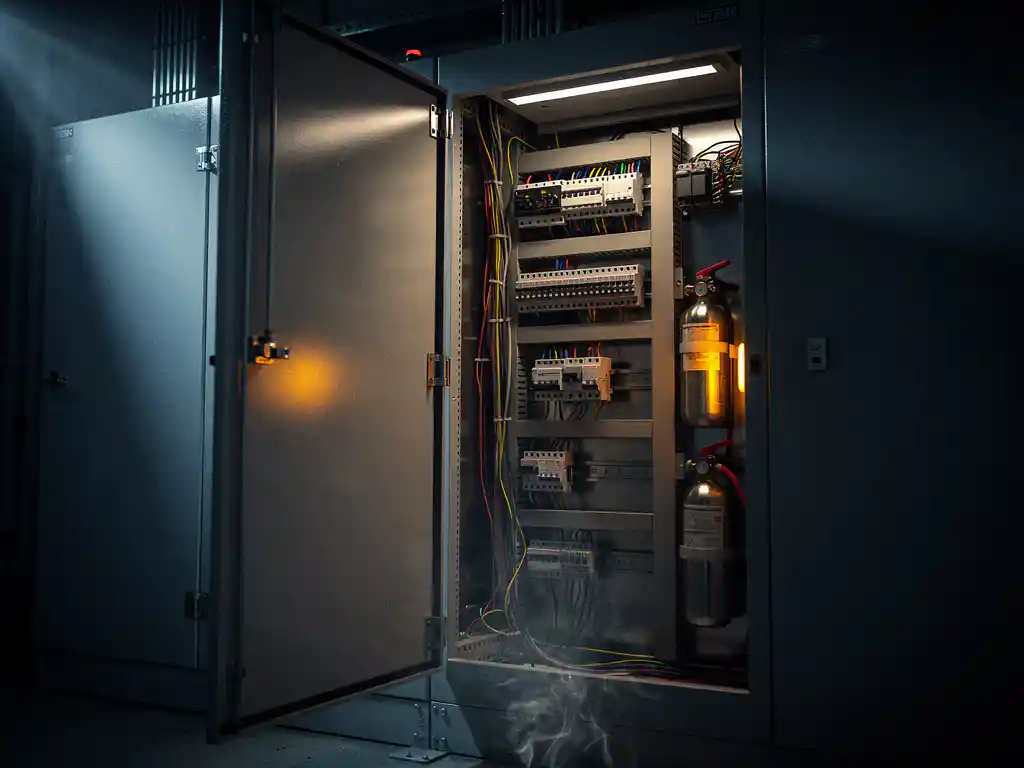
Fire safety compliance for electrical cabinets means meeting the regulatory and technical requirements that govern how electrical enclosures are protected against fire risk, including standards for detection, suppression, and containment. Compliance applies to any facility operating switchgear, control panels, motor control centers, or other enclosed electrical equipment where heat, arcing, or overloaded components can ignite a fire. The sections below address the most important questions safety and compliance managers ask when specifying or auditing electrical cabinet fire protection.
What regulations govern fire safety in electrical cabinets?
Fire safety compliance for electrical cabinets is governed by a combination of international standards, national codes, and insurance frameworks. The most widely referenced include NFPA 70 (the National Electrical Code), NFPA 72 (the National Fire Alarm and Signaling Code), and NFPA 2001 (Clean Agent Fire Extinguishing Systems). In Europe, EN 54 governs fire detection components, while IEC 60079 and the ATEX directive apply in potentially explosive atmospheres.
Beyond these, insurance bodies such as FM Global publish their own property loss prevention guidelines that often exceed the minimum requirements of national codes. Facilities operating in regulated sectors like oil and gas, petrochemicals, or mining may also face additional obligations under sector-specific standards or local authority having jurisdiction (AHJ) requirements.
The practical implication for compliance managers is that no single standard covers all scenarios. A complete compliance posture typically requires alignment with the relevant electrical installation code, the applicable fire detection and suppression standards, and any insurer or industry-specific requirements that apply to the site.
What are the most common fire risks inside electrical cabinets?
The most common fire risks inside electrical cabinets are electrical arcing, overheating of components, loose or corroded connections, and overloaded circuits. These ignition sources are particularly dangerous because they develop inside a closed enclosure, where heat accumulates quickly and a fire can grow undetected until it causes significant damage.
Thermal runaway in capacitors and insulation breakdown in aging cables are also frequent contributors. In cabinets housing variable frequency drives, transformers, or power distribution equipment, high operating temperatures are normal, but they reduce the margin before components reach ignition thresholds. Dust accumulation inside enclosures compounds the risk by providing combustible material near heat sources.
What makes electrical cabinet fires particularly costly is not always the fire itself but the downstream consequences: destroyed control systems, unplanned downtime, and the need to replace specialized equipment with long lead times. Early detection at the source is therefore far more valuable than relying on room-level detection to catch a cabinet fire after it has already developed.
What’s the difference between fire detection and fire suppression for electrical cabinets?
Fire detection identifies the presence of smoke, heat, or combustion products and triggers an alarm. Fire suppression actively intervenes to extinguish or control a fire. For electrical cabinets, the most effective approach combines both functions within the enclosure itself, so that a developing fire is caught early and suppressed before it can spread or cause structural damage.
Room-level detection systems, such as ceiling-mounted smoke detectors, are not designed to catch early-stage fires inside closed enclosures. By the time smoke escapes a sealed cabinet and reaches a ceiling detector, the internal components may already be severely damaged. Cabinet-level aspirating smoke detection solves this by continuously sampling air from inside the enclosure, detecting combustion particles at concentrations far below what standard point detectors can sense.
Suppression systems, once triggered, deliver an extinguishing agent directly into the cabinet volume. The distinction matters for compliance because many standards require both functions to be addressed, and specifying only one without the other leaves a gap in the protection strategy.
Which suppression agents are approved for use in electrical cabinets?
Approved suppression agents for electrical cabinets include inert gases, clean agents covered under NFPA 2001, and carbon dioxide in specific applications. Inert gases such as nitrogen, argon, and IG-541 (a blend of nitrogen, argon, and carbon dioxide) extinguish fire by reducing oxygen concentration without leaving residue, making them well suited for sensitive electronics.
Halon alternatives, including HFCs and HCFCs, have historically been used as clean agents, but regulatory pressure under the EU F-Gas Regulation and the Kigali Amendment to the Montreal Protocol has significantly restricted their use. Agents containing PFAS compounds are under increasing scrutiny and face bans in multiple jurisdictions, making PFAS-free alternatives the forward-compatible choice for new installations.
For electrical cabinets specifically, the ideal agent is electrically non-conductive, leaves no chemical residue that could damage components, and does not require pressurized storage that complicates installation inside or adjacent to an enclosure. Nitrogen meets all of these criteria and is recognized under both NFPA 2001 and relevant European standards as a suitable inert suppression agent.
How does fire suppression inside an electrical cabinet protect business continuity?
Fire suppression inside an electrical cabinet protects business continuity by containing a fire at its source before it can spread to adjacent equipment, damage the facility structure, or trigger a broader emergency shutdown. The faster a fire is suppressed, the smaller the zone of damage and the shorter the recovery time.
Cabinet-level suppression also reduces the risk of collateral damage from the suppression agent itself. Water-based systems are unsuitable for live electrical equipment. Powder agents leave residue that renders electronics unusable. Inert gas suppression that leaves no chemical trace means components that were not directly ignited remain operational or can be restored to service quickly after an incident.
From a business continuity perspective, the key metrics are recovery time objective (RTO) and the cost of replacement equipment. Specialized switchgear and control systems often have lead times measured in weeks or months. Suppressing a fire at the cabinet level, rather than allowing it to escalate to a room-level event, is one of the most direct ways to reduce both the financial impact and the operational disruption of a fire incident.
What should a fire safety compliance checklist for electrical cabinet fire protection include?
A fire safety compliance checklist for electrical cabinets should cover hazard identification, detection capability, suppression provision, documentation, and maintenance. Each element maps to a specific compliance requirement and helps safety managers demonstrate due diligence to regulators, insurers, and auditors.
- Hazard assessment: Identify all cabinets housing high-risk equipment (switchgear, drives, power distribution) and document their location, voltage class, and operating environment.
- Detection standard alignment: Confirm that detection systems meet the applicable standard (NFPA 72, EN 54, or equivalent) and that cabinet-level detection is addressed where room-level detection is insufficient.
- Suppression agent compliance: Verify that the suppression agent is approved under NFPA 2001 or the relevant local standard, is PFAS-free, and is appropriate for use in live electrical environments.
- ATEX or IECEx certification: For cabinets in classified hazardous areas, confirm that all detection and suppression components carry the required explosion-protection certification.
- Integration with fire panel: Check that suppression systems can report status and alarm conditions to the site’s central fire alarm panel.
- Installation records: Retain documentation of system design, commissioning, and any third-party testing or certification.
- Maintenance schedule: Establish a regular inspection and maintenance program consistent with manufacturer guidance and the applicable standard’s requirements.
- Incident response plan: Confirm that personnel responsible for the cabinets understand the suppression system’s operation and the correct response procedure following a suppression event.
Regulators and insurers increasingly expect evidence not just that a system exists, but that it has been specified correctly, installed to a recognized standard, and maintained over time. A structured checklist supports all three requirements.
How ExxFire supports electrical cabinet fire safety compliance
ExxFire’s integrated fire detection and suppression systems are designed specifically to address the compliance and protection requirements covered in this article. The systems combine aspirating smoke detection with nitrogen gas suppression in a single, pre-engineered unit, delivering cabinet-level protection that meets the most demanding switchgear fire safety standards.
- PFAS-free nitrogen suppression: ExxFire’s Cool Gas Generator technology uses non-pressurized solid-state nitrogen, leaving no chemical residue and causing no secondary damage to electronics or components.
- Early detection: Aspirating smoke detection samples air continuously from inside the enclosure, identifying combustion at a stage when standard point detectors would not yet respond, directly supporting electrical cabinet fire protection requirements.
- Certified and tested: Systems are tested and certified by CNPP in France and DMT (part of TÜV Nord) in Germany, providing the third-party validation that compliance documentation requires.
- Fire panel integration: Built-in relays allow the system to report status and alarm signals to an existing site fire panel, supporting compliance with NFPA 72 and EN 54 integration requirements.
- Easy installation: Pre-engineered for self-installation without specialist certification, reducing commissioning costs and simplifying the path to compliance.
- Scalable protection: Units protect enclosures up to 4.5 m³ and can be interconnected for larger volumes, making the solution applicable across a wide range of switchgear fire safety scenarios.
If you are reviewing your electrical cabinet fire protection strategy or preparing for a compliance audit, contact ExxFire to discuss how the system can be configured for your specific enclosures and regulatory requirements.
Related Articles
- What makes wooden buildings more vulnerable to fire?
- What are the fire risks of EV charging stations in buildings?
- What increases the fire risk in older buildings?
- How do indigenous burning practices relate to modern fire management?
- What is the fire triangle and why is it important for fire prevention?