

How do you verify that a suppression system meets NFPA requirements?
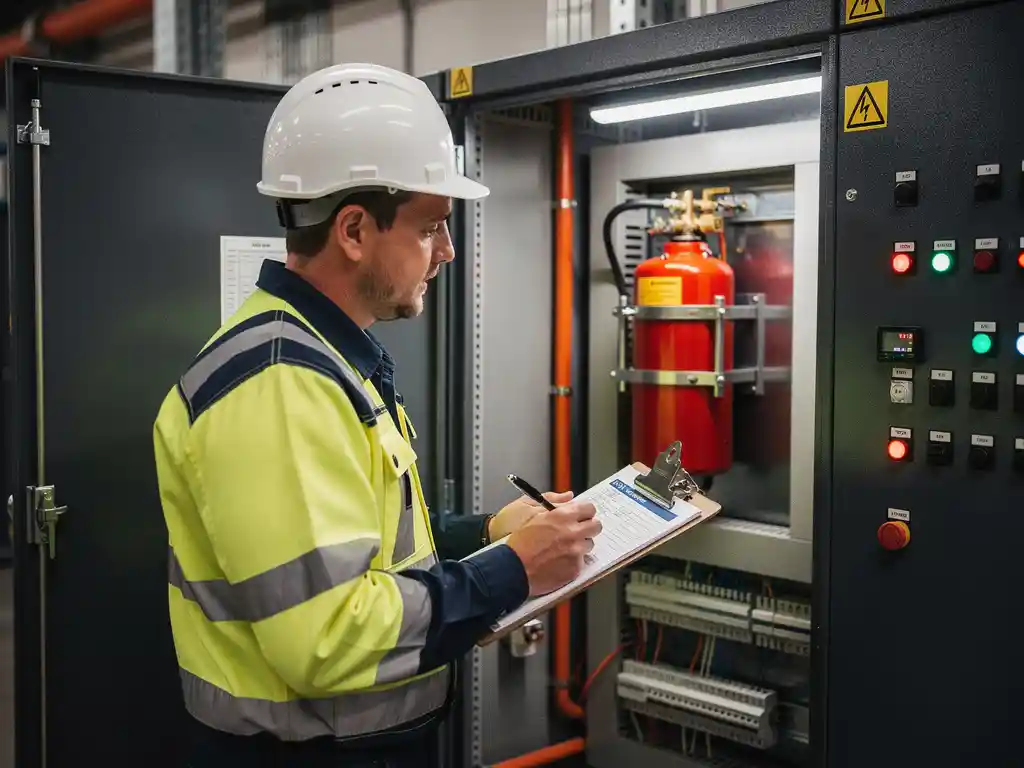
Verifying that a suppression system meets NFPA requirements means reviewing the applicable standard for your system type, confirming that all required documentation is in order, and completing a witnessed acceptance test conducted by a qualified authority. Compliance is not a one-time event — it requires ongoing inspection, testing, and record-keeping to remain valid. The sections below address the most common questions safety and compliance managers face when navigating NFPA verification for industrial fire suppression systems.
Which NFPA standards apply to fire suppression systems?
The applicable NFPA standard depends on the type of suppression agent and the hazard being protected. NFPA 13 governs automatic sprinkler systems, NFPA 12 covers carbon dioxide systems, NFPA 2001 applies to clean agent systems, and NFPA 750 addresses water mist systems. For industrial facilities with specific hazards, additional standards such as NFPA 15 (water spray) or NFPA 16 (foam-water systems) may also apply.
Selecting the correct standard is the foundation of any NFPA compliance effort. Each document specifies design criteria, agent quantities, discharge rates, component listings, and installation requirements that are specific to the suppression technology in question. Using the wrong standard as a reference — or applying a residential-grade standard to an industrial application — creates compliance gaps that inspectors will flag immediately.
For electrical enclosures, control rooms, and equipment cabinets common in manufacturing and energy facilities, clean agent and inert gas systems fall under NFPA 2001. This standard sets minimum design concentrations, enclosure integrity requirements, and agent distribution criteria that must all be satisfied before a system can be considered compliant. Industrial safety managers should confirm which edition of each standard is currently adopted by their authority having jurisdiction (AHJ), since local amendments can affect specific requirements.
What documentation is required to prove NFPA compliance?
Proving NFPA compliance requires a set of documents that collectively demonstrate the system was designed, installed, and tested in accordance with the relevant standard. At minimum, this includes hydraulic calculations or agent quantity calculations, approved shop drawings, equipment listings and data sheets, a contractor’s material and test certificate, and a record of the acceptance test.
Most NFPA standards require that documentation be submitted to the AHJ before installation begins and that a final set of as-built drawings be produced after installation is complete. The as-built drawings must reflect any field changes made during installation, since deviations from the approved design that are not documented can result in a failed inspection.
Additional documentation commonly required includes:
- Third-party listing certificates for all major components (detectors, nozzles, control panels, agent containers)
- Manufacturer installation instructions and system design manuals
- Enclosure integrity test results where required by the standard
- Training records showing that facility personnel have been briefed on system operation
- Maintenance logs from any pre-acceptance testing or commissioning activities
Keeping these records organized and accessible is not just a compliance formality. During an insurance claim or post-incident investigation, complete documentation is the primary evidence that a system was properly specified and maintained.
How does acceptance testing verify a suppression system meets NFPA standards?
Acceptance testing verifies that a suppression system meets NFPA standards by confirming that every installed component operates as designed under controlled conditions before the system is placed in service. Tests typically include functional checks of detection devices, alarm signal verification, manual release testing, and confirmation that the system responds correctly through its full sequence of operations without discharging agent.
For most suppression systems, NFPA standards require that acceptance tests be witnessed by the AHJ or an approved representative. The installing contractor prepares a test procedure in advance, and the results are recorded on a standardized form — NFPA 2001, for example, includes a specific contractor’s material and test certificate that must be completed and signed.
Enclosure integrity testing is a specific acceptance requirement under NFPA 2001 for clean agent and inert gas systems. A door fan test or equivalent method measures whether the protected space can retain agent concentration long enough to suppress a fire. If the enclosure leaks too quickly, the system may discharge the correct quantity of agent but still fail to achieve the minimum hold time specified in the standard.
Detection system performance is also verified during acceptance. Smoke detectors must respond within the sensitivity thresholds defined by their listings, and any cross-zone or pre-action logic must sequence correctly. A system that discharges too quickly, too slowly, or fails to trigger an alarm signal will not pass acceptance regardless of how well the suppression hardware is installed.
What are the most common NFPA compliance failures found during inspection?
The most common NFPA compliance failures during fire suppression system inspection involve missing or outdated documentation, unauthorized field modifications, obstructed or improperly spaced detection devices, and enclosures that no longer meet integrity requirements due to post-installation changes. These failures are preventable with disciplined change management and scheduled pre-inspection audits.
Documentation failures are among the most frequent. Systems installed years ago may lack current as-built drawings, or maintenance records may have gaps that inspectors interpret as evidence of neglected servicing. In facilities that have undergone renovations, original suppression system designs may no longer match the current hazard configuration, creating a compliance mismatch that requires engineering review to resolve.
Physical compliance failures commonly cited during inspections include:
- Detection devices painted over, obstructed, or relocated without recalculation
- Agent containers showing signs of corrosion, physical damage, or incorrect mounting
- Nozzles blocked by new equipment, cable trays, or storage added after installation
- Manual release stations that are inaccessible or lack required signage
- Enclosure penetrations introduced by new cabling or conduit that have not been sealed
For industrial facilities where equipment layouts change frequently, maintaining suppression system compliance requires treating the fire protection system as an active part of change management processes, not a fixed background system.
How often must a suppression system be retested to maintain NFPA compliance?
NFPA standards require suppression systems to undergo periodic inspection, testing, and maintenance on a schedule that varies by system type and component. Most standards mandate annual functional testing of detection and control equipment, with some components requiring quarterly or semi-annual checks. NFPA 25 governs water-based systems, while NFPA 2001 and NFPA 12 specify inspection intervals for clean agent and CO2 systems, respectively.
For clean agent and inert gas systems under NFPA 2001, annual inspection requirements include verifying agent quantity, checking container pressure where applicable, confirming all detection and control devices are functional, and reviewing enclosure integrity. A full enclosure integrity retest is not required annually by the standard, but it is strongly recommended whenever physical changes have been made to the protected space.
Component-level testing intervals add further structure to a compliance calendar. Smoke detectors typically require sensitivity testing at intervals defined by NFPA 72, which specifies testing within the first year of installation and at least every other year thereafter, with more frequent testing if detectors fail sensitivity checks. Battery backup systems, manual release mechanisms, and abort switches each carry their own inspection frequencies that must be tracked and documented.
Facilities operating in jurisdictions that have adopted FM Global standards alongside NFPA may face additional or more frequent testing requirements, since FM Global property loss prevention data sheets often specify intervals that exceed NFPA minimums.
Does NFPA compliance automatically satisfy FM Global or local fire codes?
NFPA compliance does not automatically satisfy FM Global requirements or local fire codes. FM Global operates its own independent set of property loss prevention data sheets that frequently impose stricter design, installation, and testing criteria than NFPA standards. Local fire codes, which are adopted and amended at the jurisdiction level, may reference different NFPA editions or include local amendments that create additional obligations beyond the base standard.
FM Global data sheets are particularly relevant for industrial facilities where property insurers require FM Global compliance as a condition of coverage. In these cases, a system that fully satisfies NFPA 2001 may still fall short of FM Global DS 4-9 requirements for clean agent systems, particularly regarding agent quantity safety factors, detection system design, and enclosure integrity thresholds. Facilities must verify compliance against both frameworks independently.
Local fire codes introduce a third layer of requirements. Many jurisdictions adopt model codes such as the International Fire Code (IFC) or NFPA 1, which reference NFPA suppression standards but may specify a different adopted edition or add local amendments. A system designed to the current edition of NFPA 13 may not satisfy a jurisdiction that has adopted an earlier edition with different sprinkler spacing rules. Confirming the exact adopted code and edition with the local AHJ before design begins prevents costly redesign later.
The practical approach for industrial safety managers is to identify all applicable frameworks at the outset of a project: the relevant NFPA standard, any FM Global data sheets required by the insurer, and the locally adopted fire code. Designing to the most stringent requirements across all three frameworks is the most reliable path to satisfying all parties simultaneously.
How ExxFire supports NFPA compliance for electrical enclosure protection
For industrial facilities protecting electrical cabinets, switchgear, and battery energy storage systems, ExxFire’s integrated detection and suppression systems are designed to simplify the compliance process from specification through ongoing maintenance. Key features that directly support NFPA verification requirements include:
- Third-party certification: ExxFire systems are tested and certified by CNPP in France, providing the independent component listing documentation that NFPA compliance and AHJ acceptance require
- Integrated aspirating smoke detection: Early smoke detection paired with nitrogen suppression addresses the detection performance requirements central to NFPA 2001 acceptance testing
- Non-pressurized agent storage: The Cool Gas Generator technology uses nitrogen in a solid, non-pressurized state, reducing the container inspection and pressure verification obligations associated with pressurized agent systems
- Fire panel integration: Built-in relays allow the system to report status to an existing fire panel interface, supporting the alarm signal verification steps required during acceptance testing
- Pre-engineered design: Systems are pre-engineered for defined enclosure volumes, reducing the hydraulic calculation burden and supporting clean documentation packages for AHJ submission
If you are specifying suppression protection for electrical enclosures and need a system that supports a clear compliance documentation path, contact ExxFire to discuss your application requirements.
Related Articles
- How do European fire safety standards apply to imported equipment?
- What fire risks are specific to E-cabinets in industrial settings?
- How do you document fire suppression compliance for an audit?
- What is the difference between a fire extinguisher and a sprinkler system?
- What are PFAS chemicals in fire extinguishing systems?