

What are early warning systems used in fire management?
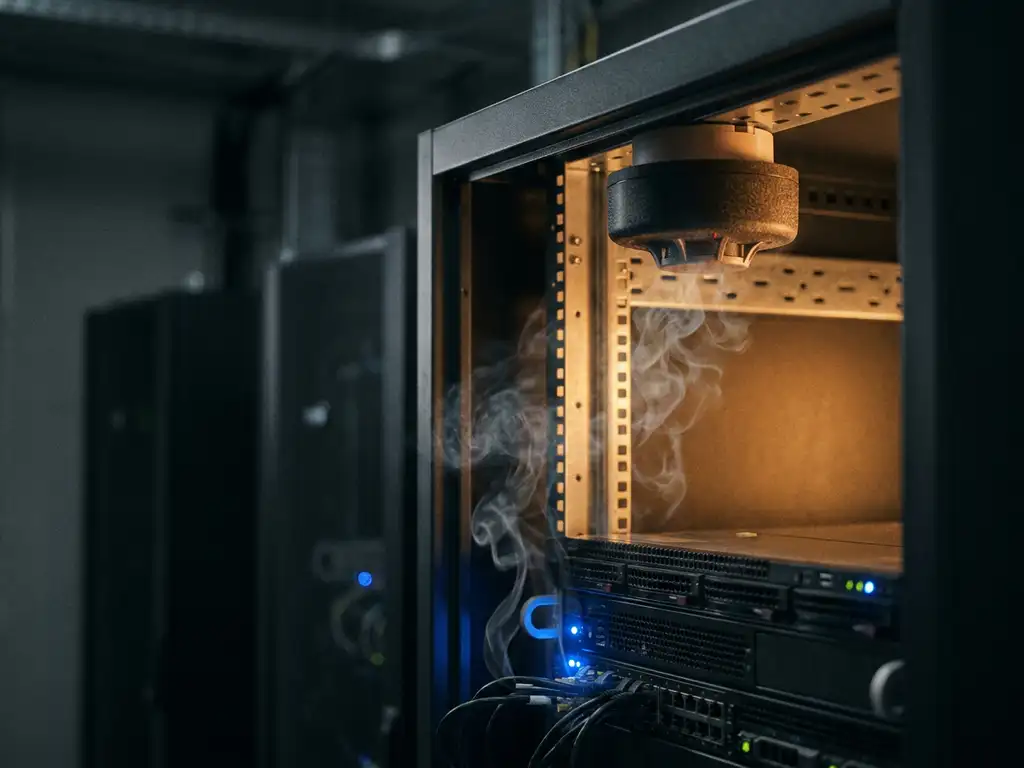
Early warning systems in fire management are detection technologies designed to identify the earliest signs of fire, typically smoke, heat, or chemical changes in the air, before flames develop and spread. These systems give people and automated suppression equipment the maximum possible time to respond, reducing damage, protecting lives, and preserving critical assets. The sections below break down how these systems work, where they are used, and how detection and suppression work together.
How do early warning systems detect fires before they spread?
Early warning fire detection systems identify fires at the pre-combustion or early smoldering stage by continuously sampling the surrounding environment for smoke particles, heat changes, or combustion gases. By detecting these indicators before visible flames appear, the systems trigger alerts and automated responses while the fire is still small and containable.
The most sensitive approach is aspirating smoke detection (ASD), which actively draws air through a network of sampling pipes into a detection chamber. This method can identify extremely low concentrations of smoke particles, often detecting a fire minutes or even hours before a conventional point detector would respond. This early lead time is what makes aspirating detection so valuable in environments where even minor fire damage can have catastrophic consequences.
Other detection mechanisms include:
- Ionization detectors that sense changes in electrical current caused by combustion particles
- Photoelectric detectors that use light beams disrupted by smoke
- Heat detectors that respond to a fixed temperature threshold or a rapid rate of temperature rise
- Multi-sensor detectors that combine two or more of the above methods to reduce false alarms
The earlier a fire is detected, the more options exist for suppression. A system that identifies smoldering in a server rack within seconds can trigger a targeted suppression response before hardware is damaged, whereas delayed detection often means the fire has grown beyond the point where object-level suppression is effective.
What are the main types of early warning fire detection systems?
The main types of early warning fire detection systems are aspirating smoke detection systems, point-type smoke detectors, heat detectors, flame detectors, and gas or chemical detection systems. Each type is suited to different environments, risk profiles, and levels of detection sensitivity required.
- Aspirating smoke detection (ASD): The most sensitive category, actively drawing air samples to a central detector. Ideal for data centers, server rooms, and electrical cabinets where early detection is critical.
- Point-type smoke detectors: The most widely installed type, using either ionization or photoelectric technology. Suitable for general building fire detection but slower to respond than ASD in low-smoke conditions.
- Heat detectors: Respond to temperature thresholds or rapid heat rises. Used in environments where smoke detectors would generate false alarms, such as kitchens or dusty industrial spaces.
- Flame detectors: Detect the infrared or ultraviolet radiation emitted by open flames. Common in outdoor or high-ceiling industrial environments.
- Gas and chemical detectors: Identify combustion byproducts such as carbon monoxide before smoke is visible. Often used as a supplementary layer in high-risk environments.
For mission-critical equipment protection, aspirating detection is the preferred choice because it operates continuously, provides graduated alarm levels, and integrates directly with suppression systems to enable an automated response.
Where are early warning fire systems most commonly installed?
Early warning fire detection systems are most commonly installed in environments where equipment value, data sensitivity, or operational continuity make a rapid fire response essential. These include data centers, server rooms, electrical switchgear cabinets, battery energy storage systems (BESS), telecommunications infrastructure, and industrial control panels.
In each of these settings, a fire that goes undetected for even a few minutes can cause damage far exceeding the cost of the detection system itself. Downtime in a data center, for example, carries significant financial and reputational consequences, making early detection a business-critical investment rather than simply a compliance requirement.
Beyond high-tech environments, early warning systems are also widely deployed in:
- Healthcare and pharmaceutical facilities protecting sensitive equipment and records
- Manufacturing plants with high-voltage cabinets and power distribution units
- Transportation infrastructure including railway signaling and control rooms
- Museums and archives where irreplaceable items require maximum protection
- Commercial buildings where early detection supports occupant evacuation
What is the difference between fire detection and fire suppression?
Fire detection identifies the presence of fire or pre-fire conditions and raises an alarm, while fire suppression actively intervenes to extinguish or contain the fire. Detection is the sensing layer; suppression is the response layer. In modern fire safety systems, these two functions are increasingly combined into a single integrated unit to eliminate the delay between detection and action.
A standalone detection system alerts occupants or monitoring centers, relying on human response or a separately triggered suppression system to act. This introduces a time gap during which the fire can grow. An integrated detection and suppression system removes that gap entirely, automatically triggering suppression the moment the detection threshold is reached.
The distinction matters most in unmanned or remotely monitored environments. A server cabinet in an unoccupied data hall, a battery storage system in an outdoor enclosure, or a switchgear cabinet in a remote substation all represent scenarios where human response time is too slow to prevent significant damage. In these cases, the combination of early detection and immediate automated suppression is the only reliable approach.
What suppression agents are used in early warning fire systems?
The suppression agents most commonly used in early warning fire systems include inert gases such as nitrogen and argon, carbon dioxide, clean agent gases such as FM-200 and Novec 1230, and water mist. The choice of agent depends on the environment being protected, the sensitivity of the equipment, and increasingly, environmental and regulatory considerations.
Inert gases, particularly nitrogen, work by reducing the oxygen concentration in the protected space below the level needed to sustain combustion. Nitrogen is especially well suited for protecting sensitive electronics because it leaves no chemical residues, causes no secondary damage to components, and poses no environmental harm. Unlike some synthetic clean agents, nitrogen contains no PFAS compounds and does not contribute to ozone depletion or global warming.
The regulatory landscape in 2026 is pushing organizations away from PFAS-containing suppression agents, which are subject to growing restrictions across Europe and other regions. This has accelerated interest in inert gas solutions that meet both fire safety and environmental compliance requirements simultaneously.
Other agents in use include:
- Carbon dioxide (CO2): Effective but hazardous to people in enclosed spaces, limiting its use to unmanned areas
- FM-200 and similar HFCs: Fast-acting clean agents, but subject to phase-out due to high global warming potential
- Water mist: Effective for certain applications but unsuitable for live electrical equipment
- Dry powder: Used in specific industrial settings, but causes significant secondary damage and cleanup challenges
How do early warning systems support business continuity?
Early warning fire systems support business continuity by minimizing the time between fire ignition and suppression, reducing the extent of hardware damage, limiting operational downtime, and enabling faster recovery. When fire is detected and suppressed at the object level before it spreads, organizations avoid the full cost of equipment replacement, data loss, and service interruption.
The financial case for early detection is straightforward. A fire that is suppressed within seconds of detection in a single cabinet may cause little or no damage to the equipment inside. The same fire, detected minutes later by a room-level system, may destroy the cabinet entirely and spread to adjacent infrastructure. The difference in recovery cost, downtime, and business impact between these two scenarios is significant.
Early warning systems also support continuity through:
- Automated response: No reliance on human intervention, ensuring action even in unmanned environments
- Graduated alarm levels: Allowing investigation and response before a full suppression event is triggered, reducing unnecessary disruption
- Integration with building management systems: Status reporting via relays to existing fire panels keeps facility teams informed in real time
- Low maintenance requirements: Systems that require minimal upkeep reduce the risk of protection gaps caused by missed service intervals
For organizations managing multiple sites or operating in regulated industries, the ability to demonstrate active, certified fire protection at the object level also supports insurance, compliance, and audit requirements, all of which contribute directly to operational resilience.
How ExxFire supports early fire detection and suppression
ExxFire provides integrated fire detection and suppression systems purpose-built for the environments where early warning matters most. Key features of ExxFire’s approach include:
- Aspirating smoke detection combined with nitrogen suppression in a single unit, eliminating the delay between detection and response
- Non-pressurized nitrogen gas that leaves no chemical residues, protecting sensitive electronics without secondary damage
- PFAS-free technology that meets current and emerging environmental regulations
- Easy self-installation without special certification, with relay outputs for integration into existing fire panels
- Tested and certified by CNPP France and DMT (TÜV Nord), providing verified performance assurance
- Scalable protection for enclosures up to 4.5 m³, with multiple units interconnectable for larger volumes
Whether you are protecting server racks, switchgear cabinets, battery energy storage systems, or other mission-critical enclosures, ExxFire’s systems are designed to detect early and suppress immediately. Contact ExxFire to discuss the right fire safety solution for your specific environment.
Related Articles
- How does fire management reduce wildfire risk?
- How does a fire suppression system work in an E-cabinet?
- How do fire safety standards differ between Europe and the United States?
- How do you conduct a fire hazard inspection at home?
- What is the difference between suppression and prevention in fire safety?