
How do you identify fire risks in a commercial building?
To identify fire risks in a commercial building, you need to systematically inspect ignition sources, fuel sources, and oxygen supplies across all areas, then assess who or what could be harmed if a fire started. This process applies to any commercial property, from office blocks and warehouses to facilities housing sensitive electrical equipment. The sections below walk through each key aspect of commercial fire risk identification in detail.
What are the most common fire hazards in commercial buildings?
The most common fire hazards in commercial buildings are electrical faults, accumulated combustible materials, human error, and inadequate storage of flammable substances. These hazards are present in virtually every commercial environment and are responsible for the majority of workplace fires reported each year.
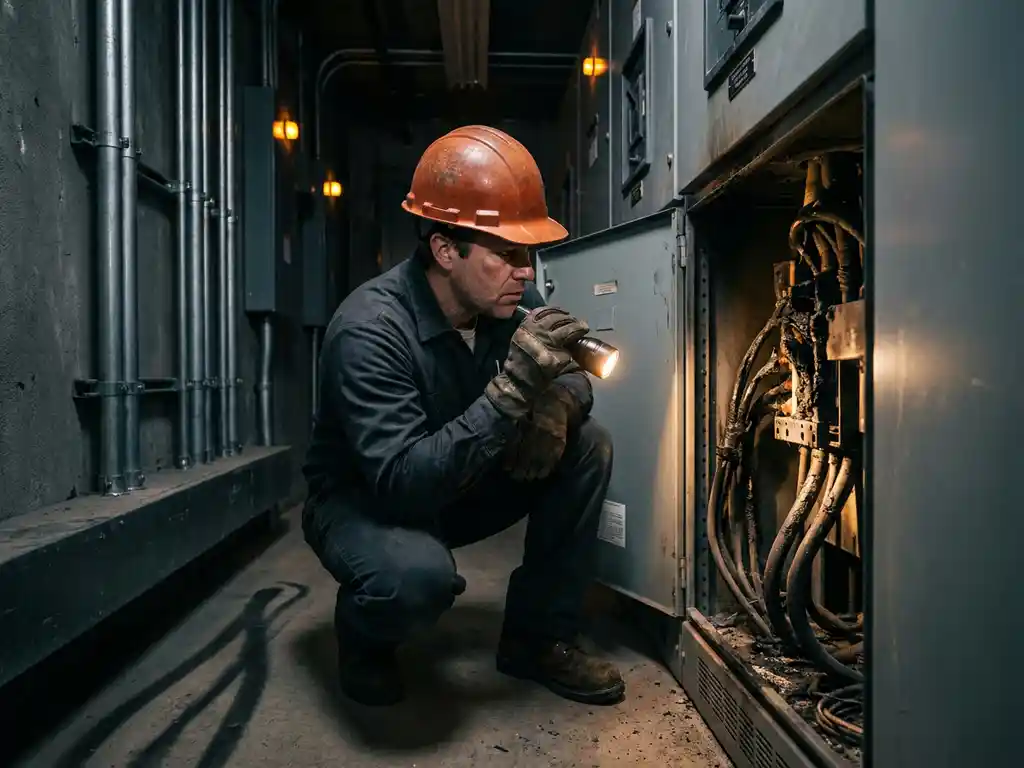
Electrical equipment is consistently one of the leading causes of commercial fires. Overloaded circuits, damaged wiring, and poorly maintained switchgear or server infrastructure can all generate heat that ignites nearby materials. In buildings with large numbers of ICT cabinets, battery energy storage systems, or high-voltage enclosures, the concentration of electrical risk is especially significant.
Beyond electrical sources, common fire hazards in commercial properties include:
- Combustible waste such as paper, cardboard, and packaging materials left near heat sources
- Flammable liquids and chemicals used in cleaning, maintenance, or manufacturing processes
- Cooking equipment in staff kitchens or canteen areas left unattended
- Heating systems that are poorly maintained or positioned too close to flammable materials
- Human behaviour including improper disposal of smoking materials or blocking fire exits with stored goods
Understanding which hazards are present in your specific building is the first step toward meaningful fire risk identification.
How do you carry out a fire risk assessment in a commercial building?
A fire risk assessment in a commercial building is carried out by identifying hazards, evaluating who is at risk, removing or reducing those risks where possible, recording findings, and reviewing the assessment regularly. In most jurisdictions, this process is a legal requirement for any non-domestic premises.
The standard five-step process for a commercial fire risk assessment is:
- Identify fire hazards — locate all ignition sources, fuel sources, and oxygen supplies throughout the building
- Identify people at risk — consider employees, contractors, visitors, and anyone who might be particularly vulnerable, such as lone workers or people with mobility limitations
- Evaluate and reduce risk — assess the likelihood and consequences of a fire starting and spreading, then take action to eliminate or control the hazards identified
- Record, plan, and train — document your findings, put an emergency plan in place, and ensure all relevant staff are trained on evacuation procedures and fire safety responsibilities
- Review and update — revisit the assessment whenever significant changes occur in the building or its occupancy, and at regular scheduled intervals
A thorough fire risk assessment considers not just the physical environment but also operational practices. How materials are stored, how waste is managed, and how equipment is maintained all influence the overall level of fire risk in a commercial building.
Which areas of a commercial building carry the highest fire risk?
The areas of a commercial building that carry the highest fire risk are electrical rooms, server and ICT rooms, kitchens, storage areas, and plant rooms. These locations combine ignition potential with fuel sources and, in some cases, limited human oversight, making early detection especially important.
Electrical and server rooms present a concentrated risk because they house equipment that generates heat continuously. A fault in a single cabinet or rack can escalate quickly in a confined space, and the value of the equipment inside means that even a small fire can cause disproportionate damage and downtime. This is why object-level fire protection for enclosed electrical equipment is increasingly considered a critical layer of defence.
Other high-risk areas include:
- Storage rooms and loading bays where combustible materials accumulate and access is infrequent
- Kitchens and catering areas where cooking equipment, grease, and open flames are present
- Plant rooms housing boilers, generators, or HVAC equipment that operates under heat and pressure
- Stairwells and corridors that can act as channels for fire and smoke to spread rapidly through a building
What role does electrical equipment play in commercial fire risk?
Electrical equipment plays a central role in commercial fire risk because it is both a primary ignition source and a high-value asset that can be severely damaged by fire. Faults in wiring, overloaded circuits, ageing infrastructure, and heat buildup within enclosed cabinets are all pathways through which electrical systems can initiate or accelerate a fire.
In modern commercial buildings, the density of electrical infrastructure has grown considerably. Server racks, switchgear cabinets, battery energy storage systems, power distribution units, and telecommunications enclosures are now standard features in many facilities. Each of these creates a localised fire risk that standard room-level suppression systems may not address quickly enough to prevent significant equipment damage.
Early smoke detection at the object level is particularly valuable in electrical environments. Aspirating smoke detection systems can identify combustion particles at a very early stage, before visible smoke or flames develop, giving suppression systems the opportunity to act before a fire establishes itself. This approach is especially relevant in unmanned or remote equipment rooms where no human observer is present to notice the early warning signs.
Regular inspection and maintenance of electrical installations, combined with appropriate object-level fire protection for high-risk enclosures, significantly reduces the contribution of electrical equipment to overall commercial fire risk.
How often should fire risks in a commercial building be reviewed?
Fire risks in a commercial building should be formally reviewed at least once a year, and immediately following any significant change to the building, its use, its occupancy, or its equipment. Waiting for a scheduled annual review when circumstances have changed is one of the most common gaps in commercial fire safety management.
Triggers that should prompt an immediate review of your fire risk assessment include:
- Structural changes such as renovations, extensions, or alterations to the building layout
- Changes in occupancy, including new tenants, significantly more staff, or a shift in the type of work carried out
- Introduction of new equipment, particularly electrical or high-voltage systems
- A near-miss incident or actual fire, however minor
- Changes in relevant fire safety legislation or guidance
- Feedback from a fire safety inspection by a regulatory authority
For buildings with complex electrical infrastructure or high-value assets, more frequent informal checks are advisable even between formal reviews. The goal is to ensure that the documented fire risk assessment always reflects the current reality of the building.
What fire suppression options are available once risks are identified?
Once fire risks in a commercial building have been identified, suppression options range from building-wide systems such as sprinklers and gaseous suppression to object-level solutions designed to protect individual cabinets, enclosures, or equipment racks. The right choice depends on the nature of the risk, the value of the assets involved, and the consequences of downtime or damage.
For general building protection, wet pipe sprinkler systems are widely used. However, water is destructive to sensitive electronics, making sprinklers unsuitable as the primary defence for server rooms, switchgear cabinets, or battery energy storage systems. Gaseous suppression systems address this limitation by flooding a room with an inert or clean agent gas, but traditional options have historically relied on pressurised cylinders or agents now subject to increasing environmental regulation due to PFAS content.
Object-level suppression offers a targeted alternative. Rather than protecting an entire room, these systems are installed directly inside or immediately adjacent to the enclosure at risk, detecting smoke early and suppressing fire at the source before it can spread. This approach is particularly effective for enclosed electrical equipment where the fire risk is concentrated and the cost of damage is high.
How ExxFire helps with fire risk in commercial buildings
ExxFire provides integrated fire detection and suppression systems specifically designed to address the electrical fire risks identified in commercial buildings. Once you have completed your fire risk assessment and identified high-value enclosures as a priority, ExxFire’s systems deliver targeted, object-level protection. Key features include:
- Aspirating smoke detection that identifies combustion particles at the earliest possible stage, before flames develop
- Non-pressurized nitrogen gas suppression that extinguishes fire without leaving chemical residues, protecting sensitive electronics and components
- PFAS-free technology that meets growing environmental and regulatory requirements as an alternative to legacy gas suppression agents
- Easy self-installation with no special certification required, and no ongoing maintenance burden once commissioned
- Integration with existing fire panels via built-in relays, ensuring your object protection works alongside your broader fire safety infrastructure
- Certification by CNPP France and TÜV Nord, giving procurement teams and facility managers confidence in independently verified performance
ExxFire systems are suitable for server racks, electrical cabinets, switchgear, battery energy storage systems, and any other enclosed equipment identified as high-risk during a commercial fire risk assessment. Ready to protect your mission-critical assets? Contact ExxFire to find the right solution for your building.
Related Articles
- How do you measure the effectiveness of a fire management strategy?
- What are the legal requirements for fire management on private land?
- Why is early fire detection critical in electrical cabinet protection?
- What fire suppression standards apply to data centers in 2026?
- How do you know if your home is a high fire risk?