

How does poor electrical wiring increase fire risk?
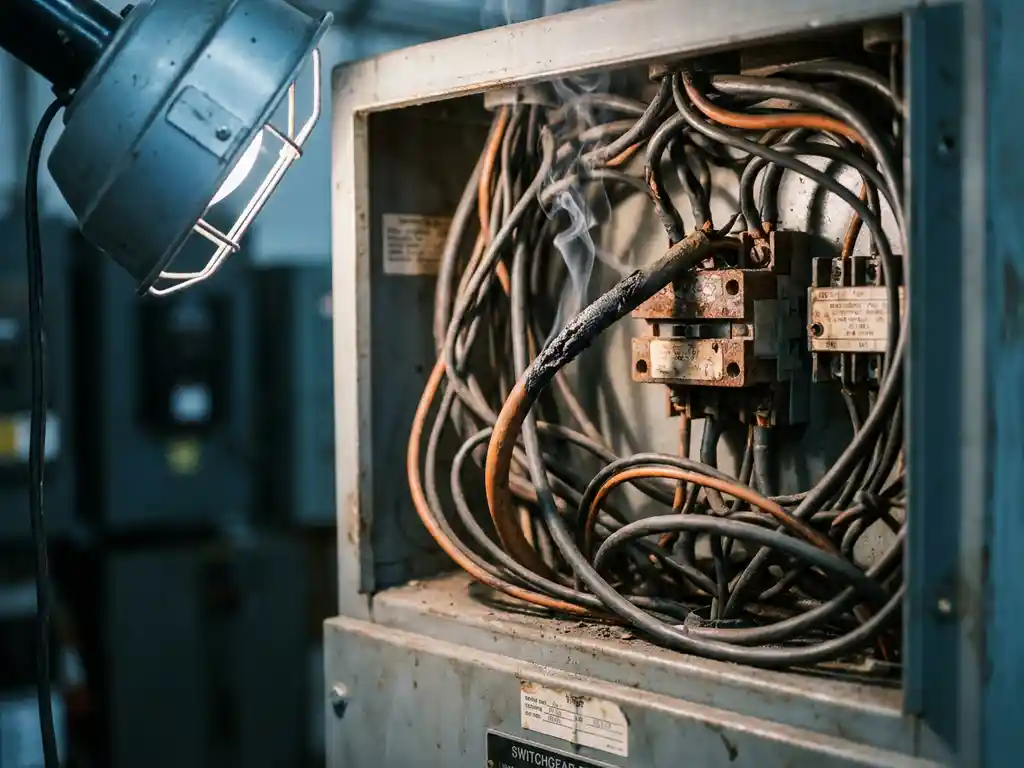
Poor electrical wiring increases fire risk by creating conditions where heat, sparks, or arcing can ignite surrounding materials. Damaged insulation, loose connections, and overloaded circuits are among the most common causes of electrical fires in both commercial and residential buildings. Understanding how faulty wiring behaves — and where the danger is greatest — is the first step toward preventing it.
What types of electrical wiring faults are most likely to cause a fire?
The electrical wiring faults most likely to cause a fire are overloaded circuits, damaged or deteriorated insulation, loose terminal connections, and incorrectly sized conductors. Each of these faults generates excess heat or sparks that can ignite surrounding materials, particularly in enclosed spaces where heat cannot dissipate quickly.
Overloaded circuits occur when more current flows through a wire than it is rated to carry. The wire heats up, and if the overcurrent protection fails to trip in time, that heat can transfer to insulation, wall cavities, or nearby combustibles. This is a particularly common cause of electrical fires in older buildings where the original wiring was not designed to handle modern electrical loads.
Damaged insulation is another serious wiring fire hazard. Insulation degrades over time due to age, heat exposure, rodent damage, or physical abrasion. Once insulation breaks down, bare conductors can come into contact with each other or with flammable materials, creating a direct ignition risk.
Loose connections at junction boxes, terminals, or outlets generate localized heat through increased resistance. This is sometimes called a “hot spot,” and it can smolder undetected for hours before igniting. Incorrectly sized conductors — where a wire is too thin for the current it carries — produce the same overheating effect across the entire length of the cable.
How does electrical arcing start a fire?
Electrical arcing starts a fire by producing an intense burst of heat — often exceeding 6,000 degrees Celsius — when electrical current jumps across a gap between two conductors. This energy is more than sufficient to ignite insulation, dust, or any nearby combustible material, even in a fraction of a second.
Arcing occurs in two main forms. Series arcing happens within a single conductor, typically at a point of damage or a loose connection where the circuit is partially broken. Parallel arcing occurs between two conductors at different voltages, for example where insulation has worn away and two wires make intermittent contact.
What makes arc faults particularly dangerous as a cause of electrical fires is their unpredictability. Standard circuit breakers are designed to respond to sustained overcurrent, not to the brief, high-energy pulses that arcing produces. An arc fault can therefore persist long enough to start a fire without ever tripping a conventional breaker. Arc Fault Circuit Interrupters (AFCIs) were developed specifically to detect and interrupt these patterns, but they are not universally installed in older electrical installations.
In enclosed environments such as electrical cabinets, switchgear, or server racks, the risk is compounded. The enclosure concentrates heat and any smoke produced by early-stage arcing, accelerating the transition from smoldering to open flame.
What are the early warning signs of dangerous wiring in a building?
The early warning signs of dangerous wiring include frequently tripping circuit breakers, flickering or dimming lights, burning smells near outlets or panels, discolored or warm switch plates, and buzzing or crackling sounds from electrical fixtures. Any of these signals should be treated as a potential electrical fire hazard requiring immediate investigation.
Frequently tripping breakers indicate that a circuit is being regularly overloaded, or that a fault is drawing excess current. While the breaker is doing its job by tripping, repeated occurrences point to an underlying wiring problem that will not resolve on its own.
Burning smells, even faint ones, near outlets, junction boxes, or consumer units are among the most serious warning signs. They often indicate that insulation is already overheating or that arcing is occurring inside a wall or enclosure. Discoloration around outlets or switch plates — yellowing, scorching, or blackening — confirms that heat has already been generated at that point.
Flickering lights, particularly when large appliances switch on, suggest voltage fluctuations caused by poor connections or undersized wiring. Buzzing or crackling sounds from outlets or light fittings can indicate loose wiring or early-stage arcing. In industrial or commercial settings, unexplained heat signatures detected during routine thermal imaging inspections of electrical panels are also a reliable indicator of developing faults.
Which environments face the highest electrical fire risk?
Environments with the highest electrical fire risk are those that combine high electrical loads, enclosed equipment, and limited ventilation — including data centers, industrial manufacturing facilities, energy storage installations, and older commercial buildings with aging electrical infrastructure. In these settings, a single wiring fault can escalate rapidly due to the density of equipment and the difficulty of early detection.
Data centers and ICT infrastructure rooms are particularly vulnerable. Server racks and networking equipment draw sustained high currents, generate significant heat, and are often housed in enclosed cabinets where airflow is managed but fire suppression may be absent at the object level. A fault within a single rack can propagate to adjacent equipment before a room-level detection system responds.
Battery Energy Storage Systems (BESS) represent a growing area of electrical fire risk in 2026. These installations involve large arrays of lithium-based cells connected through complex wiring harnesses. Wiring faults in BESS environments can trigger thermal runaway in battery cells, a process that generates its own heat and is extremely difficult to suppress once underway.
Industrial switchgear and high-voltage cabinets face similar risks. These enclosures carry high currents and are subject to vibration, dust ingress, and thermal cycling — all of which accelerate insulation degradation and connection loosening. Older commercial buildings with original wiring that has never been upgraded face a more diffuse but equally serious risk, as deteriorating insulation and undersized conductors are present throughout the structure.
How can fire suppression systems protect against electrical wiring fires?
Fire suppression systems protect against electrical wiring fires by detecting smoke or heat at the earliest possible stage and delivering a suppression agent directly at the source before a fire can spread. Object-level suppression — systems installed inside or directly on individual cabinets and enclosures — is the most effective approach for protecting high-value electrical equipment from wiring faults.
The key advantage of early detection is the ability to act before a smoldering fault becomes an open fire. Aspirating smoke detection, which actively draws air samples from inside an enclosure, can identify combustion particles far earlier than conventional point detectors. This early warning window is critical in enclosed environments where a wiring fault can transition from smoke to flame rapidly.
The choice of suppression agent also matters significantly in electrical environments. Water-based suppression is unsuitable for live electrical equipment. Chemical agents can leave residues that damage sensitive components and may contain PFAS substances that carry environmental and regulatory risks. Inert gas suppression — particularly nitrogen — extinguishes fire by reducing oxygen levels without leaving any chemical residue, making it safe for electronics and compliant with increasingly strict environmental regulations.
For wiring fire prevention in enclosed electrical equipment, the combination of early smoke detection and clean gas suppression at the object level provides a level of protection that room-level systems cannot replicate. It limits damage to the affected enclosure, prevents fire from spreading to adjacent equipment, and supports business continuity by reducing downtime and the cost of hardware replacement.
How ExxFire helps protect against electrical wiring fires
ExxFire’s integrated fire detection and suppression systems are purpose-built for exactly the environments where the fire risk from poor electrical wiring is highest. Each system combines aspirating smoke detection with non-pressurized nitrogen gas suppression, delivered through ExxFire’s patented Cool Gas Generator technology. Key features include:
- Early smoke detection: Aspirating detection identifies combustion particles inside enclosures at the earliest stage, before a smoldering wiring fault becomes an open fire
- Clean nitrogen suppression: Nitrogen leaves no chemical residues, making it safe for sensitive electronics, switchgear, server racks, and battery energy storage systems
- PFAS-free and environmentally responsible: ExxFire systems are a certified alternative to PFAS-containing gas extinguishing agents, supporting compliance with current and emerging environmental regulations
- Non-pressurized storage: The solid-state nitrogen generator eliminates the risks associated with storing high-pressure gas cylinders in enclosed spaces
- Easy installation and maintenance-free operation: Systems are designed for straightforward self-installation with no ongoing maintenance requirements, keeping the total cost of ownership low
- Fire panel integration: Built-in relays allow the system to report status to an existing fire panel, ensuring seamless compatibility with broader fire safety infrastructure
ExxFire systems are tested and certified by CNPP in France and validated by DMT, part of TÜV Nord in Germany, giving facility managers, safety officers, and procurement teams confidence in their reliability. Whether you are protecting a single electrical cabinet or an entire data center infrastructure, ExxFire’s fire suppression solutions provide the object-level protection that wiring fire risks demand. Contact ExxFire to discuss the right solution for your environment.
Related Articles
- How does fire management differ between countries?
- What is the process for getting a fire suppression system VdS certified?
- How do you prevent garage fires at home?
- How does fire suppression system design affect environmental performance?
- How do inert gas systems compare to HFC-based suppression agents?