

How do you prevent garage fires at home?
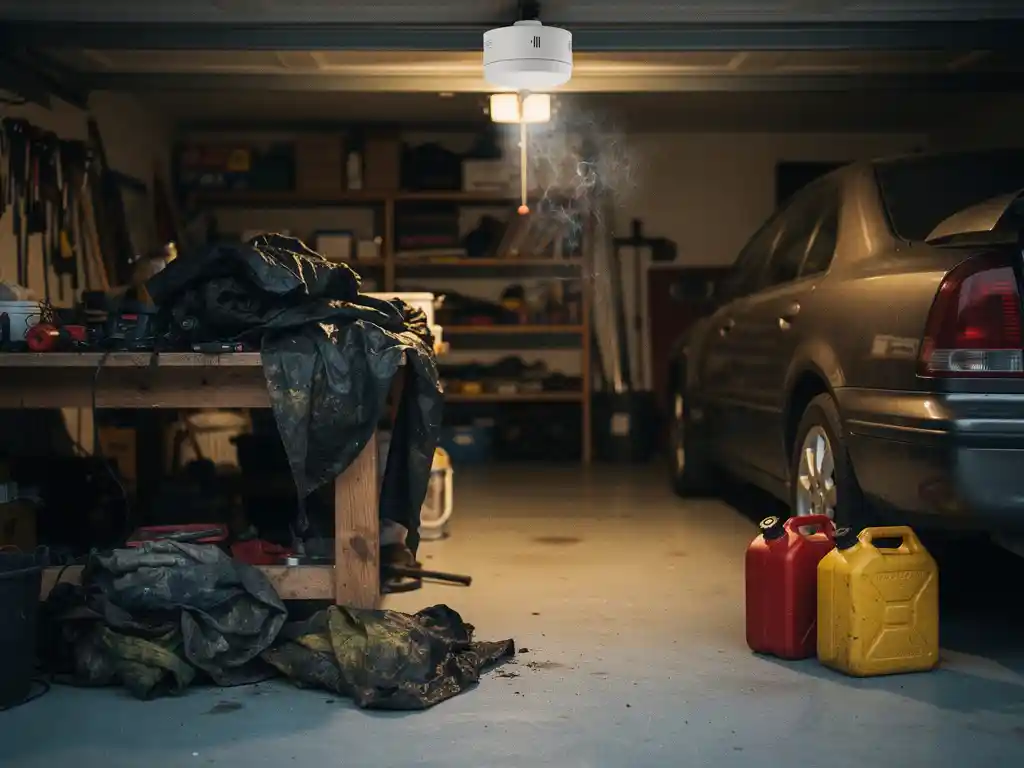
Garage fires are largely preventable with the right habits and safeguards in place. The most effective approach combines proper storage of flammable materials, routine electrical maintenance, and early detection equipment. The sections below address the most common questions homeowners have about garage fire safety.
What causes most garage fires at home?
Most garage fires at home are caused by improper storage of flammable liquids, faulty electrical wiring or appliances, and heating equipment placed too close to combustible materials. Because garages often double as workshops, storage rooms, and vehicle shelters, they concentrate multiple fire hazards in a single space that is frequently left unmonitored.
Vehicles themselves are a significant source of risk. Fuel leaks, hot exhaust systems, and oil residue can all ignite if conditions are right. Many homeowners also keep lawn mowers, power tools, and portable generators in the garage, each of which carries its own ignition risk.
Clutter compounds the danger. When combustible materials such as cardboard boxes, old furniture, paint cans, and wood scraps accumulate near heat sources or electrical outlets, a small spark can escalate quickly. Garages also tend to have poor ventilation, which allows flammable vapors to build up to dangerous concentrations before anyone notices.
How should you store flammable liquids in a garage?
Flammable liquids in a garage should be stored in approved, tightly sealed containers made of metal or approved plastic, kept away from heat sources, open flames, and electrical equipment. Small quantities are safest, and any container showing signs of leakage or damage should be disposed of immediately through a proper waste facility.
Common flammable liquids found in home garages include gasoline, motor oil, paint thinner, acetone, and propane. Each has a different flash point, but all require the same basic discipline when it comes to storage and handling.
- Use approved containers: Store gasoline only in containers specifically rated for fuel storage. Never use glass jars, open buckets, or food containers.
- Keep quantities minimal: Only store what you need for immediate use. Large reserves dramatically increase risk.
- Maintain separation from ignition sources: Keep flammable liquids at least three meters away from water heaters, furnaces, electrical panels, and any appliance with a pilot light.
- Ensure ventilation: Flammable vapors are heavier than air and settle at floor level. A well-ventilated garage reduces the chance of vapor accumulation reaching ignition concentrations.
- Label everything clearly: Unlabeled containers are a hazard. Proper labeling prevents accidental mixing and ensures safe disposal.
Never pour leftover flammable liquids down drains or into the trash. Most municipalities offer hazardous household waste collection points where these materials can be dropped off safely.
What electrical hazards in a garage can lead to a fire?
The most common electrical hazards in a garage that can lead to a fire include overloaded circuits, damaged or frayed wiring, the misuse of extension cords as permanent wiring, and faulty appliances left plugged in unattended. Garages are often added to a home’s electrical system as an afterthought, making them prone to inadequate capacity for modern power demands.
Many homeowners use their garage for power-hungry equipment such as electric vehicle chargers, refrigerators, workshop tools, and space heaters. Running multiple high-draw devices on a circuit not rated for that load creates heat buildup in the wiring, which can ignite surrounding materials without any visible warning.
Extension cords are a particular concern. They are designed for temporary use, not as a substitute for permanent outlets. When extension cords are run under rugs, through walls, or left coiled while in use, heat cannot dissipate properly and the risk of insulation failure rises sharply.
Practical steps to reduce electrical fire risk in a garage include:
- Having the garage wiring inspected by a qualified electrician, especially in older homes
- Installing ground fault circuit interrupter (GFCI) outlets, which are required in damp or wet environments
- Avoiding daisy-chaining power strips or using adapters to multiply outlet capacity
- Unplugging battery chargers and power tools when not in active use
- Replacing any appliance or cord showing signs of wear, scorching, or unusual heat
Should you have a smoke detector or fire suppression system in your garage?
Yes, every garage should have at least a smoke detector, and a fire suppression system adds a meaningful additional layer of protection for garages containing high-value equipment, vehicles, or significant quantities of flammable materials. A smoke detector provides early warning; a suppression system actively intervenes before a fire spreads beyond control.
Standard ionization smoke detectors, which are common in living areas, are less effective in garages because vehicle exhaust and dust can trigger false alarms. Photoelectric detectors or heat detectors are generally better suited to garage environments. Place the detector on the ceiling away from direct airflow, and test it monthly.
For garages that house electric vehicles, workshop equipment, or battery storage systems, the risk profile is higher and early detection becomes even more critical. EV batteries in particular can enter thermal runaway, a self-sustaining chemical reaction that generates intense heat and is difficult to extinguish with conventional methods. In these situations, a detection system that catches smoke at the earliest possible stage offers a decisive advantage.
Whatever detection equipment you install, make sure it is interconnected with the rest of your home’s alarm system so that an alert in the garage wakes occupants throughout the house.
What should you do if a fire starts in your garage?
If a fire starts in your garage, your first priority is to get everyone out of the home immediately and call emergency services. Do not attempt to fight the fire yourself unless it is very small, you have a functioning fire extinguisher rated for the type of fire, and you have a clear exit behind you at all times.
The sequence of actions matters enormously in the first moments of a garage fire:
- Alert everyone in the home and move to a pre-agreed meeting point outside.
- Close doors between the garage and living areas as you exit — this slows the spread of fire and smoke into the rest of the house.
- Call emergency services from outside. Do not re-enter to retrieve belongings.
- If you have a fire extinguisher and the fire is contained to a small area such as a trash can or workbench, use the PASS technique: Pull the pin, Aim at the base of the fire, Squeeze the handle, Sweep side to side. Stop immediately if the fire does not begin to reduce within a few seconds.
- Never open a door that feels hot to the touch. Heat on the other side indicates fire is directly behind it.
If there is a vehicle in the garage, keep in mind that fuel tanks can rupture and that electric vehicle fires are particularly difficult to extinguish. Maintain a safe distance and let professionals handle it.
The best outcome in a garage fire is one that never escalates — which is why early detection and suppression equipment, combined with good storage habits, are far more valuable than any reactive response.
How ExxFire helps protect garages and critical equipment from fire
For environments where fire risk is high and the cost of damage is significant, a passive response is not enough. ExxFire’s integrated fire detection and suppression systems are designed to act at the earliest sign of smoke, before a fire has the chance to develop into a serious incident.
ExxFire’s systems combine aspirating smoke detection with non-pressurized nitrogen gas suppression, delivered through its patented Cool Gas Generator technology. Key advantages include:
- Early intervention: Aspirating smoke detection identifies smoke at concentrations far below what a standard detector would register, giving suppression more time to act effectively.
- Clean suppression: Nitrogen leaves no chemical residue, meaning sensitive electronics, battery systems, and high-value equipment are protected without secondary damage from the suppression agent itself.
- PFAS-free: ExxFire’s systems contain no PFAS compounds, making them a responsible choice for organizations with environmental and compliance obligations.
- Easy installation: Systems are pre-engineered for straightforward self-installation without special certification requirements, reducing setup costs and complexity.
- Certified performance: All systems are tested and certified by CNPP in France and validated by DMT, part of TÜV Nord in Germany.
Whether protecting a commercial garage, an EV charging installation, or a switchgear cabinet, ExxFire provides a solution built around early detection and clean, effective suppression. Contact ExxFire today to find out which system is right for your specific environment.
Related Articles
- Are open-plan offices at higher fire risk than traditional layouts?
- How do you communicate fire risks to employees effectively?
- How do you prevent electrical fires at home?
- What are the fire prevention responsibilities of a landlord?
- What are the long-term costs of using high-GWP fire suppression agents?