

How do you train staff to recognise and report fire risks?
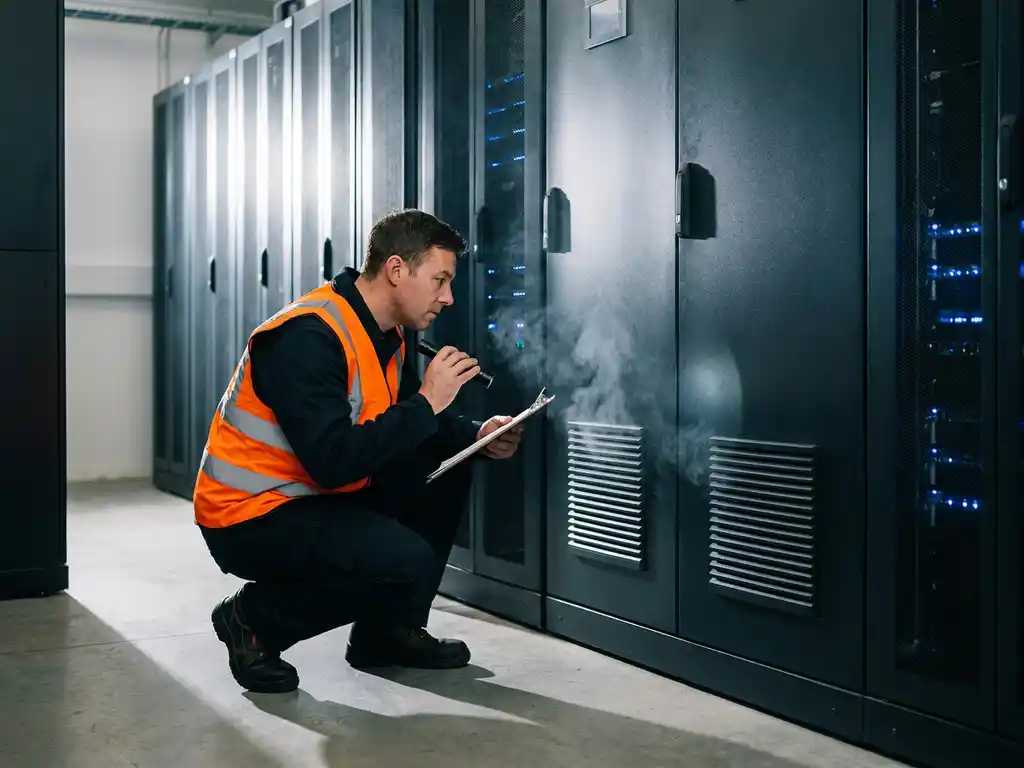
Train staff to recognise and report fire risks by combining structured fire safety awareness sessions with clear reporting procedures and regular refresher training. Every employee should know what common fire hazards look like, how to raise the alarm, and who is responsible for acting on reported concerns. The sections below answer the most common questions organisations ask when building or reviewing their fire risk training programme.
What are the most common fire risks staff fail to notice?
The fire risks staff most commonly overlook are electrical faults, overloaded power points, blocked ventilation in cabinets and enclosures, and the gradual build-up of combustible materials near heat sources. These hazards develop slowly and become part of the background, which is exactly why they go unreported until a problem occurs.
Electrical equipment deserves particular attention in workplace fire risk training. Switchgear cabinets, server racks, battery energy storage systems, and high-voltage enclosures all generate heat during normal operation. When ventilation is restricted, dust accumulates, or a component begins to fail, the risk of ignition rises steadily. Because these enclosures are closed and often unattended, the warning signs are easy to miss without a deliberate inspection routine.
Other frequently overlooked risks include:
- Cables routed under carpets or through door frames, causing insulation damage over time
- Overloaded extension leads and adapters in server rooms or technical spaces
- Flammable liquids or cleaning materials stored near electrical equipment
- Fire doors propped open, reducing compartmentalisation in the event of a fire
- Out-of-date or missing signage that staff no longer notice
Recognising fire risks is a skill that requires deliberate training, not just a general awareness of danger. Staff who understand what to look for in their specific environment are far more likely to catch a developing hazard before it becomes a serious incident.
How should staff be trained to identify fire hazards at work?
Staff should be trained to identify fire hazards through a combination of site-specific instruction, practical walkthroughs, and scenario-based exercises. Generic fire safety awareness is a starting point, but effective fire risk training connects the principles directly to the environments and equipment employees work with every day.
A well-structured fire hazard identification programme typically covers three core areas:
Understanding fire triangle basics in context
Staff do not need to be fire engineers, but they should understand that fire requires heat, fuel, and oxygen to sustain itself. When they can recognise sources of each in their own workplace, they can apply that knowledge practically. For example, an employee working near electrical cabinets should understand that a smouldering component provides heat, accumulated dust or insulation material provides fuel, and the enclosure itself contains enough oxygen to allow ignition.
Conducting structured visual inspections
Training should include how to carry out a basic visual inspection of the areas staff are responsible for. This means knowing what a healthy piece of equipment looks like compared to one showing signs of overheating, unusual odour, discolouration, or irregular noise. Checklists are a practical tool here, giving staff a repeatable process rather than relying on memory or instinct alone.
Workplace fire prevention depends on staff feeling confident that their observations matter. Training should reinforce that identifying and reporting a potential hazard early is one of the most valuable contributions any employee can make to site safety.
What is the correct procedure for reporting a fire risk?
The correct procedure for reporting a fire risk is to record the hazard clearly, notify the designated responsible person or fire safety officer immediately, and follow up to confirm the report has been received and acted upon. Speed and clarity matter. A vague verbal mention is far less effective than a written report that specifies what was observed, where, and when.
Most organisations use a formal hazard reporting system, which may be a digital form, a physical logbook, or a dedicated safety management platform. Whatever the format, a useful fire risk report should include:
- The location of the hazard, described precisely enough that someone unfamiliar with the area can find it
- A description of what was observed, including any unusual smells, sounds, or visual signs
- The date and time of the observation
- The name of the person reporting
- Any immediate action already taken, such as removing combustible material or switching off equipment
Staff should also know the threshold between reporting a risk and raising a fire alarm. A potential hazard discovered during a routine check is handled through the reporting procedure. A visible fire, significant smoke, or an immediate threat to life requires immediate activation of the fire alarm and evacuation. Training should make this distinction explicit so that staff do not hesitate when it matters most.
How often should fire safety training be refreshed?
Fire safety training should be refreshed at least annually for all staff, with additional sessions triggered by significant changes to the workplace, equipment, or workforce. Annual refresher training keeps knowledge current and ensures that new hazards introduced by changes to the environment are covered.
Certain situations call for additional fire safety awareness training outside the regular annual cycle:
- When new equipment is installed, particularly electrical or high-voltage systems
- After a near-miss incident or a fire event, however minor
- When staff move into a new role or area with different risk profiles
- Following changes to fire safety legislation or company procedures
- When a fire risk assessment identifies new or previously unrecognised hazards
In 2026, many organisations are also responding to the growing presence of battery energy storage systems and high-density electrical infrastructure, both of which introduce fire risks that older training programmes may not adequately cover. Refreshing training to reflect the actual equipment present in the workplace is not optional; it is the foundation of effective fire risk assessment training.
Who is responsible for fire safety training in a workplace?
Responsibility for fire safety training in a workplace sits with the employer, but in practice it is typically delegated to a designated fire safety officer, facilities manager, or health and safety lead. Every organisation with employees is legally required to ensure that staff receive adequate fire safety instruction and that the training is recorded and reviewed.
In larger organisations, responsibility is usually distributed across several roles:
- The employer or senior management holds ultimate legal accountability for ensuring a fire-safe workplace and adequate staff training
- The fire safety officer or health and safety manager designs and delivers the training programme, maintains records, and conducts or coordinates fire risk assessments
- Line managers and supervisors reinforce fire safety awareness day-to-day, ensure new team members receive induction training, and act as the first point of contact for reported hazards
- All employees carry a personal responsibility to follow procedures, report hazards, and participate in training
In smaller organisations, these roles may overlap significantly. What matters is that someone has clear ownership of the fire safety training programme and that staff know who to contact when they identify a risk. Ambiguity about responsibility is one of the most common reasons fire hazards go unreported.
What role does early detection technology play in fire risk management?
Early detection technology plays a critical role in fire risk management by identifying the signs of fire before flames develop, giving staff and automated systems time to respond before significant damage occurs. Aspirating smoke detection, in particular, can identify microscopic smoke particles at the earliest stage of a developing fault, well before a conventional detector would trigger.
For environments where high-value or mission-critical equipment is housed in closed enclosures, such as server racks, switchgear cabinets, or battery energy storage systems, early detection is especially important. These environments are not continuously monitored by human eyes, and by the time a fault becomes visible or smells of smoke, the damage may already be severe.
Technology supports staff fire safety training rather than replacing it. When employees understand what detection systems are in place, how they work, and what to do when an alert is triggered, the combination of human awareness and automated detection creates a much stronger layer of protection than either provides alone. Staff should be trained to treat an automated alert with the same seriousness as a visible hazard, and to understand the difference between a system status notification and an active suppression event.
Integrating detection technology into regular fire safety awareness sessions also helps staff appreciate the full picture of fire risk management in their workplace, moving beyond the basics of escape routes and extinguisher locations to a more complete understanding of how fire is prevented and controlled at the source.
How ExxFire supports fire risk management in critical environments
ExxFire provides integrated fire detection and suppression systems designed specifically for the enclosed, high-value environments where fire risks are hardest to detect and most damaging when missed. Key features of ExxFire’s approach include:
- Aspirating smoke detection that identifies fire at the earliest possible stage, before flames develop inside server racks, electrical cabinets, or battery enclosures
- Non-pressurized nitrogen gas suppression that extinguishes fire at the source without leaving chemical residues, protecting sensitive electronics and avoiding secondary damage
- PFAS-free technology that meets growing environmental and compliance requirements, making it a clean alternative to legacy suppression agents
- Easy installation and maintenance-free operation, reducing the burden on facilities teams and ensuring the system remains ready without ongoing check-ups
- Integration with existing fire panels via built-in relays, so alerts feed directly into the wider fire safety infrastructure staff are already trained to respond to
- Tested and certified by CNPP France and TÜV Nord, providing independently verified assurance of performance
Training staff to recognise and report fire risks is an essential layer of protection. Pairing that human awareness with reliable early detection and suppression technology at the object level closes the gaps that training alone cannot cover. To learn how ExxFire’s systems can strengthen fire risk management in your facility, visit ExxFire.