
How does fire management support water catchment protection?
Fire management supports water catchment protection by reducing the intensity and spread of uncontrolled wildfires, which are among the most destructive forces affecting drinking water sources. When fire burns through a catchment area, it strips away vegetation, destabilizes soils, and releases contaminants that flow directly into reservoirs and waterways. The sections below unpack the specific threats, protective strategies, and recovery timelines that define the relationship between fire and water supply.
What happens to a water catchment after a wildfire?
After a wildfire, a water catchment undergoes rapid and significant change. Vegetation is destroyed, the soil surface is sealed by ash and heat, and the landscape loses its natural ability to filter and absorb rainfall. The result is a sharp increase in runoff, erosion, and the transport of sediment, nutrients, and chemical contaminants directly into water sources.
The immediate post-fire period is the most hazardous. Rainfall on bare, hydrophobic soil runs off at a much higher rate than normal, carrying ash, charred organic material, heavy metals, and nutrients into streams and reservoirs. This surge in sediment and nutrient loading can overwhelm water treatment systems and cause algal blooms that further degrade water quality.
Beyond water quality, the hydrology of the catchment itself changes. With less vegetation to intercept rainfall and transpire water back into the atmosphere, streamflow volumes often increase dramatically in the short term. This raises flood risk downstream and accelerates erosion in gullies and stream banks, compounding the damage to the catchment’s long-term health.
How does prescribed burning protect catchment water quality?
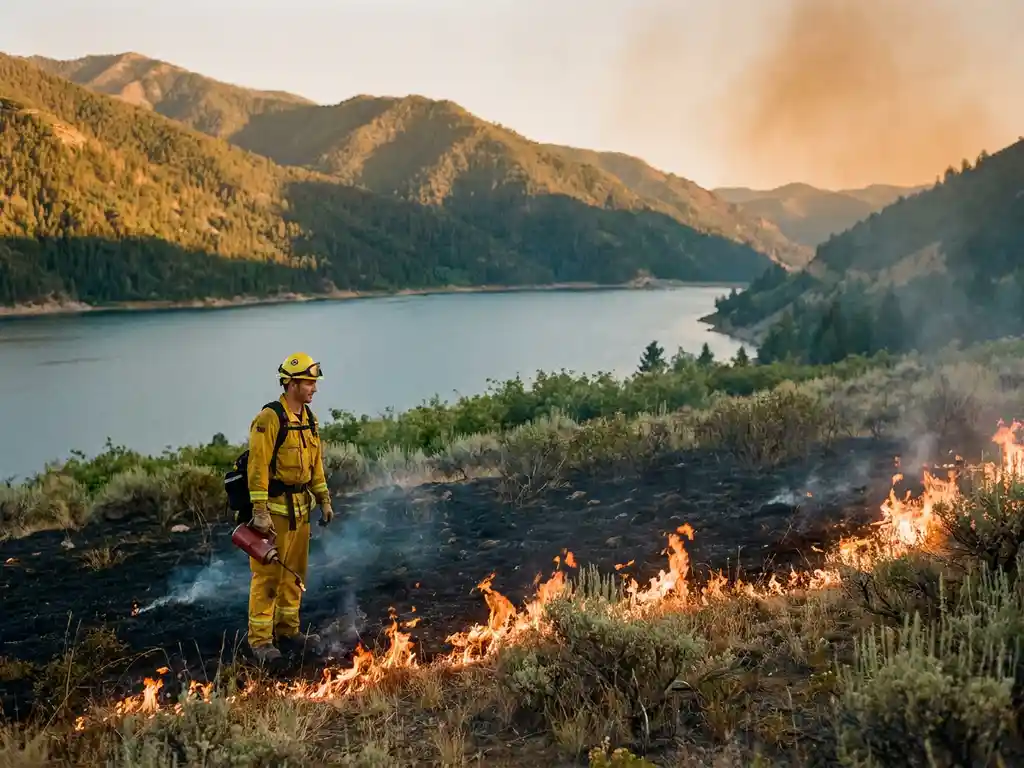
Prescribed burning protects catchment water quality by reducing the accumulation of fuel loads that would otherwise feed high-intensity wildfires. A controlled, low-intensity burn removes dry vegetation and debris before it can become fuel for a catastrophic fire, meaning that if a wildfire does ignite, it burns with less intensity and causes significantly less damage to soil and vegetation.
The key principle is that fire intensity determines the severity of catchment damage. A low-intensity prescribed burn may cause temporary, minor increases in nutrient runoff, but the soil structure and most deep-rooted vegetation survive intact. By contrast, a high-intensity wildfire can sterilize the topsoil, destroy the root networks that hold soil in place, and create the hydrophobic layer responsible for extreme runoff events.
Land managers who use prescribed burning as part of a broader catchment management strategy also benefit from improved access to remote areas, which supports monitoring and rapid response when wildfires do occur. Timing is critical: burns are conducted during cooler, moister conditions when fire behavior is predictable and the risk of escape is low, minimizing the impact on water quality while achieving meaningful fuel reduction.
What are the main threats fire poses to drinking water sources?
Fire poses several direct threats to drinking water sources, including contamination from ash and sediment, elevated levels of dissolved organic carbon, nutrient spikes that promote algal growth, and the release of heavy metals from burned soils and vegetation. In severe cases, combustion of built infrastructure within or near a catchment can introduce benzene and other hydrocarbons into source water.
The specific threats can be grouped into three categories:
- Physical contamination: Ash, sediment, and debris enter waterways rapidly after fire, increasing turbidity and placing heavy loads on filtration systems.
- Chemical contamination: Burned vegetation and soils release nitrogen, phosphorus, heavy metals, and in some cases polycyclic aromatic hydrocarbons (PAHs) that are difficult to remove through standard treatment processes.
- Biological risk: Nutrient surges following fire create favorable conditions for cyanobacteria (blue-green algae) blooms, which produce toxins that standard disinfection methods may not fully neutralize.
Water utilities serving fire-affected catchments often face increased treatment costs, the need for emergency chemical dosing, and in some cases temporary closure of intake points. The scale of the challenge depends heavily on fire severity, catchment size, and how quickly rainfall follows the burn.
How do land managers balance fire risk and catchment health?
Land managers balance fire risk and catchment health by combining fuel reduction strategies with vegetation management practices that preserve soil stability and water filtration capacity. This means designing fire management programs that reduce wildfire risk without unnecessarily disturbing the root systems, organic layers, and ground cover that protect water quality.
In practice, this balance involves several integrated approaches:
- Zoning catchments to identify areas where prescribed burning is appropriate and areas where vegetation must be retained to protect water quality.
- Scheduling fuel reduction burns during seasons when soil moisture is sufficient to prevent deep combustion and limit ash production.
- Maintaining buffer zones of unburned vegetation along stream banks and around reservoir edges.
- Coordinating with water utilities to ensure treatment capacity is adequate before any planned burn activity.
- Using mechanical fuel reduction (such as slashing and mulching) in sensitive areas where burning would pose too great a risk to water quality.
The tension between these priorities is real. Leaving fuel loads high to protect vegetation means accepting greater wildfire risk, while aggressive burning can temporarily elevate nutrient and sediment loads. Effective catchment management requires ongoing risk assessment, local ecological knowledge, and close collaboration between fire agencies and water authorities.
How long does it take a catchment to recover after fire?
A catchment typically takes between two and ten years to recover its pre-fire hydrology and water quality function, depending on fire severity, rainfall patterns, and the resilience of local vegetation. The most acute water quality risks occur in the first one to two years after a fire, when bare soils are most vulnerable to erosion and nutrient flushing.
Recovery follows a general sequence. In the first year, pioneering plant species begin to stabilize bare soil, reducing erosion rates. By years two to three, shrub and grass cover is typically re-established across much of the affected area, and runoff coefficients begin returning toward normal. Full recovery of forest canopy and deep root systems, which are critical for long-term water regulation, may take a decade or longer after high-severity fire.
Rainfall timing plays a decisive role. A major storm event in the first months after a fire can cause erosion and contamination on a scale that sets back recovery significantly. Conversely, a dry post-fire period allows vegetation to establish before heavy rain arrives, accelerating the recovery timeline. Land managers often install erosion control measures such as log barriers and seeding programs immediately after a fire to shorten the recovery period and protect downstream water quality.
What monitoring is used to protect water quality after a fire?
After a fire, water quality monitoring programs typically include continuous turbidity and conductivity sensors at stream gauging stations, regular sampling for nutrients, heavy metals, and organic compounds, and algal monitoring at reservoir intakes. These systems give water utilities early warning of contamination events so that treatment responses can be activated before water quality deteriorates at the point of supply.
Effective post-fire monitoring combines several tools:
- Real-time sensor networks: Turbidity loggers and automated samplers installed in streams provide continuous data and can trigger alerts when thresholds are exceeded.
- Laboratory water quality testing: Periodic grab samples are analyzed for a broader range of parameters including PAHs, cyanotoxins, and trace metals that sensors cannot detect directly.
- Remote sensing and aerial surveys: Satellite imagery and drone surveys assess the extent of burn severity across the catchment, helping prioritize where ground-level monitoring is most needed.
- Algal monitoring: Regular visual surveys and cell count sampling at reservoir intakes track the development of cyanobacteria blooms driven by post-fire nutrient loading.
Water utilities also review and stress-test their treatment processes before the first post-fire rainfall season, ensuring that coagulation, filtration, and disinfection systems can handle elevated loads. Early warning data from monitoring networks allows operators to increase chemical dosing, switch intake points, or draw down stored water ahead of a contamination event, protecting public health while the catchment recovers.
How ExxFire supports fire suppression in mission-critical environments
While catchment-scale fire management focuses on landscapes and water sources, the same principle of early intervention and minimal collateral damage applies equally to protecting high-value equipment in enclosed environments. ExxFire’s integrated fire detection and suppression systems are designed for exactly this purpose.
- Early smoke detection: Aspirating smoke detection identifies fire at the earliest possible stage, before it escalates into a damaging event.
- Clean nitrogen suppression: Non-pressurized nitrogen gas extinguishes fire without leaving chemical residues, protecting sensitive electronics and components from secondary damage.
- No maintenance burden: Once installed, ExxFire systems require no ongoing check-ups, reducing operational overhead for facility and infrastructure managers.
- PFAS-free technology: ExxFire’s patented Cool Gas Generator is a certified alternative to PFAS-containing suppression systems, supporting sustainability and regulatory compliance.
- Tested and certified: Systems are validated by CNPP France and DMT (TÜV Nord), providing confidence in performance across a wide range of enclosure types.
For organizations managing critical infrastructure where fire risk cannot be tolerated, ExxFire provides a proven, low-maintenance solution. Contact the ExxFire team to discuss the right system for your application.
Related Articles
- Why do forests need fire management?
- What is the difference between wildfire suppression and fire management?
- What is a total fire protection solution for industrial hardware?
- What is the future of fire suppression technology in a low-carbon economy?
- Why is zero-GWP fire suppression becoming a procurement requirement?