

How does fire management work?
Fire management is the structured process of detecting, controlling, and suppressing fires before they cause serious harm to people, property, or operations. It combines prevention strategies, early detection technologies, and suppression systems into a coordinated approach that minimizes risk at every stage. The sections below unpack each key dimension of fire management, from detection basics to regulatory standards.
What are the main stages of fire management?
Fire management operates across three core stages: prevention, detection, and suppression. Prevention reduces the likelihood of ignition through risk assessments, safe equipment design, and operational controls. Detection identifies a fire event as early as possible. Suppression then intervenes to extinguish or contain the fire before it spreads and causes significant damage.
These stages are not isolated. Effective fire risk management depends on all three working together in a coordinated system. A building with excellent suppression hardware but poor detection will respond too slowly. Equally, detection without a reliable suppression method leaves personnel and assets exposed during the critical window between the alarm and manual intervention.
A fourth stage, recovery, is increasingly recognized as part of a complete fire management strategy. This covers post-incident assessment, equipment restoration, and lessons learned that feed back into prevention planning. For businesses operating mission-critical environments, recovery planning is inseparable from the fire safety strategy itself, because the cost of downtime often rivals the cost of physical damage.
How does early fire detection work?
Early fire detection works by continuously monitoring an environment for the physical indicators of combustion, primarily smoke particles, heat, and, in some systems, gases produced during the early stages of a fire. When sensors identify these indicators at or above a set threshold, the system triggers an alarm and, in integrated setups, initiates a suppression response automatically.
The most common detection technologies include ionization detectors, optical smoke detectors, heat detectors, and aspirating smoke detection (ASD) systems. Aspirating systems are particularly effective in high-value environments because they actively draw air samples into a detection chamber rather than waiting for smoke to drift toward a passive sensor. This means they can identify combustion particles at concentrations far below what standard detectors register, often catching a fire event in its smoldering phase before visible flames develop.
Speed matters enormously in fire detection. The earlier a system identifies a developing fire, the smaller the suppression response needs to be, and the less damage results. In electrical cabinets and server environments, where fires can begin inside sealed enclosures, aspirating detection that samples air directly from within the cabinet offers a meaningful advantage over room-level detectors that only respond once smoke has escaped into the surrounding space.
What suppression methods are used in fire management systems?
Fire suppression methods work by removing one or more elements from the fire triangle: fuel, heat, or oxygen. The main suppression approaches used in modern fire management systems include water-based sprinklers, gaseous suppression agents, foam systems, dry chemical powder, and inert gas systems. The right method depends on the nature of the risk, the environment, and the assets being protected.
Water-based sprinklers remain the most widely deployed suppression technology in commercial buildings, but they are unsuitable for environments containing sensitive electronics, live electrical equipment, or irreplaceable assets. Water causes its own category of damage in these settings, often destroying hardware that the fire itself might not have reached.
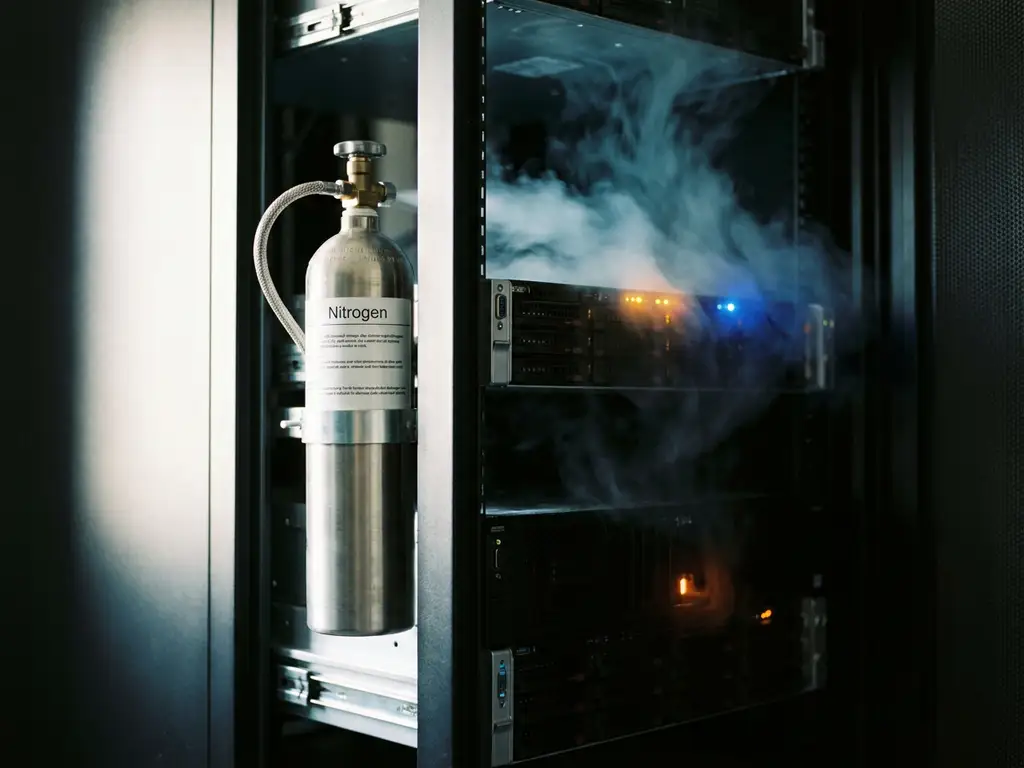
Gaseous and inert gas systems are the preferred choice for enclosed, high-value environments. These systems suppress fire by displacing or reducing oxygen within a protected space, starving the combustion process without leaving residue. Inert gases such as nitrogen are particularly clean because they are chemically neutral and leave no trace on sensitive components after discharge. This makes them well-suited to server racks, switchgear cabinets, and battery energy storage systems where equipment must remain operational or be quickly restored after an incident.
Foam and dry powder systems are typically reserved for flammable liquid or industrial hazards. While effective in those contexts, they are inappropriate for electronics environments due to the contamination they leave behind.
What is the difference between active and passive fire protection?
Active fire protection refers to systems that detect and respond to a fire event, requiring either automatic or manual activation. Passive fire protection refers to structural and material-based measures built into a building or enclosure that slow the spread of fire without any triggering mechanism. Both are essential components of a complete fire protection system.
Active protection includes smoke detectors, fire alarms, sprinkler systems, gaseous suppression systems, and fire extinguishers. These systems respond to a fire once it begins. Passive protection includes fire-rated walls, compartmentation, intumescent seals around cable penetrations, fire doors, and non-combustible building materials. These elements do not activate but instead contain fire and limit its spread by design.
The two approaches are complementary rather than interchangeable. Passive measures buy time by slowing fire spread, which increases the window for active systems to respond and for occupants to evacuate safely. Active systems address the fire directly. Relying on one without the other leaves gaps in a fire safety strategy. In practice, regulatory frameworks and risk assessments typically require both to be present and maintained.
Why is fire management especially important for electrical and ICT equipment?
Electrical and ICT equipment presents a concentrated fire risk because it generates heat continuously, contains flammable components, and is often housed in enclosed cabinets where heat buildup accelerates. At the same time, it represents high financial value, operational criticality, and sensitivity to the very suppression agents that would otherwise control a fire. This combination makes targeted fire management essential rather than optional.
Standard room-level fire suppression is rarely adequate for these environments. A sprinkler system that activates over a server rack will destroy the hardware it was meant to protect. A fire that originates inside a sealed electrical cabinet may not be detected by a ceiling-mounted smoke detector until it has already caused significant internal damage. The mismatch between conventional fire safety tools and the specific characteristics of electrical and ICT environments creates a protection gap.
Object-level fire protection, where detection and suppression are integrated directly within the cabinet or enclosure, closes that gap. By detecting smoke at the point of origin and suppressing with a clean agent that leaves no residue, these systems prevent damage to sensitive electronics while limiting downtime. For organizations where server failure, switchgear damage, or battery system loss translates directly into operational disruption and financial cost, this level of targeted protection is a core part of a fire risk management strategy.
How do fire management regulations and standards shape system requirements?
Fire management regulations and standards define the minimum requirements for detection, suppression, and protection systems across different building types, occupancies, and risk categories. They shape which systems are legally required, how they must be installed, what performance levels they must meet, and how frequently they must be inspected and maintained. Compliance is not optional in most jurisdictions.
Standards vary by country and application. In Europe, EN standards govern fire detection and alarm systems, while specific standards cover suppression systems for different agents and environments. In the United States, NFPA codes set the benchmark. International standards from ISO also apply to certain categories of fire safety equipment. For organizations operating across multiple countries, navigating this regulatory landscape requires careful attention to which standards apply in each jurisdiction.
Beyond legal compliance, standards serve a practical function. They establish performance benchmarks that help buyers evaluate whether a system will actually work under real fire conditions. Third-party testing and certification by recognized bodies, such as CNPP in France or TÜV Nord in Germany, provides independent verification that a system meets the relevant standards. For procurement managers and facility directors, certified systems reduce liability exposure and provide confidence that the technology has been validated against defined criteria rather than relying solely on manufacturer claims.
Regulations are also evolving in response to environmental concerns. The phase-out of PFAS-containing substances, driven by legislation in the European Union and increasingly in other regions, is reshaping the suppression agent market. Organizations that have historically relied on fluorinated foam or certain clean agent gases are now required to transition to compliant alternatives, making PFAS-free suppression systems not just an environmental preference but a regulatory necessity in many contexts.
How ExxFire supports fire management for critical equipment
ExxFire provides integrated fire detection and suppression systems purpose-built for the environments where conventional fire management falls short. The systems combine aspirating smoke detection with nitrogen-based suppression in a single, self-contained unit designed to protect closed enclosures such as server racks, electrical cabinets, switchgear, and battery energy storage systems.
- Early detection at the source: Aspirating smoke detection samples air directly from within the protected enclosure, identifying combustion particles before visible smoke develops.
- Clean suppression with no residue: The patented Cool Gas Generator produces nitrogen from a solid, non-pressurized chemical block, extinguishing fire without leaving chemical residue on sensitive components.
- PFAS-free and regulation-ready: ExxFire systems contain no fluorinated substances, making them compliant with current and emerging PFAS regulations across Europe and beyond.
- Easy installation and low maintenance: Systems are pre-engineered for self-installation without special certification and require no ongoing maintenance after commissioning.
- Certified performance: Tested and certified by CNPP in France and DMT, part of TÜV Nord in Germany, providing independently verified assurance of system performance.
For organizations looking to strengthen their fire safety systems for electrical and ICT equipment, contact ExxFire to discuss the right solution for your specific environment.
Related Articles
- How do you reduce fire risk without disrupting daily operations?
- How do you ensure a fire suppression system stays compliant after installation?
- What is defensible space and how does it prevent wildfire damage?
- How do sprinkler systems contribute to fire prevention?
- How do inert gas systems compare to HFC-based suppression agents?