
What are the fire risks in schools and educational facilities?
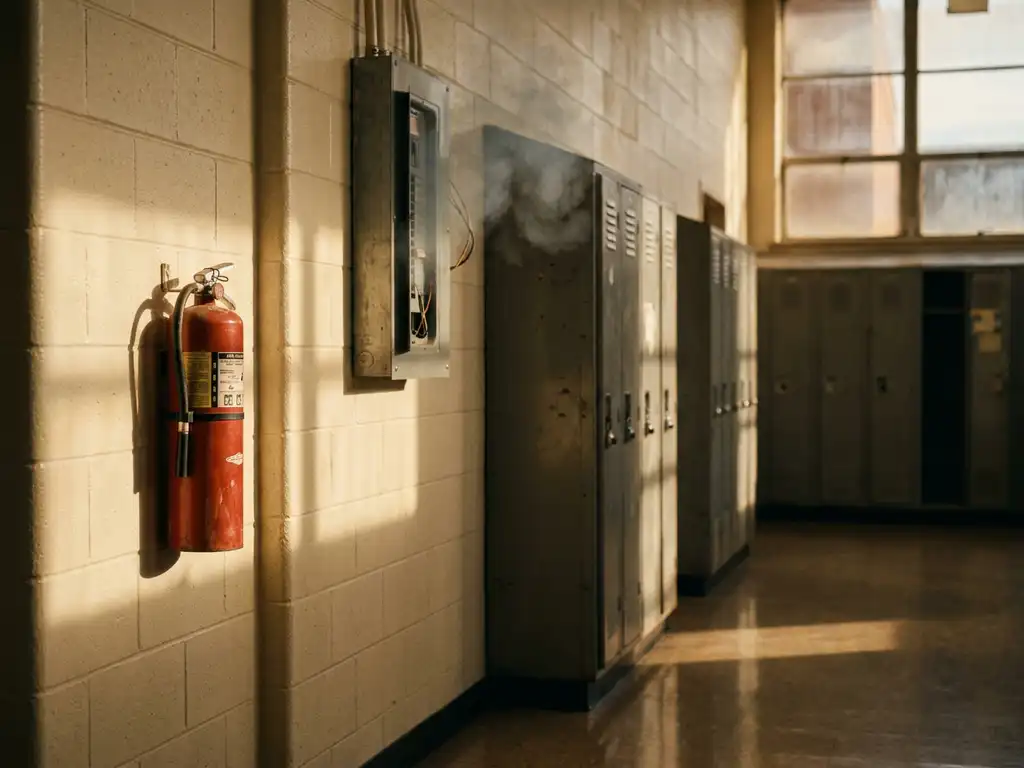
Schools and educational facilities face a wide range of fire risks, from faulty electrical wiring and arson to hazardous materials in science labs and unprotected ICT infrastructure. Fire in a school environment is particularly serious because of the large number of people present, the mix of combustible materials, and the potential for significant disruption to learning and operations. The sections below break down the most common hazards and what educational facilities can do to address them.
What types of fire hazards are most common in school buildings?
The most common fire hazards in school buildings include electrical faults, arson, cooking equipment in canteens, flammable materials in storage areas, and heating systems. Schools are especially vulnerable because they combine high occupancy, a wide variety of ignition sources, and materials like paper, textiles, and chemicals that burn readily.
Older school buildings often contain outdated wiring, poorly maintained boiler rooms, and inadequate fire compartmentation, all of which increase the likelihood of a fire spreading before it is detected. Even in newer buildings, the sheer volume of electrical equipment, from interactive whiteboards and computers to laboratory apparatus, creates multiple potential ignition points throughout the day.
Storage areas are another consistent risk. Classrooms and corridors frequently accumulate paper, cardboard, and other combustible materials that are not always stored safely. When these materials are located near heat sources or electrical outlets, the risk of ignition rises considerably. Regular fire risk assessments are essential to identify and remove these hazards before they become a problem.
Why are electrical systems a leading cause of school fires?
Electrical systems are a leading cause of school fires because schools operate large numbers of devices simultaneously, often in buildings where the electrical infrastructure has not kept pace with modern demand. Overloaded circuits, aging wiring, and poorly maintained equipment create conditions where heat builds up and ignition becomes likely.
Schools today rely heavily on technology. Computer suites, server rooms, interactive displays, charging stations, and laboratory equipment all draw significant electrical load. When this demand exceeds the capacity of the existing infrastructure, overheating can occur in switchgear, distribution boards, and cable runs, particularly in buildings that predate modern electrical standards.
Faulty or damaged equipment is another major contributor. Extension leads used in place of fixed sockets, equipment left on overnight, and devices that are not regularly inspected and tested all increase the probability of an electrical fault developing into a fire. Portable Appliance Testing (PAT) and regular inspection of fixed wiring are important preventive measures that schools should carry out on a scheduled basis.
How do arson and deliberate fire-setting affect educational facilities?
Arson is one of the most significant causes of serious fires in educational facilities. Schools are frequently targeted because they are often unoccupied during evenings, weekends, and holidays, giving perpetrators time to start a fire that goes undetected. Deliberate fire-setting accounts for a disproportionate share of the most damaging school fires.
The consequences of arson in a school go far beyond the immediate physical damage. Loss of irreplaceable records, disruption to examinations, displacement of students and staff, and the cost of rebuilding or temporary accommodation can affect an entire community for months or years. Fires started deliberately also tend to be larger because perpetrators often target areas with high fuel loads, such as storage rooms, bins, or areas containing paper and furniture.
Preventive measures include improving perimeter security, ensuring that combustible waste is stored in locked, external containers, installing monitored alarm systems, and maintaining good lighting around the building. Early detection systems that report to a monitoring centre can significantly reduce response times when a school is unoccupied, limiting the extent of damage even when a fire is set deliberately.
What fire risks are unique to school science labs and workshops?
Science laboratories and practical workshops carry fire risks that are not found elsewhere in a school building. These include the storage and use of flammable chemicals, open flame equipment such as Bunsen burners, combustible materials like wood and textiles, and the potential for reactive substances to ignite unexpectedly.
In chemistry labs, flammable solvents, alcohols, and other reactive chemicals must be stored in appropriate cabinets and used only in controlled conditions. Even small quantities of these substances can produce significant fires if ignited near other combustibles. The combination of student activity, multiple simultaneous experiments, and the presence of heat sources makes the lab environment one of the highest-risk spaces in any school.
Workshops present their own challenges. Woodworking areas generate fine dust that is highly combustible and can accumulate in extraction systems if not cleaned regularly. Metalworking and welding activities produce sparks that can travel considerable distances and ignite nearby materials. Proper housekeeping, adequate ventilation, and clear protocols for the use and storage of flammable materials are all essential in these environments.
How can schools reduce fire risk in server rooms and ICT infrastructure?
Schools can reduce fire risk in server rooms and ICT infrastructure by installing dedicated fire detection and suppression systems within server racks and electrical cabinets, maintaining proper cable management, ensuring adequate ventilation, and conducting regular inspections of all ICT equipment. Early detection at the source is critical because electrical fires in enclosed equipment can develop rapidly and cause severe damage before a room-level alarm activates.
Standard room-based fire detection systems are often too slow to catch a fire developing inside a server rack or network cabinet. By the time smoke reaches a ceiling-mounted detector, significant damage to hardware may already have occurred. Object-level protection, which places detection and suppression capability directly inside the enclosure, addresses this gap by responding at the earliest possible stage.
Proper cable management is also important. Cables that are bundled too tightly, routed near heat sources, or left damaged can overheat and ignite. Ensuring that server rooms are kept clean, that airflow is not obstructed, and that equipment is regularly inspected for signs of wear reduces the underlying risk. Schools should also consider what happens to critical data and systems if a fire does occur, and ensure that business continuity plans account for ICT infrastructure loss.
What fire safety regulations apply to schools and educational buildings?
In most countries, schools are subject to a combination of building regulations, fire safety legislation, and sector-specific guidance that together define minimum standards for fire prevention, detection, evacuation, and suppression. In the United Kingdom, for example, the Regulatory Reform (Fire Safety) Order 2005 requires schools to carry out and regularly review a documented fire risk assessment.
Beyond the legal baseline, schools are typically expected to follow guidance from their national fire authority or education department. In the UK, this includes the Department for Education’s guidance on fire safety in schools, which covers everything from the specification of fire doors and compartmentation to the management of fire drills and staff training. Similar frameworks exist across Europe, North America, and other regions, though the specific requirements vary.
Key obligations that apply in most jurisdictions include:
- Conducting a documented fire risk assessment and reviewing it regularly or after any significant change to the building or its use
- Installing and maintaining appropriate fire detection and alarm systems
- Ensuring adequate means of escape and keeping evacuation routes clear at all times
- Providing staff with fire safety training and appointing fire marshals
- Maintaining fire suppression equipment and keeping records of inspections and tests
- Ensuring that any fire suppression systems used comply with relevant environmental regulations, including restrictions on PFAS-containing agents
Compliance with fire safety regulations is not simply a legal obligation. It is a practical framework that, when followed properly, significantly reduces the likelihood of a fire causing serious harm to students, staff, or the facility itself.
How ExxFire helps protect schools against fire risks
ExxFire provides combined fire detection and suppression systems specifically designed to protect the enclosed electrical equipment that schools rely on every day. For educational facilities managing server rooms, ICT cabinets, switchgear, and network infrastructure, ExxFire’s systems offer targeted, object-level protection that acts before a fire can spread beyond its source.
- Aspirating smoke detection: Detects smoke at the earliest possible stage, directly inside the protected enclosure, rather than waiting for smoke to reach a ceiling detector
- Non-pressurized nitrogen suppression: Extinguishes fire using clean inert nitrogen gas that leaves no chemical residue, protecting sensitive electronics and avoiding secondary damage
- PFAS-free technology: Fully compliant with tightening environmental regulations, making it a responsible choice for schools with sustainability commitments
- Easy installation and low maintenance: Systems are pre-engineered for straightforward self-installation without specialist certification, and require no ongoing maintenance once commissioned
- Integration with existing fire panels: Built-in relays allow the system to report status to a school’s existing fire alarm infrastructure
Schools that want to address fire risks in their ICT and electrical infrastructure without complex installation or ongoing servicing costs will find ExxFire’s approach well-suited to their needs. Explore ExxFire’s fire suppression systems to find out how object-level protection can be applied to your facility.