
How does fire risk management reduce liability for businesses?
Fire risk management reduces liability for businesses by demonstrating that reasonable precautions have been taken to prevent fire-related harm to people, property, and third parties. When a fire incident occurs, organizations with documented risk management practices are in a far stronger legal and financial position than those without. This article unpacks the key questions businesses ask about fire risk, liability, and how suppression technology fits into the picture.
What legal obligations do businesses have around fire risk?
Businesses are legally required to identify fire hazards, assess the risk they pose, and implement appropriate control measures to protect employees, visitors, and property. In most jurisdictions, this obligation falls under national fire safety legislation and workplace health and safety law, placing direct responsibility on employers and building owners.
In the European Union, for example, the Framework Directive on health and safety at work requires employers to carry out risk assessments and take preventive action. In the UK, the Regulatory Reform (Fire Safety) Order 2005 mandates that a “responsible person” conduct and document a fire risk assessment for all non-domestic premises. Similar frameworks exist across North America, Asia-Pacific, and beyond.
Failure to meet these obligations carries serious consequences. Businesses can face enforcement notices, prosecution, fines, and in severe cases, criminal charges where negligence contributed to injury or loss of life. Beyond the legal penalties, non-compliance can also trigger insurance disputes and civil litigation from affected parties.
Key legal obligations typically include:
- Conducting and recording a formal fire risk assessment
- Implementing fire prevention and protection measures proportionate to the identified risks
- Ensuring adequate means of escape and fire detection
- Maintaining fire safety equipment in working order
- Training staff in fire safety procedures
- Reviewing the assessment regularly or after significant changes to the premises or operations
How does a fire risk assessment reduce a company’s liability exposure?
A fire risk assessment reduces liability by creating a documented record that the business identified hazards, evaluated their severity, and took proportionate action. This evidence of due diligence is central to defending against negligence claims and regulatory enforcement actions in the event of a fire incident.
Courts and regulators look for evidence that an organization acted reasonably. A thorough, up-to-date fire risk assessment demonstrates exactly that. It shows the business understood its specific fire risks, prioritized the most critical ones, and put measures in place to address them. Without this documentation, a business has no credible defense if a fire causes harm.
Beyond legal defense, the assessment process itself has practical value. By systematically identifying ignition sources, fuel loads, and high-risk areas, organizations can address vulnerabilities before an incident occurs. This proactive approach reduces the probability of a fire starting in the first place, which is the most effective form of liability reduction available.
A well-executed fire risk assessment also supports business continuity planning. When companies understand which assets and processes carry the highest fire risk, they can prioritize protective measures around those areas, limiting potential losses and recovery time if a fire does occur.
What types of assets create the highest fire liability for businesses?
The assets that create the highest fire liability are those that combine a significant ignition risk with high replacement costs, critical operational dependencies, or the potential to cause harm to people. Electrical infrastructure, battery storage systems, and data-bearing equipment consistently fall into this category.
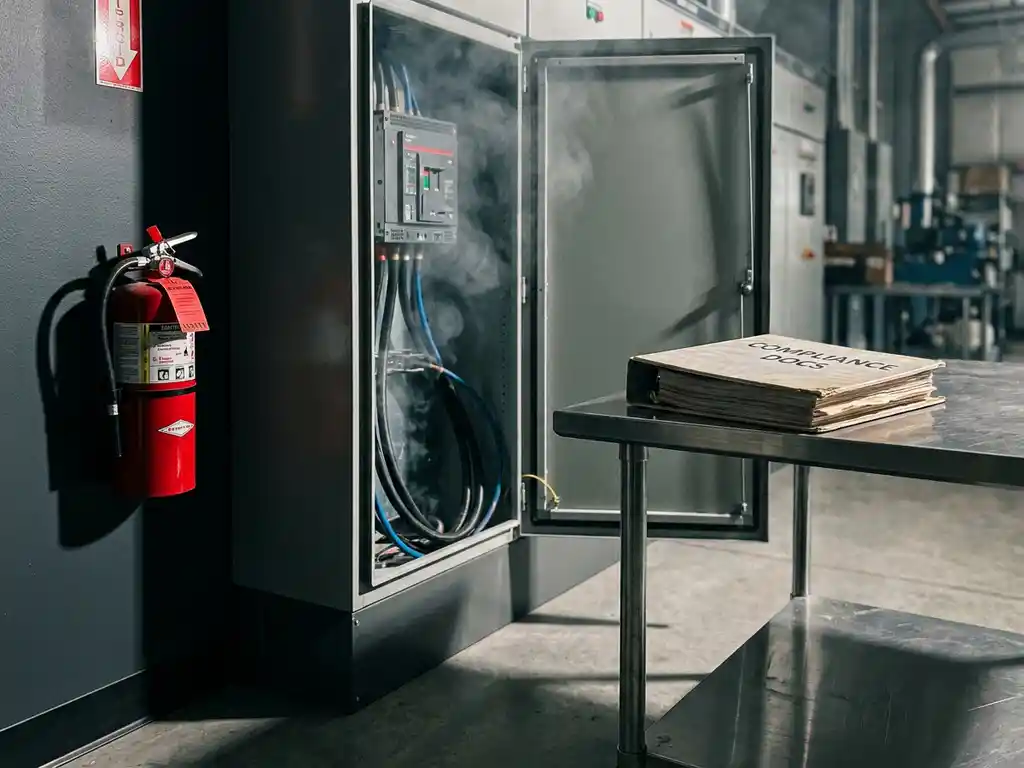
Switchgear and high-voltage electrical cabinets are among the most common sources of fire in industrial and commercial environments. Electrical faults, overloading, and poor maintenance can all trigger fires in these enclosures. Because they are often located in confined spaces and connected to broader power distribution networks, a fire in a single cabinet can escalate rapidly and affect a much larger area.
Battery Energy Storage Systems (BESS) present a growing liability concern as organizations increasingly adopt renewable energy and backup power solutions. Lithium-ion batteries carry a specific risk of thermal runaway, a self-sustaining chemical reaction that is extremely difficult to extinguish once initiated. The consequences of a BESS fire can be severe in terms of both asset loss and environmental impact.
Server racks and ICT cabinets are another high-liability category. The data and operational systems housed in these enclosures are often irreplaceable in the short term. A fire affecting server infrastructure can trigger regulatory obligations under data protection law, disrupt customer-facing services, and result in significant financial claims from affected parties.
Other high-liability asset types include:
- Telecommunications enclosures in remote or unmanned locations
- Power distribution units in manufacturing environments
- Medical equipment cabinets in healthcare facilities
- Control systems in process industries where a fire could trigger a wider incident
How do fire suppression systems limit financial and operational liability?
Fire suppression systems limit liability by containing or extinguishing a fire at its source before it spreads, dramatically reducing the scale of physical damage, operational downtime, and potential harm to people. Early suppression directly limits the financial and legal consequences a business faces after a fire event.
The financial case for suppression is straightforward. A fire that is extinguished within a server rack or electrical cabinet causes a fraction of the damage compared to one that spreads to the surrounding building. Hardware replacement, data recovery, and facility repair costs are all reduced when suppression acts quickly and precisely at the point of origin.
Operational liability is equally important. Extended downtime can breach service level agreements, trigger contractual penalties, and damage client relationships. For businesses in regulated sectors, an operational disruption caused by fire may also attract scrutiny from regulators. Suppression systems that protect critical equipment close to the fire source help organizations resume normal operations faster.
The choice of suppression agent also carries liability implications. Systems that use chemical agents can leave residues on sensitive electronics, potentially damaging equipment that the fire itself did not reach. Nitrogen-based suppression, by contrast, leaves no chemical residue, which means hardware that is not directly burned can often continue operating after an incident. This reduces both replacement costs and the secondary liability associated with collateral damage.
Does fire risk management affect business insurance premiums?
Yes, fire risk management directly affects business insurance premiums. Insurers assess the likelihood and potential severity of a fire claim when calculating premiums, and businesses with robust fire risk management practices present a lower risk profile, which typically translates into more favorable coverage terms and lower costs.
Insurers look at several factors when evaluating fire risk. These include the nature of the business and its assets, the quality of the fire risk assessment, the detection and suppression measures in place, and the maintenance history of fire safety equipment. Organizations that can demonstrate certified, well-maintained systems are generally rewarded with better terms.
Conversely, businesses without documented risk assessments or with inadequate suppression measures may face higher premiums, restricted coverage, or in some cases, difficulty obtaining insurance at all. Following a fire incident, an insurer may also investigate whether reasonable precautions were in place before agreeing to settle a claim. Poor risk management can give insurers grounds to reduce or reject a payout.
In 2026, insurers are also paying closer attention to environmental liability, particularly where fire suppression systems use PFAS-containing agents. Regulatory pressure on per- and polyfluoroalkyl substances has increased the liability exposure associated with chemical suppression systems, making PFAS-free alternatives not only an environmental choice but also a financially prudent one from an insurance standpoint.
What is the difference between fire detection and fire suppression in risk management?
Fire detection identifies the presence of fire or its early indicators, such as smoke or heat, and triggers an alert. Fire suppression actively intervenes to extinguish or contain the fire. In risk management terms, detection reduces response time while suppression reduces damage. Both are necessary, but they serve distinct functions.
Detection systems are the first line of awareness. Conventional smoke detectors respond to visible combustion products, while aspirating smoke detection systems actively draw air samples through a network of pipes, identifying smoke particles at concentrations far below what standard detectors can sense. This earlier warning gives occupants more time to evacuate and emergency services more time to respond.
Suppression systems take direct action to limit fire damage. They range from sprinkler systems designed to protect large spaces to object-level systems that target specific enclosures such as server racks or electrical cabinets. The distinction matters in risk management because suppression within a cabinet prevents a fire from ever reaching the scale where a building-wide response is needed.
The most effective risk management approach combines both. Detection without suppression relies on human or emergency service intervention, which introduces delay and uncertainty. Suppression without detection may activate too late or without adequate warning to occupants. Integrated systems that link early smoke detection directly to suppression activation close this gap, providing a faster and more reliable response than either component alone.
How ExxFire helps with fire risk management
ExxFire provides integrated fire detection and suppression systems purpose-built for the high-liability environments described throughout this article. For businesses looking to reduce fire risk at the asset level, ExxFire’s systems offer a practical, certified solution with several distinct advantages:
- Combined detection and suppression: Aspirating smoke detection is integrated directly with non-pressurized nitrogen suppression, enabling automatic response at the earliest stage of fire development
- Object-level protection: Systems are designed to protect closed enclosures such as server racks, switchgear, BESS installations, and electrical cabinets up to 4.5 m³, containing fire at its source
- PFAS-free nitrogen agent: Nitrogen leaves no chemical residue, protecting sensitive electronics from collateral damage and eliminating the environmental and insurance liability associated with chemical suppression agents
- Non-pressurized storage: The patented Cool Gas Generator produces nitrogen from a solid chemical block, removing the safety risks associated with high-pressure gas storage
- Easy installation and low maintenance: Systems are pre-engineered for self-installation without special certification, and require no ongoing maintenance once commissioned
- Fire panel integration: Built-in relays allow status reporting to existing fire panels, supporting compliance documentation and audit trails
- Tested and certified: Systems are validated by CNPP in France and DMT (TÜV Nord) in Germany, supporting insurance and regulatory requirements
For businesses that need to demonstrate fire safety compliance, protect mission-critical assets, and reduce both financial and operational liability, ExxFire’s technology addresses each of these requirements in a single, low-maintenance solution. Explore ExxFire’s systems to find out how object-level fire protection can strengthen your risk management strategy.