
What is the role of fire suppression in green building certification?
Green building certification and fire suppression are more connected than many facility managers and sustainability officers realize. Fire suppression systems – specifically the agents they use and how they are installed – can directly influence a building’s eligibility for certification credits under major frameworks such as LEED, BREEAM, and WELL. For organizations pursuing sustainable operations, understanding this relationship is increasingly important in 2026, as environmental compliance requirements tighten and PFAS-free alternatives gain regulatory momentum.
Which green building certifications include fire suppression requirements?
Several major green building certification frameworks address fire suppression either directly or through related environmental and chemical management criteria. LEED (Leadership in Energy and Environmental Design), BREEAM (Building Research Establishment Environmental Assessment Method), and the WELL Building Standard all contain provisions that reward or require the responsible selection of fire suppression agents and systems.
LEED addresses fire suppression most explicitly under its Materials and Resources and Indoor Environmental Quality categories. Projects can earn credits by avoiding halon-based and other ozone-depleting suppression agents, and by selecting systems that do not release harmful chemicals into occupied spaces. BREEAM similarly evaluates the environmental impact of installed systems, including refrigerants and suppression agents, under its Pollution category. WELL, which focuses on occupant health, penalizes systems that may release toxic residues into the air or onto surfaces where people work.
Beyond these three, regional frameworks such as DGNB in Germany and HQE in France also incorporate environmental impact assessments that touch on chemical fire suppression agents. The common thread across all frameworks is a push away from legacy chemical agents toward cleaner, inert alternatives that leave no harmful residues and pose no risk to occupants or the environment.
How does fire suppression agent choice affect certification credits?
The choice of fire suppression agent is one of the most direct ways a fire safety system can affect green building certification credits. Agents that deplete the ozone layer, contribute to global warming, or leave toxic chemical residues can actively reduce a project’s score under LEED and BREEAM. Conversely, inert gas agents that are chemically neutral and non-toxic can contribute positively to multiple credit categories.
Under LEED v4 and v4.1, projects that install fire suppression systems using halon or other ozone-depleting substances are disqualified from relevant credits. Systems using high global warming potential (GWP) chemical agents face similar scoring penalties. The framework rewards projects that either avoid suppression agents altogether in certain spaces or select agents with a GWP of zero and no ozone depletion potential.
BREEAM evaluates suppression agents under its Pol 01 (Refrigerants and Insulation) and related pollution credits. Agents classified as persistent, bioaccumulative, or toxic – a category that now includes many PFAS-containing foam and chemical suppression compounds – score poorly. Nitrogen and other inert gases, which are naturally occurring, non-toxic, and carry no GWP, align well with the intent of these credits. Selecting a PFAS-free fire suppression agent is therefore not just an environmental preference – it is a certification strategy.
What makes a fire suppression system environmentally compliant?
An environmentally compliant fire suppression system is one that suppresses fire without releasing ozone-depleting substances, high-GWP compounds, PFAS chemicals, or toxic residues that harm people, equipment, or the environment. Compliance is assessed across the agent itself, the delivery mechanism, and the long-term environmental footprint of maintaining the system.
Key criteria for environmental compliance include:
- Zero ozone depletion potential (ODP): The agent must not contain halons, HCFCs, or other ozone-depleting compounds banned under the Montreal Protocol.
- Zero or negligible global warming potential (GWP): Agents such as nitrogen have a GWP of zero, unlike many hydrofluorocarbon-based alternatives.
- PFAS-free composition: Per- and polyfluoroalkyl substances are now under strict regulatory scrutiny across the EU and beyond. Systems using PFAS-containing foams or chemical agents face increasing compliance risk.
- No toxic residue after discharge: Compliant systems should not contaminate the protected space, requiring costly decontamination or putting occupants at risk.
- Low embodied energy in production and maintenance: Systems with minimal maintenance requirements and long service intervals have a lower lifetime environmental footprint.
Inert gas suppression systems that use naturally occurring gases – nitrogen being the most common – meet all of these criteria. They suppress fire by reducing oxygen concentration rather than through chemical reaction, leaving no residue and introducing no harmful compounds into the environment.
Does fire suppression system placement matter for green certification?
Yes, where and how a fire suppression system is installed can affect green building certification outcomes. Placement influences whether suppression agents can contaminate occupied zones, how efficiently a system protects a specific asset, and whether the installation aligns with energy efficiency and material use credits.
Object-level or enclosure-level suppression – where the system is installed directly inside or immediately adjacent to the protected equipment – is generally more favorable under green building frameworks than room-level flooding systems. Room-level flooding requires larger volumes of suppression agent to fill an entire space, increasing material use, agent consumption, and the risk of agent release into occupied areas. Enclosure-level systems target only the at-risk asset, using significantly less agent and minimizing environmental exposure.
From a certification perspective, localized suppression also supports credits related to indoor air quality. When a suppression system discharges into a sealed enclosure rather than an open room, occupants are not exposed to the agent, and there is no need to evacuate or ventilate the space after activation. This matters particularly under WELL and LEED’s indoor environmental quality credits.
What’s the difference between inert gas and chemical suppression in green building contexts?
In green building contexts, the key difference between inert gas and chemical fire suppression is environmental impact. Inert gases such as nitrogen suppress fire by displacing oxygen without any chemical reaction, leaving no residue and introducing no harmful substances. Chemical suppression agents work by interrupting combustion chemistry but often leave residues, carry global warming potential, or contain regulated compounds including PFAS.
Inert gas suppression
Inert gases are naturally occurring, chemically neutral, and carry no ozone depletion potential or global warming potential. Nitrogen, for example, makes up approximately 78% of the atmosphere. When used as a suppression agent, it does not react with equipment or surfaces, leaves no residue after discharge, and poses no contamination risk to sensitive electronics. From a certification standpoint, inert gas systems align strongly with LEED, BREEAM, and WELL criteria for low-impact materials and clean indoor environments.
Chemical suppression agents
Chemical agents – including many clean agent gases marketed as halon alternatives, as well as AFFF and other foam-based systems – suppress fire through chemical interference with combustion. While effective, many carry measurable GWP values, some contain PFAS compounds now subject to EU REACH restrictions and similar regulations globally, and others leave chemical residues that require cleanup after discharge. In green building evaluations, these characteristics translate directly into scoring penalties or disqualification from specific credits.
For organizations pursuing sustainable fire suppression in mission-critical environments, the shift from chemical to inert gas systems is both an environmental and a certification-driven decision.
Can existing buildings retrofit fire suppression systems to gain green credits?
Yes, existing buildings can retrofit fire suppression systems as part of a green building certification or recertification process. Both LEED for Existing Buildings (LEED O+M) and BREEAM In-Use explicitly allow and reward improvements made to building systems – including fire suppression – as part of ongoing sustainability upgrades.
A retrofit that replaces a PFAS-containing, high-GWP, or ozone-depleting suppression system with an inert gas alternative can contribute credits under pollution, materials, and indoor environmental quality categories. The extent of the credit gain depends on the framework version, the baseline system being replaced, and the documentation provided to the certification body.
Practically, retrofitting fire suppression in an existing building is most straightforward when the new system is designed for easy installation without major structural changes. Enclosure-level systems that install directly into server racks, switchgear cabinets, or electrical enclosures are particularly well-suited to retrofit scenarios – they require no changes to the building’s existing fire infrastructure, no special installation certification, and minimal disruption to ongoing operations.
Organizations pursuing green recertification should document the environmental credentials of the replacement system – including agent composition, GWP, ODP, and PFAS-free status – as this documentation is typically required to support credit claims during the assessment process.
How ExxFire supports green building certification goals
ExxFire’s combined fire detection and suppression systems are built around nitrogen – a naturally occurring, inert gas with zero GWP, zero ODP, and no PFAS content. This makes ExxFire systems directly compatible with the environmental requirements of LEED, BREEAM, WELL, and other green building frameworks that penalize chemical and PFAS-containing suppression agents.
Key features that support green building certification outcomes include:
- PFAS-free nitrogen suppression: ExxFire’s Cool Gas Generator technology delivers nitrogen from a solid, non-pressurized state – no chemical agents, no foam, no harmful residues after discharge.
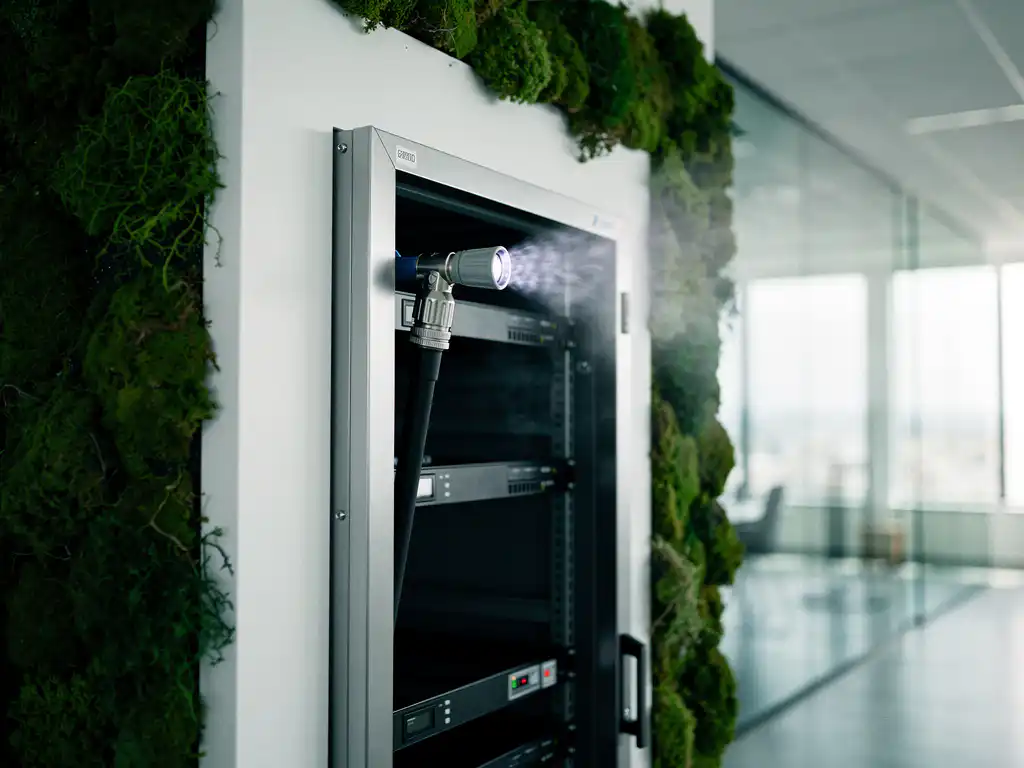
- Enclosure-level protection: Systems install directly inside server racks, switchgear cabinets, and electrical enclosures up to 4.5 m³, limiting agent use to the protected object and keeping occupied spaces clean.
- Early smoke detection integrated: Aspirating smoke detection built into each unit enables early intervention before a fire fully develops, reducing both damage and the volume of suppression agent required.
- Easy retrofit installation: Pre-engineered for self-installation without specialist certification, ExxFire systems can be added to existing buildings and equipment without structural modifications – ideal for LEED O+M and BREEAM In-Use upgrade projects.
- Low maintenance and low TCO: Minimal maintenance requirements reduce the lifetime environmental footprint of the system, supporting long-term sustainability goals.
- Certified by CNPP and TÜV Nord: Third-party testing and certification provides the documentation needed to support green building credit claims during formal assessments.
For facility managers, sustainability officers, and procurement teams working toward green building certification, ExxFire offers a fire suppression solution that meets both safety and environmental compliance requirements without compromise. Contact ExxFire to discuss how its nitrogen-based systems can support your certification goals.