
What are the most overlooked fire risks in small businesses?
Small businesses face several fire hazards that are easy to miss until they cause serious damage. Overloaded electrical systems, poorly maintained equipment, and unprotected server or ICT cabinets are among the most commonly overlooked fire risks in small businesses. These hazards are particularly dangerous because they often develop silently, inside enclosed spaces where standard smoke detectors respond too slowly. The sections below break down where these risks hide and what small business owners can do about them.
Where do most small business fires actually start?
Most small business fires start in electrical systems, kitchen areas, and storage spaces. Electrical faults are the leading cause, typically involving overloaded circuits, faulty wiring, or equipment that generates heat inside enclosed cabinets. Kitchen fires follow closely in food-related businesses, while cluttered storage areas with flammable materials round out the most common ignition points.
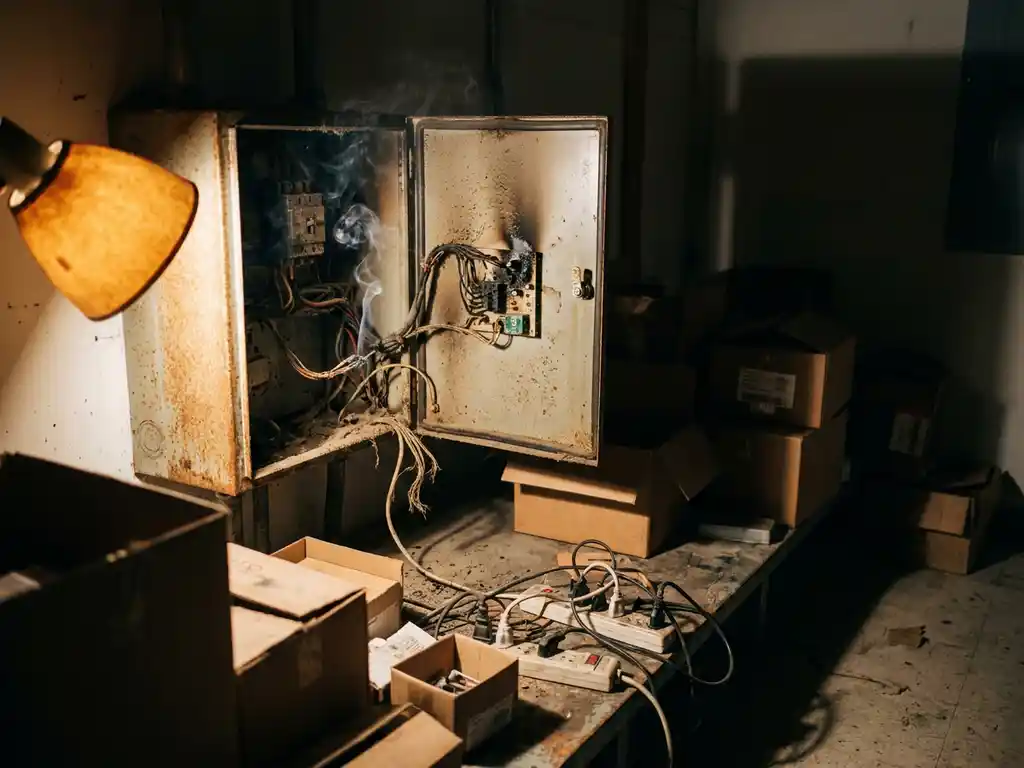
What makes electrical fires especially dangerous is that they often begin inside equipment enclosures where heat builds gradually and goes undetected. A small business may have dozens of electrical panels, switchgear units, or server racks operating continuously, and none of them may have fire detection installed at the source. By the time a ceiling-mounted smoke detector activates, the fire has already caused significant damage to the equipment inside.
Storage areas present a different kind of risk. Flammable materials stacked near heat sources, blocked ventilation, or improperly stored chemicals can ignite quickly. In small businesses where space is limited, these conditions are common simply because there is nowhere else to put things.
Why are electrical cabinets a hidden fire risk in small businesses?
Electrical cabinets are a hidden fire risk in small businesses because they concentrate heat, house high-voltage components, and are sealed from view, making it nearly impossible for standard detection systems to catch a fire before it spreads. Faults inside these cabinets can smolder for extended periods before producing enough smoke to trigger a conventional alarm.
Switchgear cabinets, power distribution units, and high-voltage enclosures are designed to contain electrical components, not to dissipate heat safely under fault conditions. When insulation degrades, connections loosen, or components fail, the result is localized heat generation inside a closed space. Without detection at the source, that heat becomes a fire.
Small businesses often assume that general building fire alarms provide adequate protection. In practice, a ceiling-mounted detector may be positioned far from the cabinet and will only activate once flames or heavy smoke escape the enclosure. At that point, the equipment inside is already destroyed, and the fire may have spread to adjacent infrastructure.
What fire risks do small businesses most commonly ignore?
The fire risks small businesses most commonly ignore are unprotected electrical enclosures, inadequate cable management, outdated fire suppression systems, and a lack of object-level protection for high-value equipment. These are risks that exist outside the typical checklist of visible hazards like blocked exits or missing extinguishers.
- Unprotected server racks and ICT cabinets: Many small businesses run critical IT infrastructure without any suppression system inside or directly attached to the cabinet itself.
- Poor cable management: Bundled or improperly routed cables generate heat and create conditions where electrical faults can escalate quickly.
- Aging electrical infrastructure: Older wiring and components that have not been inspected or replaced are a consistent source of ignition risk.
- No fire risk assessment for equipment rooms: Small businesses rarely conduct formal assessments of the fire hazards specific to their server rooms, comms rooms, or plant rooms.
- Reliance on PFAS-containing suppression systems: Some businesses still use older gas suppression systems that contain PFAS chemicals, which are increasingly restricted and pose their own environmental and health risks.
Each of these risks is easy to overlook precisely because it does not look like a fire hazard on the surface. A tidy server cabinet or a functioning electrical panel does not signal danger, yet both can become the source of a fire that destroys business-critical equipment in minutes.
How does a fire in a server room or ICT cabinet affect a small business?
A fire in a server room or ICT cabinet can shut down a small business almost immediately. Loss of servers, network equipment, or stored data disrupts operations, triggers recovery costs, and in many cases causes reputational damage that outlasts the physical repair. For small businesses without redundancy, even a brief outage can have lasting consequences.
The financial impact goes beyond replacing hardware. Downtime translates directly to lost revenue, missed client commitments, and potential contractual penalties. Recovery timelines depend on backup availability, hardware lead times, and the extent of the damage, all of which are difficult to predict and expensive to manage under pressure.
There is also the matter of data. If critical business data is stored on-site and is not fully backed up offsite or in the cloud, a fire in the server room can result in permanent data loss. For industries handling sensitive client information, this creates regulatory and legal exposure on top of the operational disruption.
Early detection and suppression at the object level, meaning inside or directly attached to the cabinet itself, is the most effective way to prevent this scenario. Stopping a fire at its source, before it spreads beyond the enclosure, is what limits damage and keeps recovery time short.
What fire suppression options exist for small business equipment?
Small businesses can choose from several fire suppression options for equipment protection, including traditional gas suppression systems, clean agent systems, and modern object-level suppression units that combine early smoke detection with targeted suppression inside the enclosure. The most appropriate option depends on the size of the space, the type of equipment, and environmental requirements.
Traditional room-level suppression systems flood an entire space with a suppression agent when a fire is detected. These systems can be effective for larger rooms but are often oversized and expensive for small business environments. They also require regular maintenance, pressure checks, and in some cases professional certification for installation.
Object-level suppression systems take a different approach. Rather than protecting a room, they protect a specific cabinet or enclosure directly. These systems use aspirating smoke detection to identify a fire at its earliest stage, often before visible flames appear, and then release a suppression agent inside the cabinet itself. This approach limits damage to the equipment at risk and avoids disrupting the rest of the facility.
For small businesses concerned about environmental compliance, PFAS-free options are increasingly available and in some jurisdictions are now the only compliant choice. Nitrogen-based systems, which use an inert gas that leaves no chemical residue, are well suited to protecting sensitive electronics without risking secondary damage from the suppression agent itself.
When should a small business upgrade its fire protection strategy?
A small business should upgrade its fire protection strategy when it adds new high-value equipment, expands its IT infrastructure, installs battery energy storage systems, or when existing suppression systems use outdated or PFAS-containing agents. Waiting for an incident to prompt a review is the most expensive approach possible.
Practical triggers for a review include:
- Installing new server racks, electrical cabinets, or switchgear without corresponding object-level protection
- Moving to a new premises where the fire safety setup has not been assessed for equipment-specific risks
- Regulatory changes that restrict or phase out certain suppression agents, including PFAS-containing gases
- A near-miss incident, such as overheating equipment or a tripped breaker that caused a temporary shutdown
- Growth in the number of employees or clients who depend on continuous system availability
In 2026, fire safety regulations across Europe and beyond are tightening, particularly around chemical suppression agents and environmental compliance. Small businesses that rely on older systems may find themselves out of compliance sooner than expected. Reviewing the fire protection strategy now, rather than reactively, reduces both risk and cost over time.
How ExxFire helps small businesses address overlooked fire risks
ExxFire provides combined fire detection and suppression systems specifically designed to protect the high-value equipment that small businesses most commonly leave unprotected. The systems are built around the following key capabilities:
- Aspirating smoke detection: Identifies smoke at the earliest possible stage, inside the cabinet, before a fire can develop
- Non-pressurized nitrogen suppression: Uses a PFAS-free inert gas that leaves no chemical residue, protecting sensitive electronics without secondary damage
- Object-level protection: Designed for server racks, electrical cabinets, and switchgear enclosures up to 4.5 m³, with multiple units interconnectable for larger volumes
- Easy self-installation: No special certification required, with built-in relays to report system status to an existing fire panel
- Maintenance-free operation: Once installed and commissioned, the system requires no further check-ups or servicing
For small businesses that cannot afford downtime, hardware replacement, or the environmental liability of outdated suppression agents, ExxFire offers a clean, certified, and cost-effective path to genuine object protection. Visit ExxFire’s website to find out which system fits your equipment and environment.