
What does fire management involve?
Fire management is the coordinated process of preventing, detecting, controlling, and suppressing fires to protect people, property, and operations. It combines risk assessment, early detection technology, suppression systems, and response planning into a unified strategy. Effective fire management goes beyond reacting to fires — it anticipates risk and eliminates it before serious damage occurs. The sections below address the most important questions about how fire management works and why it matters.
What are the key components of fire management?
Fire management consists of four core components: fire prevention, fire detection, fire suppression, and emergency response planning. Together, these elements form a layered defense that reduces both the likelihood of a fire starting and the severity of damage if one does. No single component is sufficient on its own — effective fire management requires all four to work in coordination.
Prevention focuses on eliminating ignition sources and managing fire risks through engineering controls, maintenance routines, and staff training. Detection involves continuously monitoring environments for early signs of smoke, heat, or combustion. Suppression covers the systems and agents used to extinguish or contain a fire once it is identified. Emergency response planning ensures that people know what to do, evacuation routes are clear, and fire services can be notified without delay.
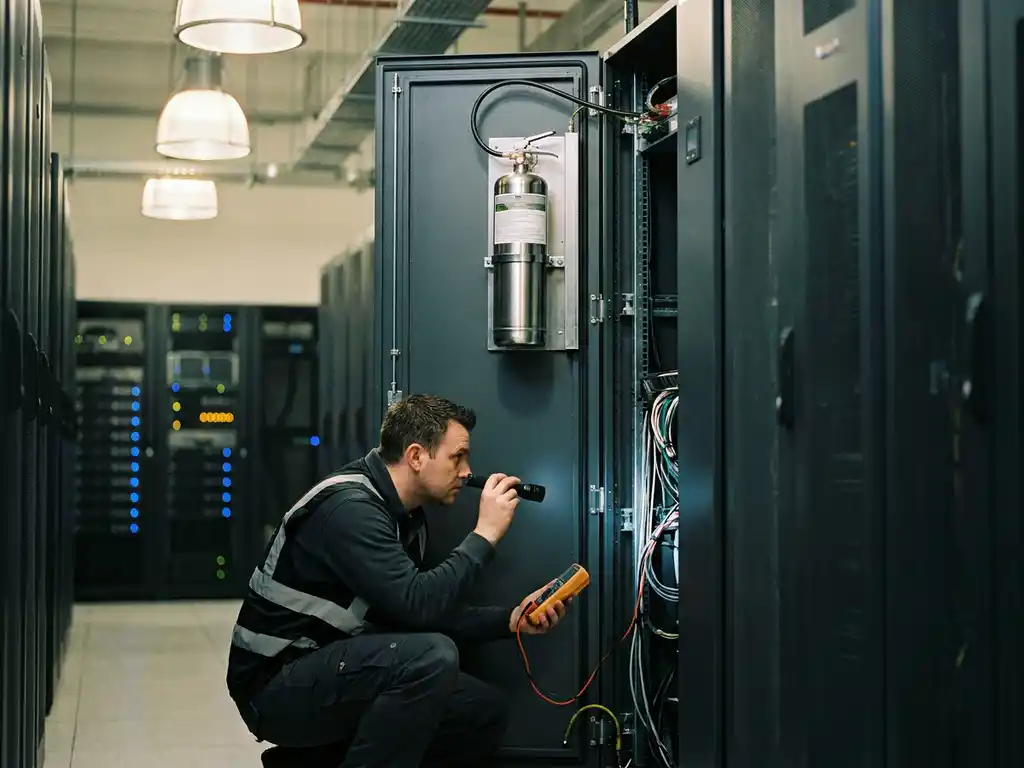
In environments protecting sensitive equipment — such as server rooms, switchgear cabinets, or battery energy storage systems — each component must be tailored to the specific risks of that environment. A generic approach rarely provides adequate protection for high-value or mission-critical assets.
What is the difference between fire prevention and fire suppression?
Fire prevention aims to stop a fire from starting, while fire suppression focuses on extinguishing or containing a fire that has already ignited. Prevention is proactive; suppression is reactive. Both are essential to a complete fire risk management strategy, but they operate at different stages of the fire lifecycle.
Prevention measures include proper electrical maintenance, safe storage of flammable materials, adequate ventilation, and regular inspection of equipment that could generate heat or sparks. In industrial and ICT environments, this also means managing cable loads, avoiding overheating in enclosed cabinets, and ensuring equipment is installed according to manufacturer specifications.
Suppression systems activate once a fire or pre-fire condition is detected. These range from sprinkler systems designed for large open spaces to object-level suppression systems built specifically for enclosed equipment. The choice of suppression agent matters significantly — water is unsuitable for electrical fires, and some chemical agents can damage sensitive electronics or leave harmful residues. Inert gas suppression, such as nitrogen-based systems, is specifically designed for environments where clean, residue-free extinguishing is required.
How does early fire detection improve fire management outcomes?
Early fire detection dramatically improves fire management outcomes by triggering suppression and response actions before a fire grows beyond the point of easy control. The earlier a fire is detected, the less damage it causes — to equipment, to structures, and to business continuity. In many cases, detection within the first seconds of smoke formation can prevent the total loss of a critical asset.
Aspirating smoke detection is one of the most sensitive technologies available. Unlike conventional point detectors that wait for smoke to reach a sensor, aspirating systems actively draw air samples from within an enclosure, identifying combustion particles at extremely low concentrations. This allows suppression to be triggered at the pre-fire stage — before flames develop.
The practical benefit is significant. A server rack or electrical cabinet that is protected with aspirating detection can be suppressed automatically at the earliest sign of thermal stress or smoldering, often before any visible fire occurs. This limits hardware damage, reduces downtime, and protects the surrounding environment from a larger fire event. In fire risk management terms, early detection is the single most effective way to reduce the gap between ignition and intervention.
What types of fire suppression systems are used in fire management?
Fire suppression systems used in fire management fall into several categories: water-based systems, gaseous suppression systems, foam systems, dry chemical systems, and object-level suppression systems. The appropriate type depends on the environment, the assets being protected, and the nature of the fire risk.
Water-based and foam systems
Sprinkler systems and water mist systems are widely used in commercial buildings and warehouses. They are cost-effective for large spaces but are unsuitable for electrical equipment, sensitive electronics, or environments where water damage would be as destructive as the fire itself. Foam systems are used primarily in industrial settings involving flammable liquids.
Gaseous and object-level suppression systems
Gaseous suppression systems use inert or chemical agents to displace oxygen or interrupt combustion chemistry within a defined space. Inert gases such as nitrogen are particularly well-suited to enclosed environments containing electronics, as they extinguish fire without leaving chemical residues. Object-level suppression systems take this a step further by targeting individual cabinets, racks, or enclosures directly — providing precise protection at the source of risk rather than flooding an entire room. These systems are increasingly preferred in ICT and server rack environments where asset value is high and contamination from suppression agents is unacceptable.
Why is fire management critical for protecting mission-critical equipment?
Fire management is critical for mission-critical equipment because even a brief fire event can cause irreversible hardware damage, extended downtime, and significant financial loss. For organizations that depend on continuous operation — data centers, energy infrastructure operators, healthcare systems, or industrial manufacturers — a fire affecting key equipment is not just a safety incident. It is a business continuity crisis.
Mission-critical environments carry specific fire risks that general building protection does not adequately address. Electrical cabinets, battery energy storage systems, and server racks generate heat, can experience thermal runaway, and often operate continuously without human supervision. A fire that starts inside a sealed enclosure may not trigger a room-level detector until it has already destroyed the equipment inside.
Object-level fire protection addresses this gap directly. By placing detection and suppression at the source — inside or immediately adjacent to the enclosure — fire management systems can intervene within seconds of a pre-fire condition. This approach limits damage to the affected unit, prevents fire spread to adjacent equipment, and allows operations to resume far more quickly than would be possible after a large-scale fire event. For organizations with high replacement costs and low tolerance for downtime, this level of fire protection is not optional — it is a fundamental operational requirement.
What regulations and standards govern fire management systems?
Fire management systems are governed by a combination of national regulations, international standards, and industry-specific certifications. These frameworks define minimum requirements for system design, installation, testing, and maintenance, and they vary by country, application type, and the nature of the assets being protected.
In Europe, fire detection and suppression systems are subject to EN standards developed by the European Committee for Standardization. EN 54 covers fire detection and fire alarm systems, while EN 15004 addresses gaseous fire suppression systems. Individual countries may layer additional national requirements on top of these standards, particularly for high-risk sectors such as energy, healthcare, and critical infrastructure.
Third-party testing and certification play an important role in demonstrating compliance and performance. Certification bodies such as CNPP in France and TÜV Nord in Germany evaluate suppression systems against defined fire scenarios and performance criteria. Systems that carry these certifications provide documented evidence of reliability — an important factor for facility managers, insurers, and procurement teams making fire safety decisions.
It is also worth noting that environmental regulations are increasingly shaping fire suppression choices. The European Union’s restrictions on PFAS substances — a class of persistent chemicals found in many traditional fire suppression agents — are driving organizations to transition toward PFAS-free alternatives. Nitrogen-based inert gas systems meet this requirement by design, as they use no fluorinated compounds and leave no chemical residues after activation.
How ExxFire supports effective fire management
ExxFire provides integrated fire detection and suppression systems specifically designed for the fire management challenges faced by operators of mission-critical equipment. Key features of ExxFire’s approach include:
- Combined detection and suppression: Aspirating smoke detection paired with non-pressurized nitrogen suppression in a single, self-contained unit
- Object-level protection: Systems designed for closed enclosures such as server racks, switchgear cabinets, and battery energy storage systems up to 4.5 m³
- PFAS-free nitrogen gas: Clean, residue-free extinguishing that causes no secondary damage to sensitive electronics or components
- Easy installation and zero maintenance: Pre-engineered for self-installation without special certification, with no ongoing maintenance requirements after commissioning
- Fire panel integration: Built-in relays allow the system to report status to an existing fire alarm panel, ensuring compatibility with wider fire safety infrastructure
- Certified performance: Tested and certified by CNPP in France and DMT, part of TÜV Nord in Germany
Whether you are protecting a single server rack or a large-scale industrial installation, ExxFire’s systems provide early intervention at the source of risk — minimizing downtime, preventing hardware loss, and supporting regulatory compliance. Contact ExxFire to discuss the right fire management solution for your environment.