

What is the difference between active and passive fire suppression?
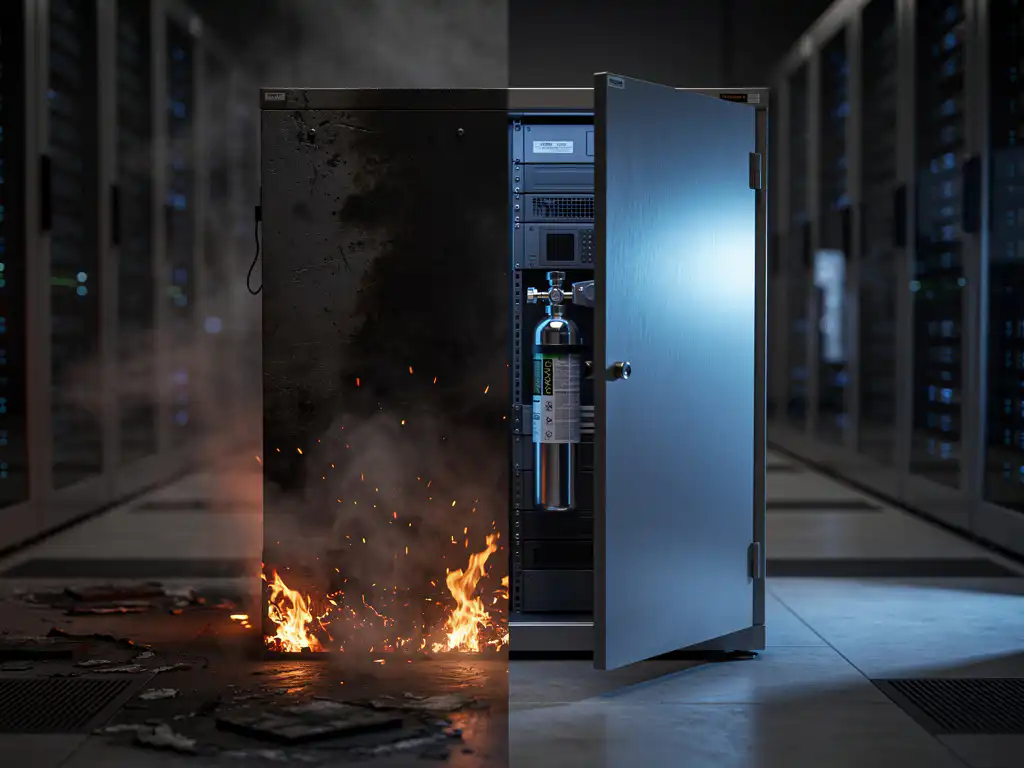
Active fire suppression and passive fire protection are two distinct but complementary approaches to fire safety. Active systems detect and respond to a fire by deploying a suppression agent, while passive systems use structural and material-based barriers to slow or contain fire spread without any triggering mechanism. For industrial facilities protecting high-value equipment, understanding both is essential to building a complete fire safety strategy.
How do active and passive fire suppression systems actually work?
Active fire suppression systems work by detecting the presence of fire or smoke and automatically deploying a suppression agent to extinguish or control the fire. Passive fire protection, by contrast, works continuously without any trigger — it relies on fire-resistant materials, structural compartmentalization, and physical barriers to limit how far a fire can spread.
The core distinction is response versus resistance. Active systems respond to an event; passive systems resist it from the moment they are installed. A sprinkler system that activates when heat is detected is active. A fire-rated wall that prevents flames from crossing into the next room is passive.
Both approaches address fire risk at different stages. Passive protection buys time by slowing fire development and keeping it contained. Active protection intervenes directly to suppress or extinguish a fire before it escalates. Together, they form the layered fire protection strategy required by most industrial safety standards.
What are examples of active fire suppression systems?
Active fire suppression systems include any technology that detects fire conditions and automatically takes action to suppress or extinguish the fire. Common examples include water sprinkler systems, gaseous suppression systems using agents such as CO2 or inert gases, foam systems, and dry chemical powder systems.
In industrial and mission-critical environments, the most relevant active suppression technologies include:
- Water-based sprinkler systems: Widely used in warehouses and manufacturing facilities, but unsuitable where water damage to electronics or sensitive equipment is a concern
- Gaseous suppression systems: Use inert gases or chemical agents to reduce oxygen levels or interrupt combustion, making them suitable for server rooms, switchgear cabinets, and electrical enclosures
- Aspirating smoke detection: An early-warning active detection method that continuously samples air to identify smoke particles well before a fire becomes visible or causes heat damage
- Foam and dry powder systems: Commonly used in oil and gas, petrochemical, and industrial settings where flammable liquids or reactive materials are present
- Integrated detection and suppression units: Pre-engineered systems that combine smoke detection with suppression in a single enclosure-level solution, designed for targeted protection of individual assets
The choice of active suppression technology depends on the nature of the hazard, the sensitivity of the protected assets, and the regulatory requirements that apply to the facility.
What are examples of passive fire protection measures?
Passive fire protection measures are built into the fabric of a building or structure and work without any activation. They include fire-resistant walls and floors, fire doors, intumescent seals, fire-rated cable coatings, and compartmentalization strategies that limit how far a fire can travel.
Key examples of passive fire protection used in industrial facilities include:
- Fire-rated compartmentalization: Dividing a building into separate fire compartments using rated walls, floors, and ceilings to contain a fire within a defined zone
- Fire doors and dampers: Self-closing or automatically triggered barriers that prevent fire and smoke from spreading through openings and ductwork
- Intumescent materials: Seals, coatings, and collars that expand when exposed to heat, closing gaps around cables, pipes, and structural penetrations
- Fire-resistant cable coatings and wraps: Applied to electrical cables and conduits to delay fire spread and maintain circuit integrity during a fire event
- Structural fire protection: Applied to steel beams and columns to maintain load-bearing capacity during a fire, preventing structural collapse
Passive measures are often invisible once installed, but they are foundational to any industrial fire safety strategy. They do not require maintenance in the same way active systems do, but they must be correctly specified, installed, and never compromised by building modifications.
Which is better for protecting high-value equipment — active or passive?
For protecting high-value equipment such as electrical cabinets, server racks, battery energy storage systems, and switchgear, active fire suppression is generally more effective than passive protection alone. Passive measures contain fire spread but cannot prevent equipment from being destroyed once a fire starts inside or immediately adjacent to an asset.
The reason is straightforward: passive protection is designed to protect people and buildings by slowing fire spread between zones. It does not intervene at the source of ignition. If a fire starts inside an electrical enclosure, a fire-rated wall around the room will not prevent that enclosure from being destroyed.
Active suppression systems, particularly those designed to protect individual enclosures, address the fire at its origin. Early smoke detection combined with targeted suppression can extinguish a fire before it causes significant hardware damage, limiting downtime and preserving business continuity. For high-value assets, the economics strongly favor active protection: the cost of suppression is typically far lower than the cost of replacing damaged equipment and recovering from operational disruption.
That said, active and passive protection are not competing choices. Passive measures protect the broader facility and provide the structural containment that supports the effectiveness of active systems.
How do fire safety standards classify active and passive protection?
Most major fire safety standards, including NFPA codes, FM Global guidelines, and European EN standards, classify fire protection into active and passive categories as distinct but complementary layers of a complete fire safety strategy. Standards typically require both to be addressed in a facility fire protection plan.
Under NFPA frameworks, active fire protection includes detection systems, suppression systems, and alarm systems — all technologies that require a trigger or activation to function. Passive fire protection covers construction elements such as fire-rated assemblies, compartmentalization, and structural fire resistance, which are evaluated through standards governing building materials and construction methods.
FM Global, which sets loss prevention standards widely followed in industrial insurance contexts, similarly distinguishes between the two and applies specific requirements to each based on occupancy type and hazard classification. ATEX directives, relevant to explosive atmospheres in oil and gas or chemical facilities, add further requirements for both detection and suppression equipment used in hazardous zones.
Fire safety compliance in industrial settings almost always requires demonstrating that both active and passive measures are in place and appropriately specified for the hazard level. Relying on passive protection alone is rarely sufficient to meet regulatory requirements for high-risk industrial occupancies.
Should industrial facilities use active suppression, passive protection, or both?
Industrial facilities should use both active suppression and passive protection. No single approach provides complete fire safety on its own. Passive protection limits fire spread and protects structural integrity; active suppression detects and extinguishes fires before they cause catastrophic damage. Together, they create a defense-in-depth strategy that meets regulatory requirements and minimizes risk.
The right balance depends on the specific hazards, asset values, and operational requirements of the facility. A practical approach involves:
- Identifying critical assets: Determine which equipment or systems, if damaged, would cause the greatest operational, financial, or safety impact
- Assessing ignition risk: Understand where fires are most likely to start — electrical faults, overheating components, flammable material storage — and specify active suppression closest to those sources
- Designing passive containment: Ensure the building structure provides adequate compartmentalization to limit fire spread between zones and protect evacuation routes
- Verifying regulatory compliance: Confirm that the combined active and passive strategy meets the applicable standards for the facility’s occupancy type and jurisdiction
- Planning for maintenance: Active systems require regular inspection and testing; passive systems must not be compromised by modifications, penetrations, or improper maintenance
For high-risk industrial environments, industry experience consistently shows that facilities with integrated active and passive strategies suffer less damage, recover faster from fire incidents, and face fewer compliance issues than those that treat fire protection as a single-layer problem.
How ExxFire helps protect high-value industrial equipment from fire
ExxFire’s integrated fire detection and suppression systems are purpose-built for the active protection of mission-critical enclosures — the exact assets where passive measures alone fall short. Each system combines aspirating smoke detection with non-pressurized nitrogen gas suppression in a single pre-engineered unit, designed to detect and extinguish a fire at the source before hardware damage occurs.
Key features that make ExxFire’s systems well-suited for industrial facilities include:
- Early smoke detection: Aspirating detection identifies smoke at the earliest possible stage, enabling suppression before a fire grows
- Clean nitrogen suppression: Non-pressurized inert nitrogen leaves no chemical residues, protecting sensitive electronics and components from secondary damage
- PFAS-free technology: A sustainable alternative to chemical suppression agents, meeting growing regulatory and environmental requirements
- Easy self-installation: Pre-engineered systems require no special certification to install and integrate with existing fire panels via built-in relays
- Tested and certified: Systems are certified by CNPP in France and tested by DMT, part of TÜV Nord, providing the documented compliance evidence that safety managers need
- Scalable protection: Units protect enclosures up to 4.5 m³ and can be interconnected for larger volumes, covering switchgear, ICT cabinets, battery energy storage systems, and high-voltage equipment
If you are specifying fire protection for critical industrial assets and need a solution that combines regulatory compliance, clean suppression, and low total cost of ownership, contact ExxFire to discuss the right configuration for your facility.
Related Articles
- How does fire risk change during hot and dry weather?
- What is the difference between a fire hazard and a fire risk?
- What is the difference between fire management and fire suppression?
- Why do regulated industries require certified fire suppression systems?
- What are the fire prevention standards for commercial buildings in 2026?