

How do inert gas systems compare to HFC-based suppression agents?
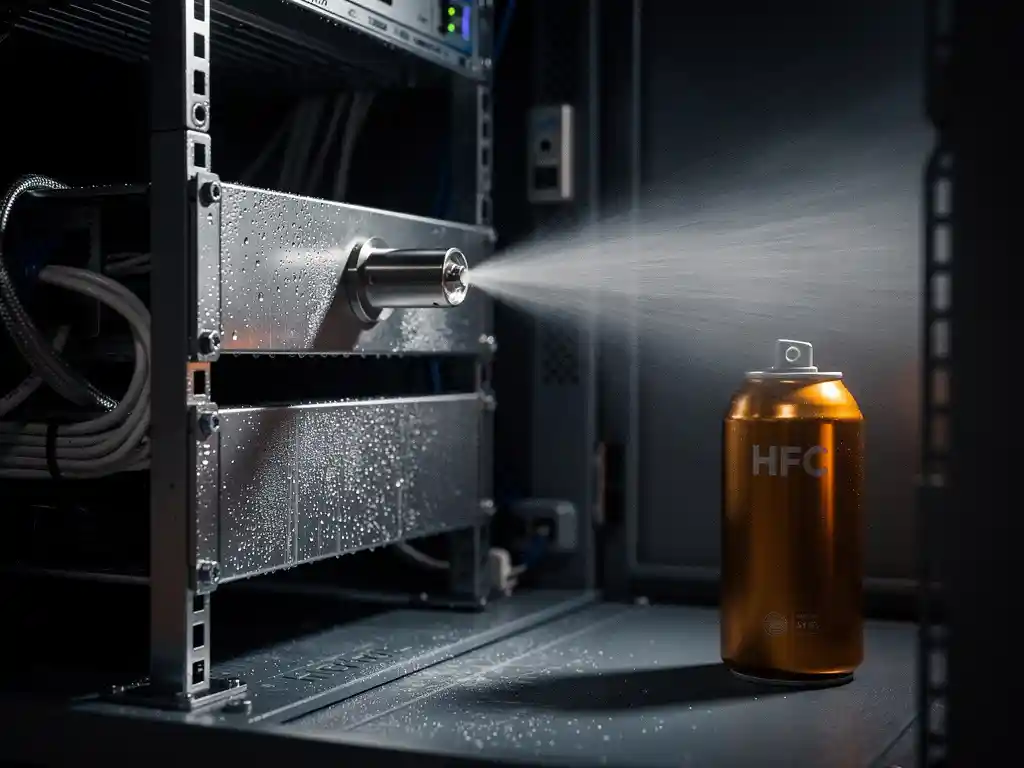
Inert gas fire suppression systems are safer and more effective than HFC-based agents for protecting sensitive electronics and mission-critical equipment. Inert gases like nitrogen suppress fire by reducing oxygen concentration without leaving chemical residues, while HFC agents work through chemical interference and can deposit harmful breakdown products on electronic components. For facilities weighing a switch, the differences in environmental impact, residue, storage, and maintenance are significant and worth examining closely.
Are inert gas systems safer for sensitive electronics than HFC agents?
Yes, inert gas fire suppression systems are significantly safer for sensitive electronics than HFC agents. Inert gases such as nitrogen suppress fire purely by lowering the oxygen level in an enclosure, leaving behind no chemical residues whatsoever. HFC agents, by contrast, suppress fire through chemical reactions and can produce acidic decomposition byproducts when exposed to heat or flame, which can corrode circuit boards, connectors, and other delicate components.
For server racks, electrical cabinets, switchgear, and battery energy storage systems, post-fire cleanup after an HFC discharge can be as damaging as the fire itself. Technicians must assess whether components have been contaminated before returning equipment to service, adding cost and downtime to an already disruptive event. With nitrogen suppression, equipment inside a protected enclosure can often be inspected and returned to operation far more quickly because there is nothing to clean up.
The risk of secondary damage is not purely theoretical. HFC agents that decompose at high temperatures release hydrogen fluoride, a highly corrosive compound. Even at low concentrations, hydrogen fluoride can degrade insulation, attack metal contacts, and render precision electronics permanently unreliable. Inert gas systems eliminate this risk entirely by using a chemically inert suppression mechanism that does not react with the materials it protects.
What are the environmental differences between inert gas and HFC suppression?
Inert gas suppression systems have a dramatically lower environmental footprint than HFC-based systems. Nitrogen and other inert gases have a Global Warming Potential (GWP) of zero, meaning their release into the atmosphere contributes nothing to climate change. HFC agents, by contrast, carry extremely high GWP values, often hundreds or thousands of times greater than carbon dioxide, making each discharge a significant greenhouse gas emission event.
Beyond global warming, HFCs belong to the broader family of fluorinated compounds, many of which are subject to increasing regulatory restrictions. In the European Union, the F-Gas Regulation has progressively tightened limits on HFC use and phase-down timelines, pushing industries toward lower-GWP alternatives. Some HFC formulations also fall under scrutiny for their relationship to PFAS, a class of persistent synthetic chemicals that accumulate in ecosystems and human tissue and do not break down naturally in the environment.
Nitrogen, on the other hand, makes up approximately 78% of the Earth’s atmosphere. When released during suppression, it simply returns to the air with no lasting environmental consequence. For organizations with sustainability commitments, regulatory compliance obligations, or ESG reporting requirements, choosing a PFAS-free fire suppression approach based on inert gas is a straightforward way to align fire safety infrastructure with broader environmental goals.
How does suppression mechanism differ between inert gas and HFC agents?
Inert gas systems suppress fire by displacing oxygen, while HFC agents suppress fire through chemical chain-breaking reactions. These are fundamentally different mechanisms, and the distinction has real consequences for how each system performs, what it protects, and what side effects it produces.
Inert gas suppression works on the principle of oxygen reduction. Combustion requires oxygen, and by flooding a protected space with an inert gas like nitrogen, the oxygen concentration drops below the threshold needed to sustain a fire, typically around 15% by volume. The fire is extinguished without any chemical reaction taking place. The gas is inert, meaning it does not react with anything in the protected environment.
HFC suppression agents work differently. They interfere with the chemical chain reactions that sustain combustion, interrupting the free radical processes in the flame. This mechanism is effective at low concentrations, which is why HFC systems can suppress fires with relatively small quantities of agent. However, when HFC molecules encounter high temperatures, they can decompose into corrosive compounds, particularly in the presence of an active flame. The suppression is chemical in nature, and the byproducts reflect that.
For enclosed object-level protection, the oxygen-reduction mechanism of inert gas is particularly well suited. In a sealed cabinet or rack, nitrogen fills the enclosed volume quickly and maintains suppression conditions as long as the enclosure remains closed, providing sustained protection rather than a single-discharge event.
Which suppression agent is better for object-level fire protection?
Inert gas is the superior choice for object-level fire protection, particularly for enclosed electrical and electronic equipment. Object-level protection means suppressing a fire at its source, within a specific enclosure such as a server rack, switchgear cabinet, or battery energy storage system, rather than flooding an entire room. For this application, nitrogen’s residue-free, chemically inert properties make it the clear front-runner.
At the object level, the goal is not just to extinguish a fire but to do so without causing collateral damage to the protected asset. HFC agents can achieve suppression, but the risk of chemical residue and decomposition byproducts makes them poorly suited for direct contact with sensitive electronics or high-value components. The cost of replacing contaminated hardware can easily exceed the cost of the fire damage itself.
Nitrogen suppression at the object level also allows for a more targeted deployment. Rather than activating a room-wide system that disrupts all operations, an object-level nitrogen system can suppress a fire within a single enclosure while adjacent equipment continues to operate normally. This precision matters enormously for facilities that cannot afford widespread downtime, such as data centers, telecommunications hubs, or energy storage installations.
What are the storage and maintenance requirements for each system type?
HFC suppression systems require pressurized cylinders that must be stored, inspected, and periodically recertified, while inert gas systems based on solid-state gas generators can be stored in a non-pressurized state, significantly reducing complexity and ongoing maintenance burden.
Traditional HFC systems store their agent in high-pressure cylinders, which introduce several operational considerations. Pressurized vessels require regular inspection to verify integrity, weight checks to confirm agent levels, and compliance with pressure vessel regulations that vary by jurisdiction. In facilities with many protected cabinets or enclosures, managing a fleet of pressurized cylinders adds meaningful administrative overhead.
Solid-state nitrogen gas generators, such as those used in advanced inert gas suppression systems, store nitrogen in a chemically stable, non-pressurized compound. There are no pressurized vessels to manage, no risk of accidental discharge during handling, and no pressure-related compliance requirements. This approach simplifies logistics, reduces the skills required for installation and maintenance, and lowers the total cost of ownership over the system’s operational life.
Both system types require periodic functional testing and smoke detector maintenance, but the absence of pressurized components in solid-state nitrogen systems removes one of the more technically demanding aspects of ongoing fire suppression system management.
When should a facility switch from HFC to an inert gas suppression system?
A facility should consider switching from HFC to an inert gas fire suppression system when regulatory pressure, environmental policy, equipment sensitivity, or maintenance complexity makes the current HFC system a liability rather than an asset. Several specific triggers make the case for transition particularly compelling.
- Regulatory compliance: If your facility operates in a jurisdiction where HFC phase-down regulations are tightening, proactive replacement avoids last-minute compliance pressure and potential penalties.
- PFAS policy commitments: Organizations with internal or external commitments to eliminate PFAS-related compounds from their operations should audit fire suppression systems as part of that effort.
- Equipment upgrades: When high-value electronics, battery storage systems, or new server infrastructure is installed, it is a natural point to upgrade fire protection to a residue-free solution that matches the sensitivity of the new assets.
- Post-incident review: If a discharge event has occurred and HFC residue caused equipment damage or extended downtime, the business case for switching becomes immediate and quantifiable.
- System end-of-life: When an existing HFC system reaches the end of its service life, replacement with an inert gas alternative avoids reinvesting in a technology with a shrinking regulatory window.
- ESG and sustainability reporting: If fire suppression infrastructure is being reviewed as part of a broader sustainability audit, HFC systems represent an identifiable improvement opportunity with measurable environmental benefit.
The transition does not need to be facility-wide or simultaneous. Object-level inert gas systems can be deployed incrementally, starting with the highest-priority enclosures and expanding over time as budgets and schedules allow.
How ExxFire protects critical equipment with inert gas suppression
ExxFire provides a purpose-built solution for facilities looking to move away from HFC agents toward a cleaner, more effective approach to inert gas fire suppression. ExxFire’s systems combine aspirating smoke detection with non-pressurized nitrogen gas suppression in a single integrated unit, designed specifically for object-level protection of closed enclosures.
- No chemical residues: Nitrogen suppression leaves behind nothing that can damage electronics, enabling faster return to operation after a suppression event.
- Non-pressurized storage: ExxFire’s patented Cool Gas Generator technology stores nitrogen in a solid, non-pressurized state, eliminating pressure vessel compliance requirements and simplifying maintenance.
- PFAS-free and zero GWP: The system contains no fluorinated compounds and releases only nitrogen, making it fully compliant with current and anticipated environmental regulations.
- Easy self-installation: Systems are pre-engineered for straightforward installation without specialist certification, reducing deployment cost and time.
- Scalable protection: Units can be interconnected to protect enclosures up to 4.5 m³ and beyond, covering everything from individual server racks to large switchgear installations.
- Certified performance: Systems are tested and certified by CNPP in France and DMT, part of TÜV Nord in Germany, providing independently verified assurance of suppression effectiveness.
If your facility is evaluating HFC alternatives or planning a fire safety upgrade in 2026, contact ExxFire to discuss which configuration best fits your enclosures, operational requirements, and compliance obligations.
Related Articles
- Are open-plan offices at higher fire risk than traditional layouts?
- How does poor electrical wiring increase fire risk?
- How do you document fire suppression compliance for an audit?
- What is the difference between fire prevention and fire protection?
- What are the differences between water mist and inert gas fire suppression?