

What should facility managers know about sustainable fire suppression?
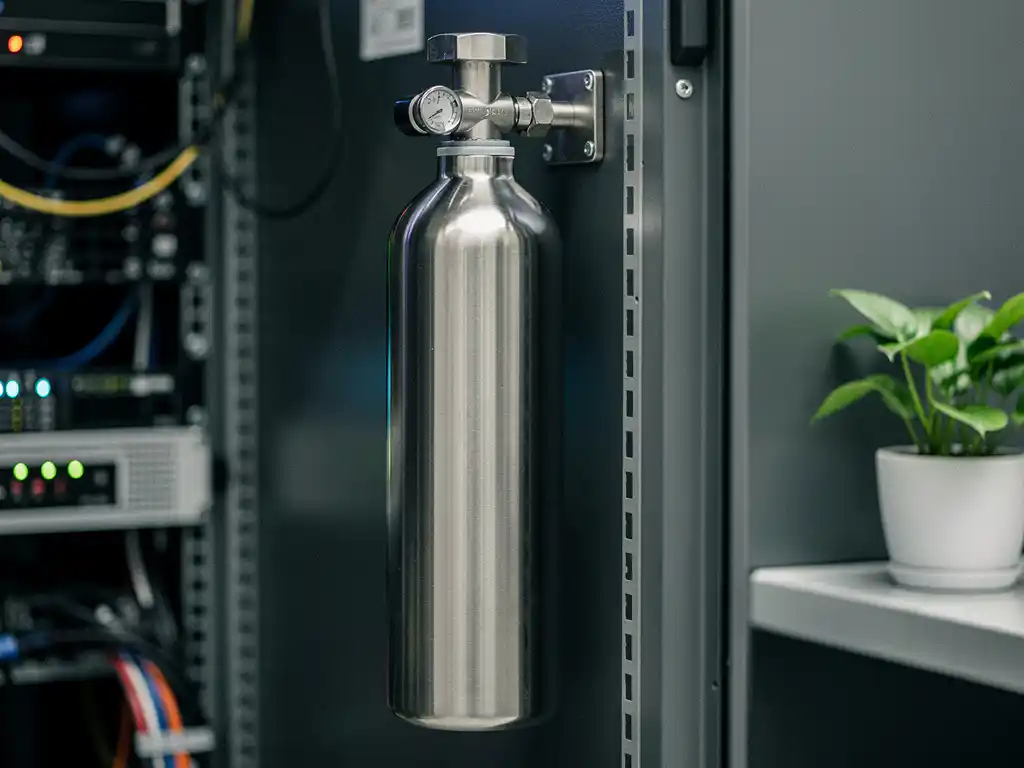
Facility managers who want truly sustainable fire suppression should prioritize systems that eliminate harmful chemical agents, minimize environmental impact, and protect sensitive equipment without causing secondary damage. The shift toward greener fire safety is no longer optional — regulatory pressure, sustainability mandates, and the true cost of chemical-based suppression are pushing organizations to rethink their approach. The questions below address the most important considerations for anyone evaluating sustainable fire suppression today.
What makes a fire suppression system truly sustainable?
A truly sustainable fire suppression system is one that suppresses fire without introducing toxic chemicals into the environment, leaves no residue that damages equipment or requires hazardous cleanup, and operates with a minimal carbon footprint across its full lifecycle. Sustainability in fire suppression covers both environmental impact and operational efficiency.
Most conventional suppression agents — including certain halon replacements and foam-based systems — leave behind chemical residues that contaminate surrounding equipment, require specialist disposal, and can persist in the environment for years. A genuinely sustainable system avoids all of these outcomes.
Key characteristics of a sustainable fire suppression system include:
- PFAS-free chemistry: No per- and polyfluoroalkyl substances that accumulate in ecosystems and human tissue
- Residue-free suppression: No cleaning or decontamination required after activation
- Non-pressurized storage: Reduced risk of accidental discharge and lower maintenance demands
- Long service life with low maintenance: Fewer replacements and lower total resource consumption over time
- Inert suppression agents: Naturally occurring gases that do not contribute to ozone depletion or global warming
Sustainability also means protecting the equipment being suppressed. A system that extinguishes a fire but destroys sensitive electronics in the process is not truly efficient — it simply trades one form of damage for another.
What are PFAS chemicals and why are they a problem in fire suppression?
PFAS — per- and polyfluoroalkyl substances — are a large group of synthetic chemicals used in many industrial applications, including certain fire suppression agents. They are a problem because they do not break down naturally in the environment, accumulate in living organisms over time, and are increasingly linked to serious health and ecological risks.
In fire suppression, PFAS have historically been used in aqueous film-forming foam (AFFF) and certain gaseous agents. Their effectiveness at smothering fires made them widely adopted, but the environmental consequences have prompted significant regulatory action across Europe, North America, and beyond.
For facility managers, the PFAS problem has several concrete dimensions:
- Regulatory risk: Bans and restrictions on PFAS-containing suppression agents are expanding. Organizations using these systems face potential compliance liabilities as regulations tighten.
- Contamination liability: PFAS discharge can contaminate soil, groundwater, and drainage systems, creating cleanup obligations and potential legal exposure.
- Reputational exposure: Organizations with strong sustainability commitments face scrutiny if their fire safety infrastructure relies on substances classified as persistent pollutants.
- Disposal costs: Decommissioning PFAS-containing systems requires specialist handling, adding to total lifecycle costs.
Switching to a PFAS-free fire suppression solution is not only an environmental decision — it is increasingly a sound risk management decision for any organization managing long-term operational and compliance exposure.
How does nitrogen-based fire suppression work compared to chemical agents?
Nitrogen-based fire suppression works by reducing the oxygen concentration within a protected enclosure to a level that cannot sustain combustion, without introducing any chemical agents. Unlike chemical suppression systems, nitrogen leaves no residue, causes no secondary damage to electronics, and poses no toxicological risk to the environment.
Nitrogen is an inert gas that makes up approximately 78% of the air we breathe. When released into a closed enclosure such as a server rack, switchgear cabinet, or battery storage unit, it displaces enough oxygen to extinguish or prevent fire while remaining entirely harmless to the equipment inside.
How nitrogen suppression differs from chemical agents
Chemical agents such as HFCs, HFOs, and certain synthetic gases suppress fire through heat absorption or chemical chain-breaking reactions. While effective, many leave trace residues, carry global warming potential, or fall under tightening environmental regulations. Some require specialist disposal at end of life.
Nitrogen suppression, by contrast, uses a naturally occurring, abundantly available gas. There is no chemical reaction with equipment surfaces, no residue to clean up, and no environmental contamination risk. After activation, the enclosure can often be restored to service faster because no decontamination is needed.
The role of non-pressurized storage
Traditional gas suppression systems store agents under high pressure, which introduces installation complexity, maintenance requirements, and the risk of accidental discharge. Nitrogen-based systems built around solid-state gas generators store the nitrogen in a non-pressurized form, releasing it only when triggered by detection. This significantly reduces both the installation footprint and the ongoing maintenance burden — an important consideration for facility managers balancing safety with operational efficiency.
Which types of equipment benefit most from sustainable fire suppression?
The equipment that benefits most from sustainable fire suppression is high-value, sensitive electronics and mission-critical infrastructure where both fire damage and suppression residue can cause catastrophic loss. This includes server racks, ICT cabinets, switchgear, high-voltage enclosures, and Battery Energy Storage Systems (BESS).
These asset types share several characteristics that make them particularly well-suited to clean, residue-free suppression:
- Server racks and ICT cabinets: Electronic components are highly sensitive to moisture, chemical residue, and temperature shock. Conventional suppression methods can destroy the very equipment they are meant to protect.
- Switchgear and high-voltage cabinets: Electrical faults in these enclosures can escalate rapidly. Localized suppression at the source prevents fire from spreading to adjacent infrastructure.
- Battery Energy Storage Systems: BESS installations present unique fire risks due to thermal runaway in lithium-ion cells. Early detection paired with clean suppression at the object level is critical to preventing cascading failures.
- Telecom enclosures and control rooms: Continuous uptime is non-negotiable in these environments. Suppression systems that avoid equipment damage directly support operational continuity.
In all of these cases, the goal is not just to stop a fire — it is to stop a fire without creating a second wave of damage through the suppression agent itself.
What should facility managers evaluate when switching to a greener suppression system?
When switching to a greener fire suppression system, facility managers should evaluate the suppression agent’s environmental profile, the system’s certification credentials, compatibility with existing fire safety infrastructure, ease of installation, and total cost of ownership over the system’s full lifecycle.
A structured evaluation should cover the following areas:
- Agent classification: Confirm the system is PFAS-free and uses an agent with no ozone depletion potential and no significant global warming potential. Request documentation.
- Third-party certification: Look for systems tested and certified by recognized independent bodies. Certifications from organizations such as CNPP (France) or TÜV Nord provide verified performance evidence rather than manufacturer claims alone.
- Compatibility with existing fire panels: A suppression system that integrates with your current fire alarm infrastructure reduces installation complexity and avoids redundant investment. Systems with built-in relay outputs simplify this integration.
- Installation requirements: Assess whether specialist contractors are required or whether the system is designed for straightforward self-installation. Simpler installation translates directly into lower upfront costs.
- Maintenance demands: Evaluate the frequency and cost of inspections, agent replacement, and component servicing. Lower-maintenance systems reduce long-term TCO significantly.
- Scalability: Confirm the system can protect enclosures of varying sizes and that units can be interconnected to cover larger volumes as your infrastructure grows.
Facility managers should also consider the regulatory trajectory in their operating regions. Choosing a system already compliant with emerging PFAS restrictions protects the organization from future retrofit costs.
How do sustainable fire suppression systems support business continuity?
Sustainable fire suppression systems support business continuity by detecting fire at the earliest possible stage, suppressing it at the source before it can spread, and doing so without causing secondary damage to the protected equipment. This means faster recovery, lower replacement costs, and shorter downtime compared to conventional suppression approaches.
Business continuity in fire safety depends on three interconnected factors: speed of detection, precision of suppression, and the condition of equipment after activation. Sustainable systems built around early smoke detection and clean inert gas suppression address all three.
Early detection — typically through aspirating smoke detection technology — identifies a developing fire before it reaches a destructive stage. Suppression at the object level, rather than flooding an entire room, means only the affected enclosure is treated. And because inert gas suppression leaves no residue, the surrounding hardware remains undamaged and operational.
For organizations where downtime carries significant financial or operational consequences, this combination directly limits exposure. Hardware does not need to be replaced, data is not lost to fire damage, and the facility can return to normal operations far more quickly than after a conventional suppression event that requires cleanup, decontamination, and equipment assessment.
How ExxFire supports sustainable fire suppression for facility managers
ExxFire provides facility managers with a complete, certified solution for sustainable fire suppression that addresses every dimension covered in this article. The ExxFire system combines aspirating smoke detection with non-pressurized nitrogen gas suppression in a single integrated unit, built around the patented Cool Gas Generator technology originally developed for the European Space Agency.
Key features that make ExxFire the right choice for facility managers switching to greener fire safety include:
- Completely PFAS-free: Nitrogen suppression with no chemical residues, no contamination risk, and full compliance with tightening environmental regulations
- Non-pressurized storage: Safer to install, easier to maintain, and free from the risks associated with high-pressure gas systems
- Pre-engineered for self-installation: No specialist certification required, reducing installation costs and simplifying deployment across multiple sites
- Compatible with existing fire panels: Built-in relay outputs allow seamless integration with your current fire alarm infrastructure
- Independently certified: Tested and validated by CNPP France and DMT (part of TÜV Nord), providing verified performance evidence
- Scalable protection: Designed for closed enclosures up to 4.5 m³, with units interconnectable to protect larger volumes
ExxFire systems are installed in over 500 locations worldwide, protecting mission-critical equipment for organizations including Novartis, Siemens, and the European Space Operations Centre. If you are ready to replace outdated or PFAS-containing suppression systems with a clean, certified, and low-maintenance alternative, contact ExxFire to discuss the right solution for your facility.
Related Articles
- What are the fire risks linked to dust accumulation in industrial settings?
- How does fire management support water catchment protection?
- Can a single suppression system meet both EN54 and NFPA standards?
- What certifications should a fire suppression system have in 2026?
- How does fire suppression certification affect equipment insurance coverage?