

What is the difference between fire prevention and fire safety?
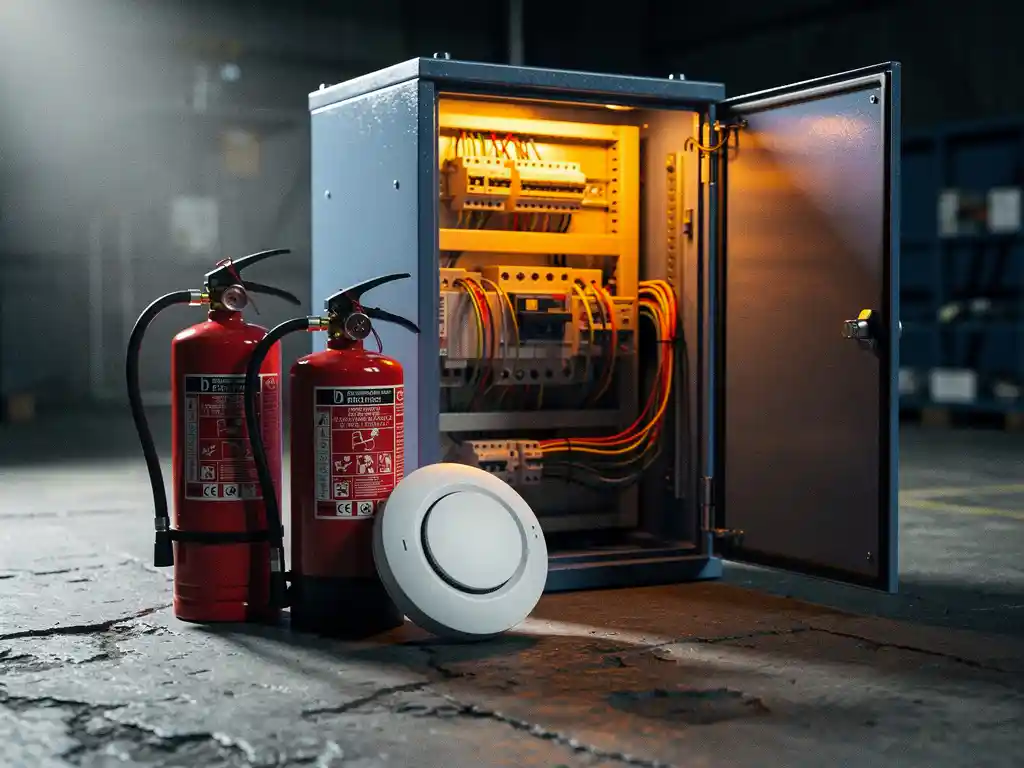
Fire prevention and fire safety are related but distinct concepts. Fire prevention focuses on stopping fires from starting in the first place, while fire safety is the broader discipline that includes prevention, detection, suppression, evacuation, and the protection of people and assets. Understanding both is essential for anyone responsible for protecting a workplace, facility, or critical infrastructure.
The distinction matters most in high-risk environments where equipment failure, electrical faults, or energy storage systems create fire hazards that cannot always be eliminated through prevention alone. This article unpacks each concept, explains how they work together, and identifies which approach best suits environments where downtime and equipment damage are unacceptable.
What does fire prevention actually involve?
Fire prevention refers to the set of measures taken to eliminate or reduce the conditions that allow a fire to start. It is the proactive side of fire safety, focused on hazard identification, risk reduction, and controlling ignition sources before any fire occurs.
In practice, fire prevention involves a structured approach to managing the three elements that combine to create fire: heat, fuel, and oxygen. Remove or control any one of these, and the risk of ignition drops significantly. Common fire prevention activities include:
- Regular inspection and maintenance of electrical systems, wiring, and switchgear
- Proper storage and handling of flammable materials
- Enforcing no-smoking policies and controlling ignition sources
- Training staff to recognize and report fire hazards
- Conducting formal fire risk assessments to identify vulnerabilities
Fire prevention is largely a management and behavioral discipline. It relies on human vigilance, procedural compliance, and systematic maintenance. While it is a foundational element of any workplace fire safety program, it cannot guarantee that a fire will never occur.
What is included in fire safety beyond prevention?
Fire safety is the complete framework for managing fire risk across its entire lifecycle, from prevention through response and recovery. Beyond prevention, fire safety includes fire detection, suppression, structural containment, evacuation planning, and post-incident recovery procedures.
Where fire prevention asks “how do we stop a fire from starting?”, fire safety asks “what do we do at every stage, including if a fire starts anyway?” This broader scope is what separates a comprehensive fire safety strategy from a basic prevention-only approach.
The key components of a full fire safety framework include:
- Detection systems: Smoke detectors, heat sensors, and aspirating detection technology that identify fire at the earliest possible stage
- Suppression systems: Automatic extinguishing mechanisms that respond to a detected fire without human intervention
- Passive fire protection: Structural measures such as fire-rated walls, doors, and compartmentalization that contain fire spread
- Evacuation procedures: Plans, drills, and signage that ensure occupants can exit safely
- Emergency response planning: Defined roles, communication protocols, and coordination with fire services
Workplace fire safety regulations in most countries require organizations to address all of these components, not just prevention. A fire risk assessment is typically the starting point for building a compliant and effective fire safety plan.
How do fire detection and suppression fit into fire safety?
Fire detection and suppression are the reactive layers of fire safety, designed to minimize harm once a fire has started or is beginning to develop. Detection identifies the presence of smoke or heat as early as possible, while suppression acts to extinguish or control the fire before it can cause serious damage.
Together, these two functions form the active core of any fire safety system. Early detection is critical because fire development is exponential. A fire detected at the smoldering stage, before open flames develop, can often be suppressed with minimal damage. A fire detected after it has spread may be beyond the reach of localized suppression and will require a full emergency response.
Modern detection technology ranges from standard point detectors to aspirating smoke detection systems that continuously sample air and can identify combustion particles at extremely low concentrations. This level of sensitivity is particularly valuable in environments such as server rooms, electrical cabinets, and battery storage systems, where a slow-developing fault can produce smoke long before flames appear.
Suppression systems respond to a confirmed detection event by releasing an extinguishing agent directly at the source. The choice of agent matters significantly. Water-based systems are unsuitable for electrical environments. Certain gas-based systems have historically relied on substances now classified as PFAS, which carry serious environmental and regulatory concerns. Inert gas suppression using nitrogen offers a clean, residue-free alternative that protects sensitive electronics without causing secondary damage.
Why is fire prevention alone not enough for critical equipment?
Fire prevention alone is not sufficient to protect critical equipment because many fire causes in technical environments are inherent to the equipment itself and cannot be fully eliminated through preventive measures. Electrical faults, component degradation, thermal runaway in battery systems, and manufacturing defects can all trigger fires regardless of how well prevention protocols are followed.
In environments such as data centers, switchgear rooms, and battery energy storage installations, the equipment itself is the hazard. Lithium-ion batteries can undergo thermal runaway due to internal cell failure, a process that no external prevention measure can reliably stop. Similarly, aging electrical insulation or a transient voltage spike can create an arc fault inside a sealed cabinet with no visible warning signs.
The consequences of relying solely on prevention in these environments are severe:
- Undetected fires can destroy hardware worth hundreds of thousands of euros before any alarm is triggered
- Business-critical systems go offline, causing operational disruption and financial loss
- Recovery and re-installation costs far exceed the cost of a suppression system
- In some cases, a fire in one cabinet can spread to adjacent infrastructure, compounding the damage
This is why organizations operating critical infrastructure treat fire detection and suppression as essential, not optional. Prevention reduces risk; suppression limits consequences when that risk materializes.
What is the difference between active and passive fire protection?
Active fire protection refers to systems that require action or activation to respond to a fire, including detection systems, suppression systems, sprinklers, and fire extinguishers. Passive fire protection refers to structural and building elements that contain or slow the spread of fire without any activation, such as fire-rated walls, floors, doors, and seals.
The distinction is important because both types serve different but complementary roles within a fire safety strategy.
Active fire protection intervenes in the fire event itself. It detects, alerts, and suppresses. Its effectiveness depends on correct installation, regular maintenance, and reliable activation when needed. Active systems are the primary line of defense for protecting specific equipment or zones.
Passive fire protection works continuously without any trigger. A fire-rated door does not need to be activated; it simply resists heat and flame by design. Passive measures are built into the structure of a building and are intended to buy time, limit spread, and protect evacuation routes.
In a well-designed fire safety plan, passive protection contains the fire at a structural level while active protection addresses it at the source. Neither replaces the other. A building with excellent passive compartmentalization but no detection or suppression will still suffer significant equipment loss. A building with advanced suppression but poor compartmentalization may see fire spread beyond the suppressed zone.
Which fire safety approach best protects high-value assets?
The fire safety approach that best protects high-value assets combines early-stage detection directly at the asset with targeted suppression at the point of origin. This means placing detection and suppression capability inside or immediately adjacent to the equipment being protected, rather than relying solely on room-level or building-level systems.
Room-level suppression systems, such as total flooding gas systems, are designed to protect a space. Object-level suppression systems are designed to protect a specific piece of equipment. For high-value assets such as server racks, electrical switchgear, or battery storage units, object-level protection offers several critical advantages:
- Suppression is delivered directly at the fire source, reducing damage to the protected equipment
- Adjacent equipment and infrastructure are not affected by the suppression agent
- Response time is faster because detection and suppression are co-located with the hazard
- The system can activate without triggering a full facility evacuation or shutdown
The choice of suppression agent is equally important. For sensitive electronics, the agent must be electrically non-conductive, leave no residue, and cause no secondary damage. Inert gases such as nitrogen meet all of these criteria and carry no PFAS-related environmental liability, making them the preferred choice for organizations with sustainability commitments or regulatory exposure.
How ExxFire protects high-value assets against fire
ExxFire provides integrated fire detection and suppression systems purpose-built for the object-level protection approach described above. Each system combines aspirating smoke detection with nitrogen-based suppression delivered through ExxFire’s patented Cool Gas Generator technology, all within a single pre-engineered unit designed for closed enclosures such as server racks, electrical cabinets, and battery storage systems.
Key features of ExxFire’s approach include:
- Early smoke detection: Aspirating detection identifies combustion particles at the pre-fire stage, before open flames develop
- Clean nitrogen suppression: Non-pressurized nitrogen gas leaves no chemical residue and causes no damage to sensitive electronics or components
- PFAS-free: ExxFire systems contain no PFAS substances, meeting the highest environmental and regulatory standards in 2026
- Easy installation: Pre-engineered systems require no special certification to install and integrate with existing fire panels via built-in relays
- Scalable protection: Units protect enclosures up to 4.5 m³ and can be interconnected to cover larger volumes
- Certified performance: Systems are tested and certified by CNPP in France and DMT, part of TÜV Nord in Germany
ExxFire systems are in active use across more than 40 countries, protecting mission-critical infrastructure for organizations including Novartis, Siemens, and the European Space Operations Centre. If you are responsible for protecting high-value equipment and want to understand which solution fits your environment, contact ExxFire to speak with a specialist.
Related Articles
- What is the purpose of a fire suppression system?
- What is the difference between inert gas and chemical suppression agents?
- How do PFAS restrictions impact fire protection planning in 2026?
- How do you choose a sustainable fire suppression system?
- How does inert gas suppress fire without damaging the environment?