

What are the leading causes of workplace fires?
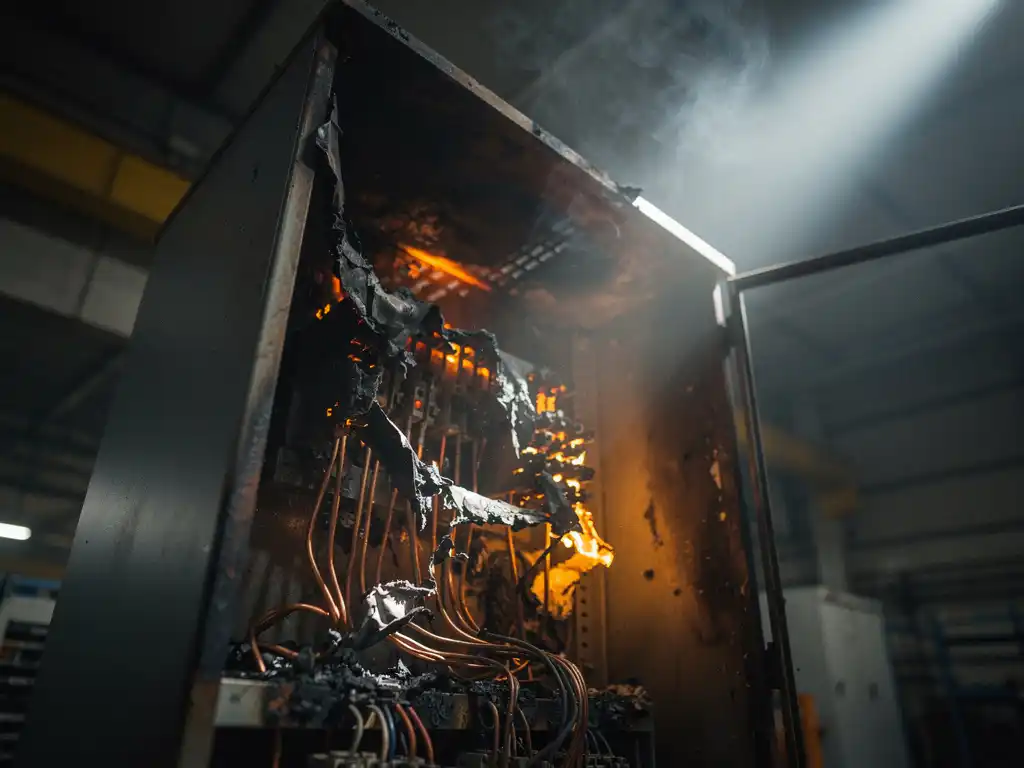
Workplace fires are most commonly caused by electrical faults, equipment failure, and human error. These three categories account for the vast majority of fire incidents in commercial and industrial environments. Understanding the specific hazards behind each cause is the first step toward preventing them. The sections below break down the most common fire risks at work and what businesses can do to address them.
What types of equipment are most likely to start a workplace fire?
The equipment most likely to start a workplace fire includes electrical switchgear, server racks, battery storage systems, industrial machinery, and heating appliances. Any device that generates heat, draws significant electrical current, or stores large amounts of energy carries an inherent fire risk, particularly when it operates continuously or without adequate monitoring.
Electrical cabinets and switchgear are among the most common ignition points in commercial buildings. These enclosures house high-voltage components that can arc, short-circuit, or overheat, especially as they age or when connections become loose. In data centers and ICT environments, server racks and networking equipment generate substantial heat and can ignite if cooling systems fail or airflow is obstructed.
Industrial machinery with moving parts is another significant source of workplace fires. Friction, mechanical failure, and the presence of flammable lubricants or dust create conditions where a fire can start quickly and spread before staff are even aware of it. Heating equipment, including boilers, furnaces, and portable heaters, rounds out the list of high-risk assets in most workplaces.
How do electrical faults cause fires in commercial buildings?
Electrical faults cause fires in commercial buildings when excess current, damaged insulation, or poor connections generate enough heat to ignite surrounding materials. The most common electrical fire causes are short circuits, overloaded circuits, faulty wiring, and loose or corroded connections that produce arcing. These faults can smolder undetected inside enclosed panels for extended periods before breaking into open flame.
Overloading is particularly common in older buildings where the original electrical infrastructure was not designed to support modern equipment loads. When too many high-draw devices share a single circuit, the wiring heats up beyond safe operating temperatures. Without a thermal cutoff or circuit breaker that responds quickly enough, this can result in insulation melting and ignition.
Arcing faults are especially dangerous because they can occur inside sealed enclosures, out of sight of staff and conventional smoke detectors. An arc generates temperatures far exceeding what most materials can withstand, and the resulting fire can become well-established before any external signs appear. This is why fire hazards at work within enclosed electrical equipment are considered among the hardest to detect early using standard methods.
What role does human error play in workplace fire incidents?
Human error is a contributing factor in a significant proportion of workplace fire incidents. The most common forms include improper storage of flammable materials, failure to follow safe working procedures, incorrect equipment installation, and neglecting routine maintenance. In many cases, fires caused by human error are preventable with better training, clearer procedures, and more consistent oversight.
Maintenance failures are a particularly important category. When electrical connections are not inspected regularly, when filters are not cleaned, or when warning signs of overheating are ignored, the likelihood of a fire increases substantially. Facilities that rely on aging equipment without scheduled servicing face a compounding risk over time.
Improper use of heating equipment, leaving devices running unattended, and storing combustible materials near heat sources are also frequent contributors to common workplace fires. In environments with high staff turnover or limited fire safety training, these behaviors can become normalized, making the risk harder to manage at an organizational level.
Why are battery energy storage systems a growing fire risk?
Battery energy storage systems (BESS) are a growing fire risk because lithium-ion batteries can undergo a process called thermal runaway, in which a single failing cell generates heat that cascades through adjacent cells, rapidly escalating into a fire that is extremely difficult to extinguish. As BESS installations grow in scale and number, driven by the energy transition, this fire hazard at work has become a serious concern for facility managers and safety officers.
Thermal runaway can be triggered by overcharging, physical damage, manufacturing defects, or exposure to high ambient temperatures. What makes it particularly dangerous is the speed at which it develops and the intensity of the resulting fire. Standard suppression methods are often ineffective because the chemical reaction generating heat occurs inside the battery cell itself.
The risk is compounded by the fact that BESS installations are frequently housed in enclosed cabinets or containers, which can concentrate heat and combustion gases rapidly. Early detection is critical in these environments, as intervening at the smoke stage, before open flame develops, offers the best chance of preventing catastrophic damage. The growing deployment of large-scale battery systems in commercial and industrial settings makes this one of the most important emerging causes of workplace fires in 2026.
Which industries have the highest workplace fire risk?
The industries with the highest workplace fire risk include manufacturing, energy and utilities, data centers and telecommunications, healthcare, and logistics and warehousing. These sectors share common characteristics: high concentrations of electrical equipment, significant energy loads, the presence of flammable materials, and operations that run continuously with limited opportunity for shutdown and inspection.
Manufacturing environments face elevated risk due to the combination of industrial machinery, flammable substances, and combustible dust. A spark from a machine or a static discharge in the presence of fine particulates can ignite rapidly. Logistics and warehousing operations, particularly those storing lithium-ion battery products or flammable goods, also carry substantial risk.
Data centers and telecommunications infrastructure represent a growing category of fire risk, not because they involve open flames or combustibles in the traditional sense, but because they operate dense concentrations of electrical equipment around the clock. The consequences of a fire in these environments extend well beyond physical damage, encompassing data loss, service disruption, and significant financial liability. For industries where fire safety at work directly intersects with business continuity, the stakes are especially high.
How can businesses reduce the risk of a workplace fire starting?
Businesses can reduce the risk of a workplace fire by conducting regular fire risk assessments, maintaining electrical equipment on a scheduled basis, training staff in fire prevention behaviors, and installing fire detection systems appropriate to the specific hazards present. Workplace fire prevention is most effective when it combines physical safeguards with procedural controls and staff awareness.
Key preventive measures include:
- Regular electrical inspections: Identifying loose connections, degraded insulation, and overloaded circuits before they become ignition sources.
- Scheduled equipment maintenance: Servicing machinery, cleaning filters, and replacing aging components to prevent heat buildup and mechanical failure.
- Proper storage of flammable materials: Keeping combustibles away from heat sources and in designated, clearly marked storage areas.
- Staff fire safety training: Ensuring all personnel understand the fire hazards specific to their work environment and know how to respond.
- Early detection systems: Installing smoke detection inside enclosed equipment where fires are most likely to start, not just in open room spaces.
- Suppression at the source: Protecting high-risk enclosures with suppression systems that can act before a fire spreads beyond its origin point.
For enclosed equipment such as electrical cabinets, server racks, and battery systems, room-level detection is often insufficient. By the time smoke reaches a ceiling-mounted detector, a fire inside a cabinet may already have caused significant damage. Directing detection and suppression capability to the equipment itself, rather than the surrounding space, is a more effective approach to fire prevention at work.
How ExxFire helps protect businesses against workplace fire causes
ExxFire’s combined fire detection and suppression systems are designed specifically to address the causes of workplace fires at their most dangerous point: inside enclosed, high-value equipment. Rather than waiting for a fire to spread into open space, ExxFire’s systems act at the earliest sign of smoke, directly inside the enclosure where the fire originates.
Key features of ExxFire’s approach include:
- Aspirating smoke detection: Continuously samples air from inside the protected enclosure, detecting smoke at a stage when suppression can still prevent significant damage.
- Non-pressurized nitrogen suppression: The patented Cool Gas Generator technology releases inert nitrogen gas to extinguish the fire without leaving chemical residues, protecting sensitive electronics and avoiding secondary damage.
- PFAS-free and environmentally responsible: A clean alternative to legacy suppression agents, supporting sustainability and regulatory compliance.
- Easy self-installation: Pre-engineered systems require no special certification to install, reducing deployment time and cost.
- Integration with existing fire panels: Built-in relays allow the system to report status to an existing fire safety infrastructure without requiring a full system replacement.
- Certified performance: Tested and validated by CNPP in France and DMT/TÜV Nord in Germany, providing assurance that the system performs as specified under real fire conditions.
Whether protecting switchgear cabinets, ICT enclosures, or battery energy storage systems, ExxFire’s technology addresses the specific fire risks that matter most to businesses that cannot afford downtime or equipment loss. Contact ExxFire to discuss how its systems can be applied to your specific environment and risk profile.
Related Articles
- What is the difference between suppression and extinguishing in fire safety?
- What is the difference between a fire alarm system and a suppression system?
- Why is fire safety certification important for industrial equipment?
- How do you conduct a fire hazard inspection at home?
- How does fire suppression system design affect environmental performance?