

How do you prevent fires caused by overloaded power strips?
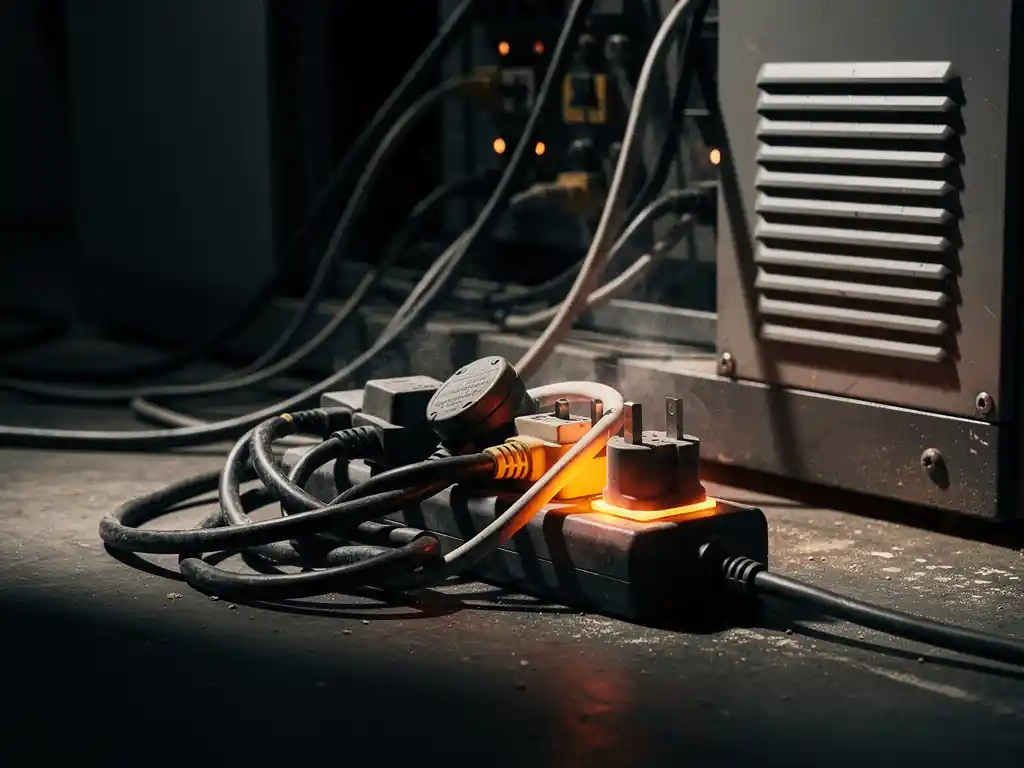
To prevent fires caused by overloaded power strips, avoid plugging high-wattage appliances into them, stay within the strip’s rated amperage, and replace any strip that shows signs of heat, discoloration, or damage. Overloaded power strips are one of the most common causes of electrical fires in both office and industrial environments, yet the risk is easy to manage with the right habits and equipment choices.
The sections below address the most important questions about power strip fire hazards, from recognizing the warning signs of overload to choosing the right fire protection for environments where electrical equipment is mission-critical.
What makes a power strip catch fire?
A power strip catches fire when the total electrical load connected to it exceeds its rated capacity, causing the internal wiring to overheat. This excess heat can melt insulation, ignite surrounding materials, or trigger an arc fault. Most power strip fires result from sustained overloading rather than a single sudden event, meaning the risk builds gradually and often goes unnoticed until damage has already begun.
Several factors contribute to this hazard. Power strips are rated for a maximum current draw, typically expressed in amperes. When multiple devices collectively pull more current than the strip is designed to handle, resistance in the wiring generates heat. If that heat cannot dissipate quickly enough, the strip’s plastic housing and internal components become a fuel source.
Daisy-chaining, which means plugging one power strip into another, compounds the problem significantly. This practice multiplies the load on a single outlet and is a leading cause of electrical fire prevention failures in office and server environments. Age and physical damage also increase fire risk. Frayed cords, loose sockets, and worn insulation all reduce a strip’s ability to safely carry current.
How do you know if a power strip is overloaded?
A power strip is likely overloaded if it feels warm or hot to the touch, if the connected devices flicker or lose power intermittently, or if the circuit breaker trips repeatedly. These are physical indicators that the strip is drawing more current than it can safely handle. A burning smell near the strip is a serious warning sign that should prompt immediate action.
To assess the load more precisely, add up the wattage of every device plugged into the strip and compare that total to the strip’s rated capacity. Most standard power strips handle between 1,500 and 1,800 watts. If the combined load approaches or exceeds that figure, the strip is operating at an unsafe level.
Beyond wattage, pay attention to the following warning signs:
- The strip or plug feels noticeably warm after short periods of use
- Outlets on the strip are discolored or show scorch marks
- Devices connected to the strip run inconsistently or restart unexpectedly
- The strip’s indicator light (if present) flickers or goes dark
- There is a faint burning or plastic smell near the strip
Any of these signs should be treated as a power strip fire hazard requiring immediate attention. Unplug the strip, redistribute the load, and inspect the strip before using it again.
What devices should never be plugged into a power strip?
High-wattage appliances should never be plugged into a power strip. This includes space heaters, refrigerators, microwaves, washing machines, air conditioners, and other devices that draw sustained high current. These appliances are designed to be connected directly to a wall outlet, which is built to handle the load safely over extended periods.
The reason is straightforward: power strips are designed for low-to-medium draw devices such as computers, monitors, lamps, and phone chargers. High-draw appliances push the strip’s wiring to or beyond its thermal limit, even if the strip has a built-in surge protector. A surge protector guards against voltage spikes, not sustained overcurrent.
In professional and industrial settings, the same principle applies to electrical cabinets, server infrastructure, and battery systems. Connecting high-load equipment through intermediate distribution points without proper current management creates the same overloaded outlet risk at a larger scale. In these environments, dedicated circuits and properly rated distribution units are the correct approach.
How do you safely manage power distribution for multiple devices?
To safely manage power distribution for multiple devices, calculate the combined load before connecting anything, use power strips or PDUs rated for that load, and connect high-draw appliances directly to dedicated wall outlets. Distributing the load across multiple circuits rather than concentrating it on a single strip or outlet is the most effective way to reduce power strip fire risk.
In home and small office settings, the following practices form the foundation of power strip safety:
- Know your ratings: Check the amperage and wattage rating printed on the power strip and compare it to the combined draw of connected devices.
- Use one strip per outlet: Never daisy-chain power strips. Each strip should connect directly to a wall outlet.
- Separate high-draw devices: Plug appliances like printers, monitors, and desktop computers into separate outlets rather than grouping them on a single strip.
- Choose strips with overload protection: Look for strips that include a thermal fuse or automatic shutoff, which cuts power if the load becomes unsafe.
- Inspect regularly: Check cords and sockets for wear, heat discoloration, or physical damage at least every few months.
In larger environments such as data centers, industrial facilities, or buildings with multiple electrical cabinets, power distribution requires a more systematic approach. Dedicated Power Distribution Units (PDUs) with monitoring capabilities, proper circuit labeling, and load balancing across phases are standard practice for electrical fire prevention at scale.
What fire suppression options exist for electrical cabinet and ICT environments?
In electrical cabinet and ICT environments, the most effective fire suppression options are systems that detect smoke at the earliest possible stage and suppress the fire directly at the source before it spreads. These include clean agent suppression systems, inert gas systems, and integrated detection-suppression units designed specifically for enclosed equipment. The goal is to extinguish a fire without damaging sensitive electronics or leaving chemical residue.
Traditional room-level suppression systems are not well suited to protecting individual cabinets or server racks. By the time a room-level system activates, the equipment inside an enclosure may already be severely damaged. Object-level protection, installed directly within the cabinet, responds far faster and limits the scope of damage.
Key considerations when evaluating suppression options for these environments include:
- Agent type: Clean agents and inert gases such as nitrogen leave no residue and do not harm electronics, making them preferable to water-based or chemical powder systems
- Detection speed: Aspirating smoke detection, which actively draws air samples, identifies combustion particles far earlier than standard point detectors
- Enclosure compatibility: The system must be sized and sealed appropriately for the cabinet volume to achieve an effective suppression concentration
- Regulatory compliance: In 2026, environmental regulations increasingly restrict PFAS-containing agents, making PFAS-free inert gas solutions the compliance-aligned choice
- Integration with existing infrastructure: Systems that report to a central fire panel via relay allow facility managers to monitor status without replacing existing alarm infrastructure
How ExxFire helps protect against electrical fire hazards
ExxFire’s integrated fire detection and suppression systems are purpose-built for exactly the environments where overloaded power strips and electrical fire hazards pose the greatest risk: server racks, ICT cabinets, switchgear enclosures, and similar closed equipment environments. The systems combine aspirating smoke detection with non-pressurized nitrogen gas suppression, delivering early warning and automatic suppression before a small electrical event becomes a large-scale fire.
Key features that make ExxFire systems particularly suited to these environments include:
- PFAS-free nitrogen suppression: Nitrogen is an inert, clean agent that leaves no chemical residue and causes no secondary damage to sensitive electronics
- Non-pressurized storage: The patented Cool Gas Generator technology stores nitrogen in a solid, non-pressurized state, eliminating the safety and maintenance concerns associated with pressurized cylinders
- Early smoke detection: Aspirating detection identifies combustion particles at the pre-fire stage, enabling suppression before flames develop
- Easy self-installation: Systems are pre-engineered for straightforward installation without specialist certification, reducing deployment cost and complexity
- Fire panel integration: Built-in relays allow the system to communicate with existing fire alarm infrastructure, supporting seamless integration into broader ICT cabinet fire protection strategies
- Tested and certified: Systems are validated by CNPP in France and DMT, part of TÜV Nord in Germany, providing confidence in performance and compliance
If you manage environments where electrical equipment failure or fire would mean costly downtime, hardware loss, or regulatory exposure, contact ExxFire to discuss the right protection solution for your specific setup.
Related Articles
- How does fire management reduce wildfire risk?
- When should you upgrade your fire suppression system to meet new standards?
- How do you achieve EN54 compliance for an electrical enclosure?
- What is the role of heat detection in early fire prevention?
- What is the future of fire suppression technology in a low-carbon economy?