
How do you choose a compliant fire suppression system in 2026?
Choosing a compliant fire suppression system in 2026 means selecting a solution that meets the applicable fire safety standards for your industry and hazard type, uses approved suppression agents, and has been independently tested and certified. The right system depends on your specific risk environment, the assets you are protecting, and the regulatory frameworks that govern your facility. The questions below unpack each decision point in detail.
What fire safety regulations govern suppression system selection in 2026?
Fire suppression system selection is governed by a combination of international standards, regional legislation, and industry-specific codes. The most widely referenced frameworks include NFPA 12 (carbon dioxide systems), NFPA 2001 (clean agent systems), and NFPA 750 (water mist systems) from the National Fire Protection Association, alongside FM Global property loss prevention standards and the European EN 15004 series for gaseous suppression systems.
In 2026, regulatory pressure has intensified in two key areas. First, the European Union’s restrictions on per- and polyfluoroalkyl substances (PFAS) under the REACH regulation are reshaping which suppression agents are legally permissible. Second, the IEC 62305 and ATEX directives continue to set the baseline for explosion-risk environments across manufacturing, oil and gas, and chemical processing facilities.
Compliance is not simply about choosing a system that was certified at the time of installation. Regulations evolve, and facilities operating under FM Global or insurer mandates may face additional requirements beyond statutory minimums. Safety and compliance managers should audit their suppression infrastructure against current standards annually, not only at the point of procurement.
What types of fire suppression systems are used in industrial settings?
Industrial fire suppression systems fall into five main categories, each suited to different hazard types and asset configurations. Understanding the distinctions is the first step toward compliant fire suppression system selection.
- Gaseous suppression systems: Use inert gases or chemical agents (such as FM-200 or Novec 1230) to displace oxygen or interrupt the combustion chain. Common in data centres, control rooms, and electrical equipment enclosures.
- Water-based systems: Include sprinklers, deluge systems, and water mist. Widely used across general industrial facilities, warehouses, and process areas where water damage is acceptable.
- Foam systems: Applied in flammable liquid storage, aircraft hangars, and fuel loading areas where hydrocarbon fires are the primary risk.
- Dry chemical and dry powder systems: Used for fast knockdown of flammable liquid and gas fires, particularly in outdoor or harsh environments.
- Nitrogen-based inert gas systems: Reduce oxygen concentration within a protected enclosure to a level that suppresses combustion without harming sensitive electronics or leaving chemical residue.
Many modern industrial environments combine more than one system type. A manufacturing facility might use sprinklers for general floor protection while deploying a dedicated gaseous or nitrogen-based system inside high-value electrical cabinets or battery storage units.
How do you match a suppression system to your specific hazard class?
Matching a suppression system to a hazard class requires identifying the fire risk category of the materials and processes involved, then selecting a suppression mechanism that is both effective against that fuel type and compatible with the assets being protected. The key variables are the nature of the fuel (solid, liquid, gas, or energised electrical), the enclosure type, and the acceptable level of collateral damage.
Hazard classification typically follows frameworks such as the NFPA hazard occupancy categories or the European EN 2 fire class system, which distinguishes between Class A (ordinary combustibles), Class B (flammable liquids), Class C (energised electrical equipment), and Class D (combustible metals). Each class points toward a compatible suppression agent.
For facilities protecting energised electrical equipment, such as switchgear, battery energy storage systems (BESS), or high-voltage cabinets, the suppression agent must be electrically non-conductive and must not cause secondary damage to sensitive components. Inert gas and nitrogen-based systems are particularly well suited here because they suppress fire without leaving residue or conducting electricity.
Facilities in ATEX zones face additional constraints. Any detection or suppression equipment installed in potentially explosive atmospheres must carry appropriate ATEX certification, and the system design must account for the ignition energy thresholds of the gases or dusts present. Consulting the applicable ATEX category for your zone classification before specifying any equipment is not optional – it is a legal requirement across the EU and a best-practice standard elsewhere.
What’s the difference between object protection and room flooding suppression?
Object protection targets suppression directly at a specific piece of equipment or enclosed asset, while room flooding fills an entire space with suppression agent to extinguish a fire anywhere within that volume. The choice between them depends on where the highest risk is concentrated and what level of collateral exposure is acceptable.
Object protection is designed for scenarios where the fire risk originates inside or immediately adjacent to a defined enclosure, such as a server rack, electrical cabinet, or battery module. Suppression is delivered at the source, which means faster response, lower agent consumption, and minimal impact on the surrounding environment. This approach is particularly effective when the protected asset is high-value, sensitive to water or chemical agents, and located within a larger space that does not itself need suppression.
Room flooding fills the entire protected volume with suppression agent, typically an inert gas or clean chemical agent, reducing oxygen concentration throughout the space to a level that prevents combustion. This approach suits enclosed rooms such as server rooms, archive vaults, or control rooms where fire could originate from multiple points and the entire room volume needs to be protected simultaneously.
A critical practical difference is system complexity and cost. Room flooding systems require detailed volume calculations, door sealing assessments, and pressure relief mechanisms to ensure agent retention. Object protection systems are generally simpler to install and maintain, and they can be deployed without modifying the surrounding room infrastructure.
Why are PFAS-containing suppression agents being phased out?
PFAS-containing suppression agents, including aqueous film-forming foam (AFFF) and certain fluorinated clean agents, are being phased out because they are persistent environmental contaminants linked to serious health and ecological risks. PFAS compounds do not break down naturally in the environment, accumulate in living organisms, and have been associated with adverse health outcomes in both human and animal studies.
In the European Union, the universal PFAS restriction under REACH is progressively eliminating the use of fluorinated substances across industrial applications, including fire suppression. Several member states have already banned AFFF in training exercises and are moving toward full prohibition in fixed systems. The United States Environmental Protection Agency has similarly tightened oversight, and many insurers and facility operators are proactively removing PFAS-based agents from their risk management programmes ahead of mandatory deadlines.
For industrial safety managers, the phase-out creates a direct procurement obligation: any new suppression system specified in 2026 should use a PFAS-free suppression agent to avoid future non-compliance, remediation liability, and reputational exposure. Inert gases such as nitrogen, argon, and CO2 are inherently PFAS-free and represent the most straightforward compliant alternative for enclosed equipment protection. When evaluating replacement options, confirm that the proposed agent has no fluorinated components and that the supplier can provide documentation supporting regulatory compliance in your jurisdiction.
What certification and testing criteria should a compliant system meet?
A compliant fire suppression system should carry third-party certification from a recognised testing body confirming that the system performs as claimed under standardised fire conditions. Certification is not the same as self-declaration – it requires independent evaluation of detection sensitivity, suppression effectiveness, agent concentration, and system integrity under realistic fire scenarios.
Key certifications and standards to look for include:
- CNPP (Centre National de Prévention et de Protection), France: Widely recognised for testing gaseous and combined fire detection and suppression systems, particularly for enclosed equipment protection.
- TÜV Nord / DMT, Germany: Provides rigorous independent testing for industrial fire suppression and detection equipment, with particular authority in European markets.
- UL (Underwriters Laboratories): The primary certification body for North American markets, covering both detection and suppression components.
- FM Approvals: Required by many insurers and facility operators globally; FM-approved systems meet stringent property loss prevention criteria.
- CE marking and EN standards compliance: Mandatory for systems sold within the European Economic Area.
- ATEX certification: Required for any equipment deployed in potentially explosive atmospheres within the EU.
Beyond the certification label itself, ask suppliers for the full test reports, not just the certificate. Test reports reveal the specific fire scenarios evaluated, the agent concentrations achieved, and the detection response times recorded. A system certified for one enclosure volume or fuel type may not be certified for your specific application, so verifying the scope of certification against your actual use case is essential before committing to a specification.
Maintenance and inspection requirements are also part of compliance. Many standards, including NFPA 2001 and EN 15004, specify inspection intervals, agent quantity checks, and functional testing schedules. A system that was compliant at installation can fall out of compliance if maintenance obligations are not met, creating both safety and regulatory risk.
How ExxFire supports compliant fire suppression system selection
ExxFire’s integrated fire detection and suppression systems are purpose-built to address the compliance, performance, and environmental requirements that industrial safety managers face in 2026. The systems combine aspirating smoke detection with non-pressurized nitrogen gas suppression, delivering early fire detection and clean suppression within a single pre-engineered unit.
Key features that support compliance and specification confidence include:
- PFAS-free suppression: Nitrogen is an inert gas with no fluorinated components, making ExxFire systems fully compliant with current and anticipated PFAS restrictions under EU REACH and equivalent frameworks.
- Independent certification: Systems are tested and certified by CNPP in France and DMT (part of TÜV Nord) in Germany, providing documented third-party validation of detection and suppression performance.
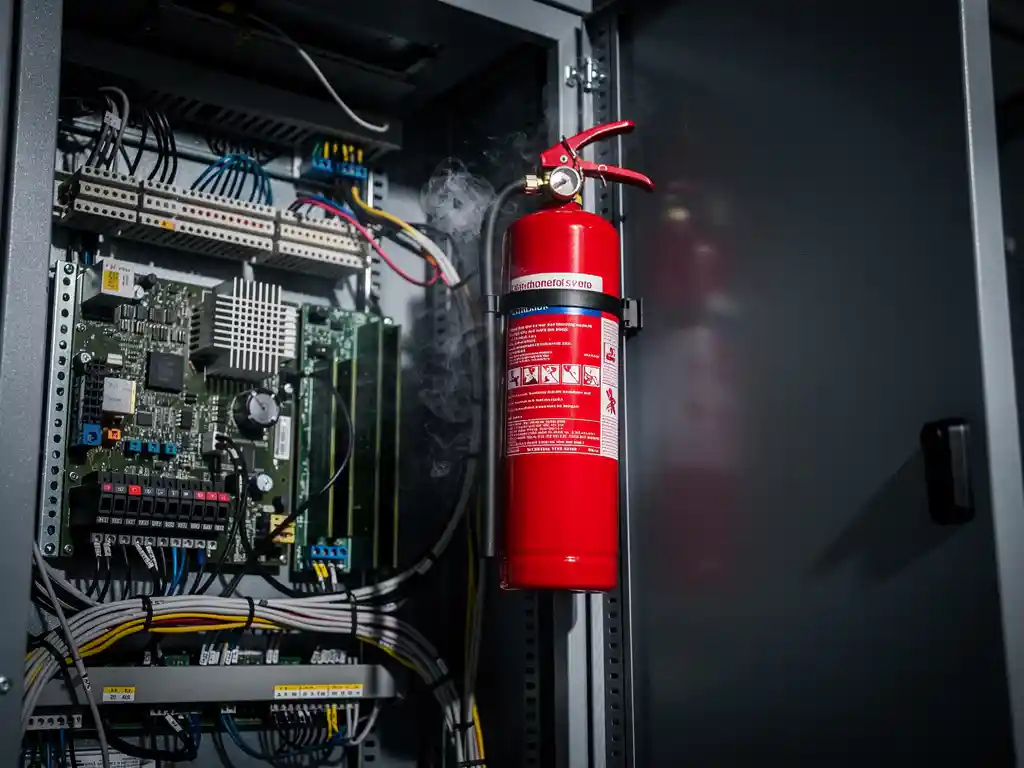
- Object protection design: Systems are designed for closed enclosures up to 4.5 m³, with multiple units interconnectable for larger volumes, making them directly applicable to switchgear, electrical cabinets, ICT enclosures, and BESS fire protection.
- No residue, no secondary damage: Nitrogen leaves no chemical residue, protecting sensitive electronics and eliminating post-suppression remediation costs.
- Simple installation and low TCO: Pre-engineered for self-installation without special certification, with built-in relays for integration with existing fire alarm panels.
If you are specifying a fire suppression system for electrical cabinets, battery storage, or other mission-critical enclosures and need a solution that meets current fire suppression standards without PFAS exposure or complex installation requirements, contact ExxFire to discuss your application and receive technical documentation.