

What are the IEC standards for fire detection in electrical enclosures?
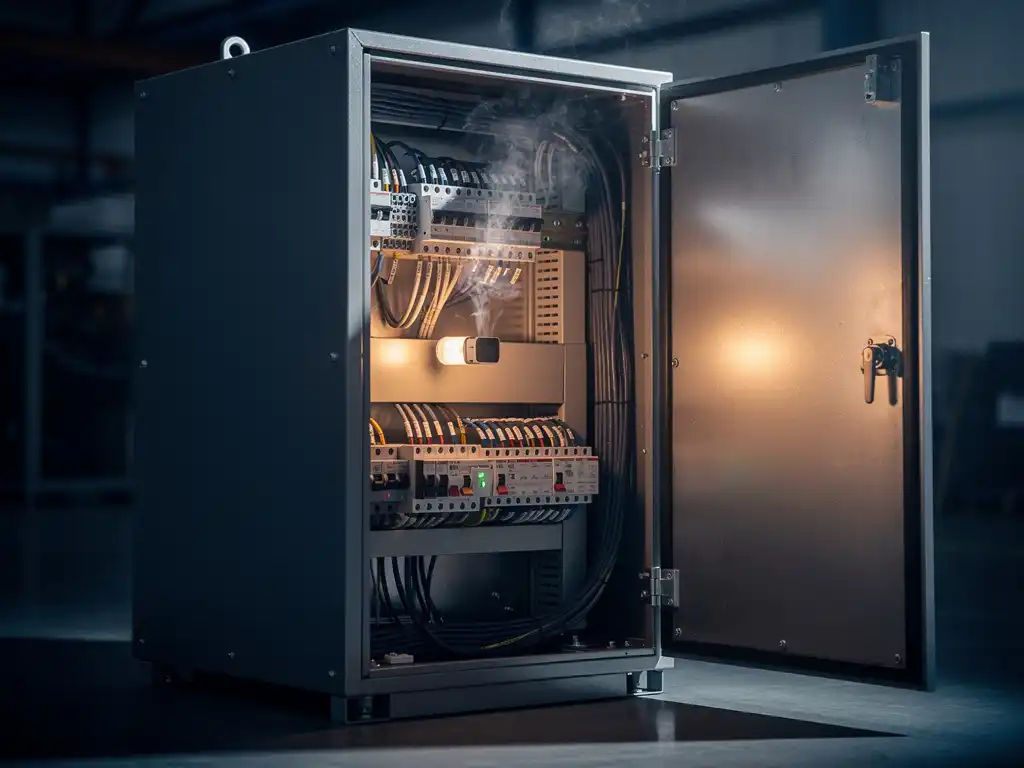
Electrical enclosures used in industrial environments must comply with a range of IEC standards for fire detection, depending on the equipment type, installation context, and hazard classification. The most relevant standards include IEC 62368-1 for audio/video and IT equipment, IEC 60079 for hazardous area enclosures, and IEC 60529, which governs ingress protection ratings that directly affect detector placement. Understanding how these standards interact is essential for safety and compliance managers specifying fire detection solutions for switchgear, electrical cabinets, and battery systems.
Which IEC standards apply specifically to electrical enclosures?
Several IEC standards apply to fire detection in electrical enclosures, with the most relevant being IEC 62368-1 (audio/video, IT, and communication equipment), IEC 60079 (equipment in explosive atmospheres), IEC 60529 (ingress protection), and IEC 60670 (enclosures for household and similar wiring accessories). The applicable standard depends on the enclosure type, the equipment it houses, and the environment in which it operates.
For industrial applications, safety managers typically need to consider multiple standards simultaneously. A high-voltage electrical cabinet in a petrochemical plant, for example, may need to satisfy both IEC 60079 requirements for hazardous area classification and the broader fire safety requirements embedded in equipment-specific standards. IEC 60529 is particularly relevant when selecting detection technology, because the ingress protection rating of an enclosure determines which sensor types can be physically installed inside it without compromising the enclosure’s rated performance.
It is also worth noting that IEC standards are developed by the International Electrotechnical Commission and serve as the global baseline. Regional bodies such as CENELEC in Europe frequently adopt these as EN standards with minor modifications, which is why the same standard may appear under both an IEC and EN designation depending on the jurisdiction.
How does IEC 62368-1 address fire hazards in electrical equipment?
IEC 62368-1 addresses fire hazards by classifying energy sources within electrical and electronic equipment and establishing safeguards to prevent those energy sources from igniting combustible materials. The standard introduces a hazard-based safety engineering (HBSE) approach, replacing the older prescriptive rules of IEC 60950-1 and IEC 60065 with a framework that focuses on the cause, transfer, and effect of energy.
Under IEC 62368-1, fire hazards are managed through a layered safeguard model. The standard identifies three classes of energy source severity and requires that appropriate safeguards be in place to protect both users and bystanders. From a fire detection perspective, the standard’s requirements for thermal management, component spacing, and material flammability ratings all influence the likelihood of an ignition event occurring inside an enclosure.
For compliance managers, the practical implication is that equipment certified to IEC 62368-1 has already been designed with fire risk reduction in mind at the component level. However, this does not eliminate the need for active fire detection at the enclosure or installation level, particularly in environments where multiple cabinets are co-located or where the consequences of a fire event extend beyond the equipment itself.
What is the difference between IEC and EN fire detection standards?
IEC standards are international standards published by the International Electrotechnical Commission, while EN standards are European Norms adopted by CENELEC, the European Committee for Electrotechnical Standardization. In most cases, an EN standard is a direct adoption of the corresponding IEC standard, sometimes with country-specific annexes or deviations noted as “A-deviations” or “Special National Conditions.”
For fire detection specifically, the EN 54 series governs fire detection and fire alarm systems in Europe and has no direct IEC equivalent at the same level of specificity. EN 54 covers everything from control panels and smoke detectors to aspirating smoke detection systems. When specifying fire detection for electrical enclosures in Europe, EN 54 compliance is often a regulatory requirement, whereas IEC standards address the electrical equipment inside the enclosure rather than the detection system itself.
Outside Europe, IEC standards carry more direct authority, and national bodies in countries such as Australia, South Korea, and Brazil typically adopt IEC publications with minimal modification. In the United States, NFPA and UL standards take precedence, though IEC standards are increasingly referenced in international procurement specifications. A compliance manager working across multiple jurisdictions should map each installation site to the applicable regional adoption of the relevant IEC baseline.
Does IEC 60079 cover fire detection in hazardous area enclosures?
IEC 60079 covers the design, construction, and testing of electrical equipment intended for use in explosive atmospheres, but it does not directly specify fire detection requirements. Instead, it establishes protection concepts such as flameproof enclosures (Ex d), increased safety (Ex e), and intrinsic safety (Ex i) that govern how equipment, including detectors, must be constructed to operate safely in zones where flammable gases, vapors, or dusts may be present.
For fire detection in hazardous area enclosures, the relevant implication of IEC 60079 is that any detector installed in or around a classified zone must itself comply with the appropriate Ex protection concept. A smoke detector installed in a Zone 1 or Zone 2 area, for example, must carry the corresponding ATEX or IECEx certification to confirm it will not become an ignition source. This requirement applies to the detector hardware, its wiring, and any associated control equipment.
IEC 60079-14 specifically addresses the selection and installation of electrical equipment in hazardous areas and is the sub-part most relevant to specifying detection systems. Compliance managers in oil and gas, chemical processing, and mining environments should treat IEC 60079-14 as a mandatory reference when designing detection layouts for enclosures located in classified zones.
What detection technologies meet IEC requirements for enclosed spaces?
The detection technologies most commonly used inside electrical enclosures and compatible with IEC requirements include aspirating smoke detection (ASD), point-type photoelectric smoke detectors, and thermal detectors. Aspirating smoke detection is particularly well-suited to enclosed spaces because it actively draws air samples from inside the cabinet to an external detector, avoiding the need to install sensitive electronics directly inside the enclosure.
Aspirating smoke detection offers several advantages for IEC-compliant installations:
- Early warning capability: ASD systems can detect smoke at very low concentrations, providing detection well before a smoldering fault develops into an open flame.
- Enclosure integrity: Because the detector unit sits outside the cabinet, the enclosure’s IP rating is preserved and no additional penetrations are required beyond a small sampling tube.
- Compatibility with EN 54-20: High-sensitivity aspirating detectors certified to EN 54-20 Class A meet the most stringent sensitivity requirements and are widely accepted in European compliance frameworks.
- Hazardous area variants: ATEX and IECEx-certified aspirating detectors are available for installations within classified zones under IEC 60079.
Thermal detectors and fixed-temperature heat detectors are also used in enclosures where dust or aerosols would cause false alarms with smoke-based technologies. However, thermal detection responds to a fire event that has already progressed significantly, making it less effective for protecting sensitive electronics where early intervention is critical.
How do IEC standards interact with fire suppression inside electrical cabinets?
IEC standards for electrical equipment set the baseline for fire risk at the equipment level, but they do not mandate integrated suppression inside individual cabinets. The decision to add suppression is typically driven by risk assessment, asset criticality, and facility-level fire safety regulations rather than by IEC standards alone. However, the IEC framework directly influences how a suppression system must be designed and what agents are permissible.
When a suppression agent is deployed inside an electrical enclosure, it must not damage sensitive components, create secondary hazards, or compromise the enclosure’s structural integrity. Inert gas suppression using nitrogen is particularly well-aligned with the requirements of IEC-regulated equipment because nitrogen leaves no chemical residue, does not conduct electricity, and does not react with electronic components. This makes it a practical choice for protecting switchgear, ICT cabinets, and battery energy storage systems where equipment continuity after a suppression event is a priority.
The interaction between detection and suppression is also governed by system-level standards. In Europe, EN 15004 covers gaseous fire suppression systems, and any integrated detection-suppression solution installed in an electrical enclosure should demonstrate compatibility with both the relevant equipment standard (such as IEC 62368-1) and the applicable suppression standard. Compliance managers should request documented test evidence from manufacturers to confirm that the combined system has been validated under realistic conditions.
How ExxFire supports compliance with fire detection standards for electrical enclosures
ExxFire’s integrated fire detection and suppression systems are purpose-built for the compliance challenges described throughout this article. The systems combine aspirating smoke detection with non-pressurized nitrogen gas suppression in a single pre-engineered solution designed for closed enclosures such as server racks, switchgear cabinets, and battery systems up to 4.5 m³ in volume. Key features relevant to IEC compliance include:
- Aspirating smoke detection: Provides early-stage detection aligned with EN 54-20 Class A sensitivity requirements, preserving enclosure integrity without modifying IP ratings.
- Nitrogen-based suppression: Uses inert gas in a non-pressurized, solid state, leaving no chemical residue and causing no secondary damage to sensitive electronics or components.
- CNPP-certified systems: Independently tested and certified by CNPP in France, providing documented evidence of system performance for procurement and compliance documentation.
- Fire panel integration: Built-in relays allow the system to report status to an existing fire detection panel, ensuring compatibility with facility-level fire safety infrastructure.
- Scalable protection: Multiple units can be interconnected to protect larger volumes, making the solution adaptable to complex industrial enclosure configurations.
- PFAS-free suppression: Eliminates the regulatory and environmental risks associated with PFAS-containing extinguishing agents, supporting compliance with evolving chemical safety regulations alongside fire safety standards.
If you are specifying fire detection and suppression for electrical enclosures and need a solution that aligns with IEC, EN, and facility-level compliance requirements, contact ExxFire to discuss your specific installation requirements and receive technical documentation for your procurement process.