

How does off-gas detection work in battery storage systems?
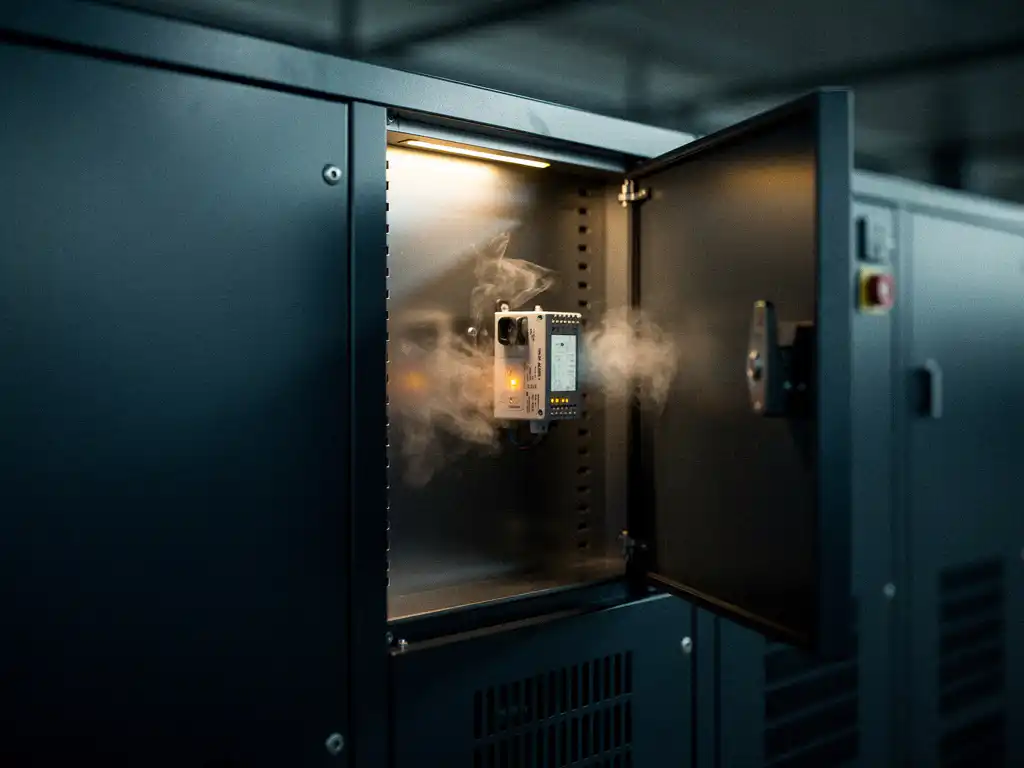
Off-gas detection in battery storage systems works by monitoring the air inside a battery enclosure for the specific gases that lithium-ion cells release before they ignite. When a cell begins to degrade or overheat, it emits hydrogen, carbon monoxide, and volatile organic compounds long before visible smoke or flames appear. The sections below explain the full detection and suppression chain, from the chemistry of thermal runaway to the standards that govern BESS fire safety in 2026.
What gases are released during battery thermal runaway?
During battery thermal runaway, lithium-ion cells release a mixture of flammable and toxic gases, including hydrogen, carbon monoxide, methane, ethylene, and carbon dioxide. Hydrogen is typically the earliest and most abundant gas produced, often appearing well before the cell reaches temperatures that cause visible smoke or fire.
Thermal runaway is a self-reinforcing chemical reaction triggered by overcharging, physical damage, internal short circuits, or extreme temperatures. As a cell heats beyond its safe operating range, its electrolyte begins to decompose. This decomposition releases the gas mixture listed above, along with heat that accelerates the reaction in neighboring cells. The result is a chain reaction that can spread rapidly across an entire battery module or rack.
The composition of off-gases varies depending on the battery chemistry. Lithium iron phosphate (LFP) cells tend to produce less heat and fewer hydrocarbons than nickel manganese cobalt (NMC) cells, but both chemistries release hydrogen as a primary off-gas indicator. Understanding which gases a specific battery type produces is essential when specifying detection equipment, because sensors must be calibrated to the relevant gas signatures for reliable early warning.
How do off-gas sensors detect early signs of fire?
Off-gas sensors detect early signs of fire in a battery storage system by continuously sampling the air inside an enclosure and measuring the concentration of target gases such as hydrogen and carbon monoxide. When concentrations exceed a pre-set threshold, the sensor triggers an alarm before any thermal event becomes uncontrollable.
Most off-gas detection systems use electrochemical sensors for hydrogen and carbon monoxide, and catalytic bead or infrared sensors for flammable hydrocarbons. Electrochemical sensors work by passing sampled air across a chemical cell that produces a measurable electrical current proportional to gas concentration. The sensor electronics translate this signal into a parts-per-million (ppm) reading and compare it against alarm thresholds.
Modern BESS off-gas detection systems often combine multiple sensor types in a single unit to cover the full range of gases released during early-stage thermal runaway. Some systems also incorporate temperature monitoring, so that a rise in both gas concentration and cell temperature can trigger a higher-priority alarm. This layered approach reduces false alarms while ensuring that genuine early-stage events are never missed.
What’s the difference between off-gas detection and smoke detection in BESS?
Off-gas detection identifies the chemical gases released by degrading battery cells before combustion occurs, while smoke detection identifies airborne particles produced during or after combustion. In a battery storage context, off-gas detection provides significantly earlier warning because gases are released minutes to hours before visible smoke appears.
Traditional smoke detectors, including photoelectric and ionization types, respond to the physical particles generated when material burns. In a sealed or semi-sealed battery cabinet, smoke concentration may remain low for a considerable time even as a cell undergoes serious thermal stress. By the time a smoke detector activates, the thermal event may already be well advanced.
Aspirating smoke detection (ASD) improves on standard smoke detection by actively drawing air samples through a pipe network to a central detector, increasing sensitivity. However, even high-sensitivity smoke detection still responds to combustion byproducts rather than pre-combustion off-gases. For battery energy storage systems, the combination of off-gas detection as the primary early-warning layer and smoke detection as a secondary confirmation layer represents current best practice. The two technologies complement each other: off-gas detection catches the earliest chemical signals, while smoke detection confirms that a thermal event is progressing toward ignition.
Where should off-gas detectors be placed in a battery storage system?
Off-gas detectors should be placed inside the battery enclosure or cabinet, as close to the battery modules as possible. Because hydrogen is lighter than air, sensors for hydrogen specifically should be positioned at or near the top of the enclosure where the gas accumulates first.
Placement strategy depends on the physical layout of the BESS installation. Key considerations include:
- Inside the cabinet: Sensors mounted within the enclosure respond to off-gases at the source, before dilution by ambient air reduces concentrations below detectable levels.
- Near the top of the enclosure: Hydrogen rises and stratifies near the ceiling of a sealed cabinet, so upper placement maximizes early detection sensitivity.
- Close to high-risk modules: Cells operating at higher charge states or in warmer zones of a rack are statistically more likely to initiate thermal runaway and warrant closer sensor proximity.
- Away from ventilation outlets: Placing sensors directly in the path of ventilation airflow can dilute gas concentrations and delay detection. Sensors should be positioned to sample representative air, not purged air.
For large-scale BESS installations with multiple racks or containers, a distributed detection approach is recommended, with sensors in each individual enclosure rather than relying on a single room-level detector. This ensures that an event in one rack is detected independently of conditions elsewhere in the facility.
How does off-gas detection trigger fire suppression in a BESS?
When an off-gas sensor detects gas concentrations above the alarm threshold, it sends a signal to the fire suppression control panel, which then activates the suppression agent within the affected enclosure. In well-designed systems, this entire sequence happens automatically and within seconds of the alarm trigger.
The integration between detection and suppression is what makes combined systems particularly effective for battery energy storage fire safety. A standalone detector that only sounds an alarm relies on human intervention, which introduces delay. An integrated system eliminates that delay by linking the detection signal directly to the suppression mechanism.
For enclosed battery cabinets, nitrogen-based suppression is well suited to this integrated approach. Nitrogen displaces oxygen within the enclosure, suppressing combustion without leaving chemical residues that would damage sensitive battery management electronics. The suppression agent is released in a controlled, targeted way into the specific cabinet where the event is occurring, rather than flooding an entire room.
The control panel can also be configured to send status signals to a building fire alarm system via relay outputs, ensuring that facility-level response protocols are activated simultaneously with local suppression. This means the suppression system operates as part of a broader fire safety infrastructure rather than in isolation.
What standards apply to off-gas detection in battery energy storage?
Several international and regional standards govern off-gas detection and fire safety in battery energy storage systems. The most relevant in 2026 include NFPA 855, IEC 62933, and UL 9540A, alongside regional building codes and insurance requirements from bodies such as FM Global.
Key standards and their relevance include:
- NFPA 855 (Standard for the Installation of Stationary Energy Storage Systems): Specifies fire protection requirements for BESS installations, including detection, suppression, and ventilation. It explicitly addresses the need for early warning detection systems capable of identifying pre-fire conditions.
- UL 9540A (Test Method for Evaluating Thermal Runaway Fire Propagation in Battery Energy Storage Systems): Provides the test methodology used to assess how fire spreads within and between battery units, informing suppression system design requirements.
- IEC 62933 (Electrical Energy Storage Systems): Covers safety requirements for grid-connected energy storage systems, including requirements related to hazardous gas management.
- FM Global Data Sheet 5-33: Provides insurer-driven guidance on the protection of battery energy storage systems, which increasingly references off-gas detection as a required or strongly recommended component.
Compliance requirements vary by country and installation type, and the regulatory landscape for BESS fire safety continues to evolve as large-scale deployments become more common. Facility managers specifying detection equipment should verify which standards apply to their specific installation type, jurisdiction, and insurance requirements before finalizing system design.
How ExxFire supports off-gas detection and suppression in battery storage
ExxFire’s integrated fire detection and suppression systems are designed specifically for the kind of enclosed, high-value environments where battery energy storage systems operate. The systems combine early detection with fast, targeted suppression to address the full thermal runaway risk chain.
Key features relevant to BESS fire safety include:
- Aspirating smoke detection paired with nitrogen gas suppression, providing both early-stage detection and clean, residue-free suppression within the same enclosure
- Non-pressurized nitrogen suppression via the patented Cool Gas Generator technology, which displaces oxygen without leaving chemical residues that could damage battery management systems or electronics
- Pre-engineered enclosure protection for cabinets up to 4.5 m³, with multiple units interconnectable for larger battery rack configurations
- Built-in relay outputs that integrate with existing fire panels, ensuring facility-level alarm protocols activate alongside local suppression
- PFAS-free suppression agent, meeting current and anticipated environmental compliance requirements without compromising suppression effectiveness
- Tested and certified by CNPP France, providing the documented third-party validation that compliance managers need when specifying systems for regulated installations
If you are specifying BESS fire protection for a new or existing installation and want to understand which configuration fits your enclosure type and risk profile, contact ExxFire directly to discuss your requirements.