

How does off-gas detection reduce the risk of thermal runaway in battery cabinets?
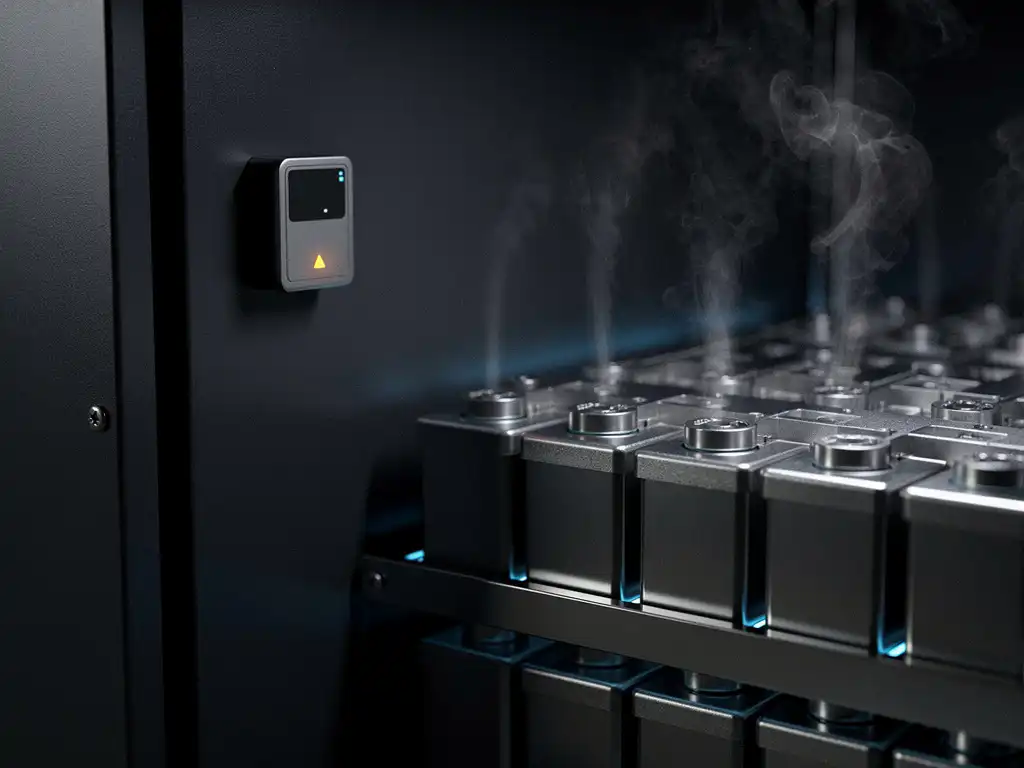
Off-gas detection reduces the risk of thermal runaway in battery cabinets by identifying the hazardous gases that lithium-ion cells release in the minutes before ignition, giving suppression systems time to act before a fire develops. This early chemical warning stage is the most reliable intervention point in the thermal runaway sequence. The sections below unpack how the process works, why it outperforms conventional detection methods, and which systems and standards define best practice today.
What gases are released during thermal runaway in battery cabinets?
During thermal runaway, lithium-ion battery cells release a mixture of flammable and toxic gases before any visible flame or significant heat is detectable. The primary gases include hydrogen, carbon monoxide, carbon dioxide, methane, and various volatile organic compounds. Hydrogen is particularly dangerous because it is highly flammable at low concentrations and accumulates rapidly inside sealed battery enclosures.
The off-gassing process begins well before the cell reaches ignition temperature. As a cell degrades under conditions such as overcharging, internal short circuits, or mechanical damage, its electrolyte begins to decompose. This decomposition produces the gas mixture described above as a direct byproduct of the electrochemical breakdown occurring inside the cell casing. In a multi-cell battery cabinet, even a single failing cell can initiate a cascade that propagates to neighboring cells if not interrupted early.
The composition and concentration of these gases vary depending on battery chemistry, state of charge, and the severity of the fault. Lithium iron phosphate cells tend to produce less heat and fewer volatile compounds than lithium nickel manganese cobalt oxide cells, but all lithium-ion chemistries produce detectable off-gases during the pre-ignition phase. This chemical signature is what off-gas detection systems are designed to identify.
How does off-gas detection work inside a battery cabinet?
Off-gas detection works by continuously sampling the air inside a battery cabinet and analyzing it for the specific gases associated with cell degradation. Sensors calibrated to detect hydrogen, carbon monoxide, or a combination of volatile compounds trigger an alarm when concentrations exceed a defined threshold, typically long before any smoke or heat is measurable.
The most common sensor technologies used are electrochemical sensors for hydrogen and carbon monoxide, and photoionization detectors for broader volatile organic compound signatures. Some advanced systems use multi-gas sensor arrays to reduce false alarms and improve specificity, distinguishing genuine cell degradation from benign sources such as cleaning agents or ambient industrial gases.
Inside a battery cabinet, sensors are typically positioned near the top of the enclosure, where lighter gases such as hydrogen accumulate first. Sampling can be passive, relying on natural gas stratification, or active, using small fans or aspirating systems to draw air across the sensor continuously. Active sampling provides faster response times and more uniform coverage across larger cabinet volumes, which is particularly important in battery energy storage system installations where multiple cabinet bays are interconnected.
Why is early gas detection faster than smoke or heat detection for batteries?
Off-gas detection is faster than smoke or heat detection for batteries because gas release precedes both smoke production and significant temperature rise in the thermal runaway sequence. Gases begin accumulating during the early degradation phase, which can occur minutes to tens of minutes before a cell reaches the temperature at which it produces visible smoke or ignites.
Conventional smoke detectors respond to combustion particles, which are only generated once a fire has already started or is imminent. Heat detectors respond to temperature changes that, in a battery enclosure, may only become measurable after significant internal damage has already occurred. Both technologies are therefore reactive to events that have already progressed past the safest intervention window.
Gas detection operates at a fundamentally earlier stage. Hydrogen concentrations inside a sealed cabinet can reach detectable levels within the first minutes of a cell fault, providing a warning that allows suppression systems to activate, ventilation to engage, or operators to isolate the affected unit before propagation occurs. In battery energy storage systems, where large numbers of cells are housed in close proximity, this time advantage is critical to preventing a single-cell fault from becoming a multi-cabinet event.
What happens after off-gas detection triggers a suppression response?
After off-gas detection triggers a suppression response, the system activates a fire suppression agent inside the battery cabinet to reduce oxygen concentration, cool the affected cells, and interrupt the thermal runaway process. The sequence typically includes an alarm signal, a short pre-discharge delay to allow personnel to respond, and then agent release directly into the protected enclosure.
The choice of suppression agent matters significantly in battery cabinet applications. Inert gas suppression using nitrogen is particularly well suited because nitrogen displaces oxygen without leaving chemical residues, avoiding secondary damage to sensitive battery management electronics and cell components. This is important not only for fire control but also for post-incident recovery, since contaminated or corroded components in a battery system can create ongoing safety risks.
After suppression, the system continues to monitor the enclosure. If gas concentrations remain elevated or a second thermal event begins, the system can signal for additional intervention. Integrated systems that connect suppression outputs to a central fire panel allow facility teams to coordinate emergency response, isolate the electrical supply to the affected cabinet, and notify maintenance teams, all from a single monitoring point.
Which battery cabinet types and applications benefit most from off-gas detection?
The battery cabinet types and applications that benefit most from off-gas detection are those where high cell density, limited ventilation, or high-value assets make early intervention essential. These include battery energy storage systems, uninterruptible power supply cabinets, electric vehicle charging infrastructure, industrial backup power systems, and telecommunications battery banks.
Large-scale BESS installations face the highest risk because a thermal runaway event in one cabinet can propagate to adjacent units through radiated heat and shared ventilation pathways. Off-gas detection provides the earliest possible warning in these environments, where the consequences of a delayed response extend beyond equipment loss to grid instability or facility-wide fire.
Smaller applications such as UPS cabinets in data centers and server rooms also benefit significantly. These environments often have strict requirements around agent cleanliness and residue-free suppression because the surrounding IT infrastructure is equally sensitive. Industrial backup power cabinets in oil and gas or manufacturing facilities represent another high-priority application, particularly where switchgear and high-voltage equipment is located in the same area and a battery fire could initiate a broader electrical incident.
What standards and certifications apply to off-gas detection in battery systems?
Off-gas detection in battery systems is governed by a combination of battery safety standards, fire detection standards, and installation codes that together define performance requirements, testing protocols, and integration expectations. The most relevant frameworks in 2026 include IEC 62933 for battery energy storage systems, IEC 62619 for lithium-ion secondary cells in industrial applications, and NFPA 855, which specifically addresses the installation of stationary energy storage systems and includes requirements for fire detection and suppression.
For detection equipment itself, EN 54 covers fire detection and fire alarm systems in European markets, and UL 2075 addresses gas and vapor detectors in North American contexts. ATEX and IECEx certifications apply where battery cabinets are installed in potentially explosive atmospheres, such as in certain industrial or offshore environments, requiring that all detection and suppression equipment meet zone-specific ignition protection standards.
FM Global property loss prevention guidelines, particularly FM Data Sheet 5-33 on electrical energy storage systems, provide additional specification guidance that many industrial insurers reference when assessing risk and setting coverage terms. Compliance with these standards is increasingly a procurement requirement for large BESS projects and is closely monitored by safety and compliance managers responsible for both regulatory adherence and insurance obligations.
How ExxFire supports early fire detection in battery cabinets
ExxFire’s integrated fire detection and suppression systems are designed specifically for the kind of enclosed, high-value environments where off-gas detection provides its greatest advantage. The systems combine aspirating smoke detection with non-pressurized nitrogen gas suppression delivered through the patented Cool Gas Generator technology, providing a complete response from early warning to agent release within a single pre-engineered unit.
- Early detection: Aspirating detection continuously samples air inside the cabinet, identifying combustion indicators at the earliest possible stage before visible smoke or heat develops.
- Clean suppression: Nitrogen gas leaves no chemical residues, protecting sensitive battery management electronics and avoiding secondary damage to cells and wiring.
- Scalable protection: Systems protect enclosures up to 4.5 m³ and can be interconnected to cover larger battery cabinet arrays typical of BESS installations.
- Simple integration: Built-in relays allow the system to report status to an existing fire panel, supporting centralized monitoring without requiring additional infrastructure.
- Certified performance: Systems are tested and certified by CNPP in France, providing documented compliance evidence for procurement, insurance, and regulatory purposes.
- Low maintenance: The non-pressurized design and straightforward installation reduce both ongoing maintenance burden and total cost of ownership.
For safety and compliance managers specifying BESS fire safety solutions or protecting battery cabinets in industrial environments, ExxFire’s systems provide a technically validated, residue-free, and environmentally responsible answer to the thermal runaway challenge. Contact ExxFire to discuss your specific application and receive a system recommendation tailored to your cabinet type and installation environment.
Related Articles
- How does fire risk vary between urban and rural properties?
- What are the biggest fire risks in an office environment?
- How do animal habitats influence fire management decisions?
- How does IEC 62368 relate to fire safety in electronic equipment?
- How does ESG compliance affect fire protection decisions in 2026?