

What are the biggest fire risks in an office environment?
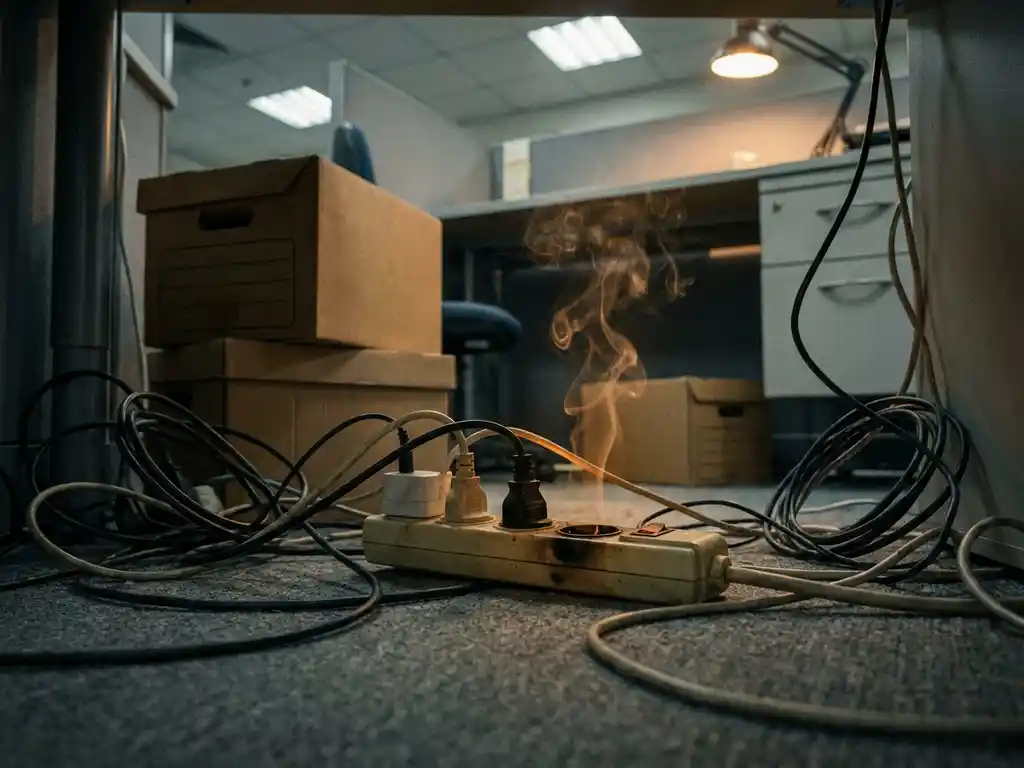
The biggest fire risks in an office environment are electrical faults, overloaded circuits, and poorly maintained equipment — particularly in areas housing server racks, switchgear cabinets, and battery storage systems. These hazards are especially dangerous because they often develop undetected inside closed enclosures, where heat and smoke build up long before a conventional detector triggers an alarm. The sections below break down each major risk category and explain how offices can protect against them.
What causes most fires in office buildings?
Most fires in office buildings originate from electrical sources. Faulty wiring, overloaded power strips, malfunctioning equipment, and heat buildup inside electrical enclosures are the leading causes. Unlike open-flame hazards, electrical fires typically start inside walls, ceilings, or closed cabinets, making early detection far more difficult and the consequences far more severe.
Common ignition sources in office environments include:
- Overloaded electrical circuits caused by too many devices drawing power from a single outlet or distribution board
- Aging or damaged wiring that degrades over time, generating heat at connection points
- Unattended equipment such as printers, coffee machines, or phone chargers left running overnight
- Poor cable management inside server rooms or IT closets, which restricts airflow and accelerates heat buildup
- Dust accumulation inside electrical cabinets and ventilation systems, which acts as fuel once a spark occurs
Understanding these common office fire hazards is the first step toward effective office fire prevention. The risk is not limited to industrial facilities — modern offices with dense IT infrastructure and high-voltage equipment face many of the same ignition risks as manufacturing environments.
Why are electrical cabinets and switchgear a high fire risk in offices?
Electrical cabinets and switchgear are a high fire risk in offices because they concentrate large amounts of electrical energy in a confined, often unmonitored space. Heat from arcing, short circuits, or loose connections can ignite insulation material rapidly, and because the enclosure is closed, oxygen depletion from a small fire is slow enough to allow significant heat and smoke to build before suppression occurs.
Switchgear panels manage the distribution of power across an entire building. A fault at this level can cascade into a full electrical fire that affects multiple floors or systems simultaneously. The enclosed nature of these cabinets also means that conventional smoke detectors mounted on ceilings nearby will not respond until smoke escapes the enclosure, by which point significant internal damage has already occurred.
The risk increases in older office buildings where switchgear has not been updated to handle the power demands of modern IT and HVAC systems. Overloading switchgear designed for lower capacity generates chronic heat stress on components, accelerating wear and increasing the probability of an electrical fire in the office.
How does a fire in an ICT or server room spread so quickly?
A fire in an ICT or server room spreads quickly because the environment contains an extremely high density of combustible materials — cables, circuit boards, plastic housings, and insulation — combined with constant airflow from cooling systems that actively feeds oxygen to any ignition point. Once a fire starts inside a server rack, forced air circulation can spread flames and smoke to adjacent racks within minutes.
Several factors compound the speed of fire spread in server environments:
- Continuous airflow: Cooling systems designed to prevent overheating also supply the oxygen that sustains and spreads fire
- High cable density: Cable bundles running between racks act as fuel pathways, allowing fire to travel horizontally across a room
- Raised floor voids: Many server rooms use raised flooring for cable routing, creating hidden channels where fire and smoke can travel undetected
- Delayed detection: Ceiling-mounted smoke detectors may not respond until smoke has already filled the room, by which point hardware damage is extensive
This is why aspirating smoke detection — which actively draws air samples from inside enclosures — is far more effective than passive ceiling detectors in ICT environments. Early detection at the source is the only reliable way to prevent a small electrical fault from becoming a room-wide disaster.
What are the consequences of an office fire on business continuity?
An office fire, even a contained one, can cause severe disruption to business continuity. Hardware replacement, data loss, regulatory reporting obligations, and the time required to restore systems to full operation can result in days or weeks of downtime. For organizations that depend on continuous access to IT systems or electrical infrastructure, the financial and operational consequences are significant.
The direct costs include destroyed equipment, emergency repair work, and potential data loss if backup systems were not isolated from the fire source. Indirect costs are often larger: lost productivity, reputational damage, contractual penalties for service interruptions, and the cost of temporary infrastructure while permanent systems are rebuilt.
Fire safety in the office is therefore not just a compliance issue — it is a business resilience issue. Organizations that invest in early detection and suppression at the object level, protecting individual cabinets and racks rather than relying solely on room-level suppression, dramatically reduce the scope of damage when an incident does occur. Limiting a fire to a single enclosure rather than allowing it to spread to an entire server room is the difference between a few hours of disruption and weeks of recovery.
How can offices reduce fire risk in high-voltage and battery storage areas?
Offices can reduce fire risk in high-voltage and battery storage areas through a combination of regular maintenance, proper ventilation, early detection systems, and object-level suppression. Battery Energy Storage Systems (BESS) and high-voltage cabinets present unique hazards because thermal runaway in lithium-based batteries can generate heat and flammable gases that conventional suppression methods struggle to control effectively.
Practical steps for reducing fire risk in these areas include:
- Schedule regular inspections and thermal imaging of high-voltage cabinets to identify hot spots before they become ignition sources
- Ensure adequate ventilation around battery storage systems to prevent heat accumulation and gas buildup
- Install object-level detection inside enclosures rather than relying solely on room-level smoke detectors
- Avoid overcharging battery systems and use battery management systems that monitor cell temperature and voltage in real time
- Segregate high-risk equipment from general office areas where possible, using fire-rated partitions
- Replace PFAS-containing suppression agents with clean, inert alternatives that do not damage sensitive components or create secondary environmental hazards
Office fire prevention in battery and high-voltage areas requires a proactive approach. Waiting for a fire to reach a room-level detector before suppression begins is not a viable strategy when thermal runaway can escalate in seconds.
What fire suppression method is safest for office electronics?
The safest fire suppression method for office electronics is inert gas suppression — specifically nitrogen-based systems that reduce oxygen levels within a closed enclosure without leaving chemical residues. Unlike water-based or powder suppression systems, inert gas does not damage sensitive circuit boards, hard drives, or other electronic components, meaning hardware can often be recovered and operations restored quickly after an incident.
Halon alternatives and PFAS-containing gases have historically been used in data center and server room environments, but their environmental impact and regulatory restrictions have driven demand for cleaner alternatives. Nitrogen is non-toxic, leaves no residue, and does not contribute to ozone depletion or persistent chemical contamination — making it the preferred choice for organizations with sustainability commitments as well as practical fire safety requirements.
For enclosed environments such as server racks and electrical cabinets, the most effective approach combines aspirating smoke detection — which samples air from inside the enclosure continuously — with an integrated nitrogen suppression system that activates at the first sign of combustion. This object-level protection addresses the fire at its source before it spreads, rather than flooding an entire room with suppression agent after significant damage has already occurred.
How ExxFire helps protect offices against fire risks
ExxFire provides integrated fire detection and suppression systems specifically designed to address the fire risks described throughout this article — from electrical cabinets and switchgear to server rooms and battery storage areas. Key features of ExxFire’s approach include:
- Aspirating smoke detection that monitors air inside closed enclosures, detecting smoke far earlier than ceiling-mounted detectors
- Non-pressurized nitrogen suppression based on the patented Cool Gas Generator, which extinguishes fire without leaving chemical residues or damaging sensitive electronics
- PFAS-free technology that meets modern environmental compliance requirements and replaces legacy gas suppression agents
- Easy installation without special certification, with built-in relays for integration with existing fire panels
- Maintenance-free operation once commissioned, reducing the total cost of ownership over the system’s lifetime
- Tested and certified by CNPP France and DMT (TÜV Nord), ensuring reliability in mission-critical environments
Whether you are protecting a single server rack or a network of high-voltage cabinets across multiple sites, ExxFire’s systems are designed to limit fire damage, reduce downtime, and keep your operations running. Contact ExxFire to find out how object-level fire protection can safeguard your office environment.
Related Articles
- How do you prioritise fire risks when resources are limited?
- What is the role of remote sensing in fire management?
- How does sustainable fire protection support corporate climate commitments?
- What are PFAS chemicals in fire extinguishing systems?
- What are the long-term costs of using high-GWP fire suppression agents?