

Why do kitchen fires start so easily?
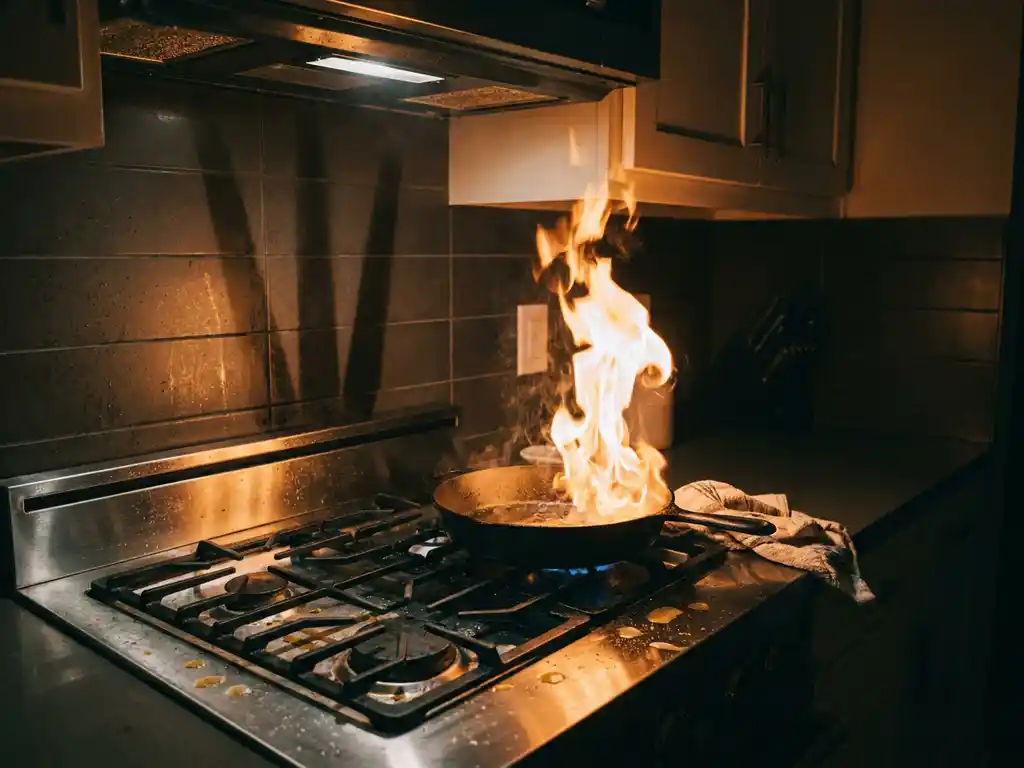
Kitchen fires start so easily because cooking involves open heat sources, flammable fats, and distracted human behavior, all in close proximity. The combination of high temperatures, combustible materials like cooking oil and grease, and brief lapses in attention creates conditions where a fire can ignite within seconds. This article unpacks the specific reasons kitchens are so fire-prone and what you can do to reduce the risk.
What makes kitchens more fire-prone than other rooms?
Kitchens are more fire-prone than other rooms because they concentrate heat sources, flammable materials, and human error in a single space. Unlike a living room or office, a kitchen is designed around controlled combustion and high-temperature processes. When that control slips, even briefly, the environment is already primed to ignite.
Several factors make kitchens uniquely hazardous compared to the rest of a building:
- Sustained high heat: Stovetops, ovens, and grills operate at temperatures well above the ignition point of many common materials.
- Flammable residue: Grease, oil, and food particles accumulate on surfaces and inside appliances over time, creating a ready fuel source.
- Combustible surroundings: Dish towels, wooden utensils, paper packaging, and curtains are often within reach of active burners.
- Frequent human error: Cooking requires constant attention, and distraction is one of the leading contributors to kitchen fire incidents.
No other room in a home or commercial facility combines all of these elements at the same time, which is why kitchens account for the majority of residential fire incidents across most countries.
What are the most common causes of kitchen fires?
The most common causes of kitchen fires are unattended cooking, grease buildup, and placing flammable materials too close to heat sources. These three factors account for the overwhelming majority of kitchen fire incidents in both residential and commercial settings. Faulty appliances and improper use of cooking equipment also contribute significantly.
Breaking this down further, the most frequently cited kitchen fire causes include:
- Unattended cooking: Leaving food on the stove or in the oven without supervision is the single most common trigger. Heat builds unchecked, food burns, and ignition follows.
- Grease and oil overheating: Cooking fats reach their smoke point and then flash point quickly when left on high heat. Once ignited, grease fires escalate rapidly.
- Flammable items near the hob: Dish towels, paper towels, plastic packaging, and loose clothing can catch fire if they come into contact with a burner or hot surface.
- Dirty appliances: Ovens, extractor hoods, and fryers with accumulated grease residue are significantly more likely to ignite during normal use.
- Faulty or misused appliances: Damaged wiring in toasters, microwaves, or cookers can cause electrical fires that are harder to detect and extinguish.
Understanding these causes is the foundation of effective kitchen fire prevention. Most incidents are avoidable with consistent attention and routine maintenance of cooking equipment.
How does a grease fire start and spread so fast?
A grease fire starts when cooking oil or fat is heated beyond its flash point, the temperature at which it spontaneously ignites. Once ignited, grease fires spread fast because burning fat releases flammable vapors continuously, feeding the flames and making the fire self-sustaining within moments. Adding water makes it dramatically worse, causing the fire to explode outward.
The physics behind a grease fire help explain why it behaves so differently from other kitchen fires. When oil is heated, it first reaches its smoke point, producing visible vapor. If heating continues, it reaches the flash point and ignites. The burning oil then releases more vapor, which burns, which releases more vapor, creating a rapid feedback loop.
Water is dangerous on a grease fire because it instantly vaporizes on contact with the burning oil, expanding to roughly 1,700 times its liquid volume in an instant. This expansion throws burning oil droplets in all directions, spreading the fire across a much wider area in a fraction of a second.
Grease fires are best controlled by removing the oxygen supply, either by covering the pan with a lid, using a fire blanket, or applying a dry powder or CO2 extinguisher designed for Class F fires. Speed matters enormously. A grease fire that is contained in the first few seconds is manageable. One that spreads to surrounding surfaces, cabinets, or extraction systems becomes a structural fire quickly.
Why do kitchen fires often go undetected until they’re serious?
Kitchen fires often go undetected until they are serious because smoke and heat from normal cooking regularly trigger false alarms, leading people to disable or ignore detection systems. When alarms are silenced out of habit, an actual fire can develop significantly before anyone responds. Steam, burnt toast, and cooking vapors all mimic early fire signals.
This is sometimes called the “cry wolf” effect in fire safety. Standard ionization smoke detectors in kitchens are particularly prone to nuisance alarms from everyday cooking activity. Over time, occupants become conditioned to dismiss alerts, assuming it is just steam or a forgotten piece of toast. When a real fire starts, the same alarm receives the same dismissive response.
There are additional reasons why kitchen fires escalate before detection:
- Fires starting inside appliances: A fire beginning inside an oven or under an extractor hood may not produce visible smoke in the room until it has already grown substantially.
- Nighttime cooking incidents: Fires starting from appliances left on or from residual heat after cooking can develop while occupants are asleep.
- Grease fires behind surfaces: Grease that has accumulated inside extraction ducting can ignite and spread through the duct system before any visible sign appears in the kitchen itself.
Positioning detection technology appropriately and choosing systems that distinguish between cooking vapors and actual combustion smoke is a meaningful step toward catching fires at an earlier, more manageable stage.
What’s the difference between a kitchen fire and an electrical cabinet fire?
A kitchen fire is typically caused by heat, open flames, and combustible cooking materials, while an electrical cabinet fire originates from electrical faults, overheating components, or arc flashes inside enclosed equipment. The key practical difference is that kitchen fires are usually visible early, while electrical cabinet fires often develop silently inside sealed enclosures before any external sign appears.
This distinction matters for how each type of fire is detected and suppressed:
- Kitchen fires tend to produce visible flames, smoke, and heat quickly. They occur in open environments where standard smoke detectors and human observation can identify them relatively fast.
- Electrical cabinet fires develop inside closed metal enclosures. Smoke, heat, and combustion gases are contained within the cabinet before they become detectable externally, meaning the fire can reach a damaging intensity before any alarm triggers.
Suppression methods also differ significantly. Kitchen fires are addressed with extinguishers, fire blankets, or fixed suppression systems designed for cooking environments. Electrical cabinet fires require suppression agents that are non-conductive, leave no residue, and do not damage sensitive electronics. Water or foam is unsuitable for both reasons. Inert gas suppression, such as nitrogen-based systems, is the appropriate solution for enclosed electrical equipment because it extinguishes the fire without causing secondary damage to the components inside.
How can early detection prevent a small kitchen fire from becoming a disaster?
Early detection prevents a small kitchen fire from becoming a disaster by giving occupants time to intervene before the fire reaches a self-sustaining size. A fire caught in its first seconds can be extinguished with a pan lid or a small extinguisher. A fire that has been burning undetected for several minutes may already have spread to cabinets, extraction systems, or structural elements.
The difference between a contained incident and a building fire is almost always measured in the speed of detection and response. Research and fire safety practice consistently show that the first two to three minutes after ignition are the critical window. Within that window, most kitchen fires can be controlled by a single person with basic equipment. Beyond it, the fire doubles in size and temperature rapidly.
Practical steps that improve early detection in kitchens include:
- Installing heat detectors rather than standard smoke alarms in cooking areas, since they respond to temperature rise rather than vapors and produce fewer false alarms.
- Keeping extraction hoods and filters clean, since blocked filters can both catch fire and prevent smoke from reaching ceiling-mounted detectors.
- Never leaving active cooking unattended, even briefly.
- Ensuring a suitable extinguisher is mounted within reach of the cooking area and that all occupants know how to use it.
The same principle of early detection applies across all fire environments, from kitchens to industrial facilities. The closer detection is to the source, and the faster the response, the lower the damage and disruption.
How ExxFire helps with fire detection and suppression
While kitchen fire prevention depends largely on human behavior and appropriate appliances, protecting the electrical and mission-critical equipment in your facility requires a more robust, automated solution. ExxFire provides combined fire detection and suppression systems designed specifically for enclosed, high-value environments where a fire can develop silently before any external sign appears.
Key features of ExxFire’s approach include:
- Aspirating smoke detection: Detects smoke at the earliest possible stage, before a fire has developed into an open flame.
- Non-pressurized nitrogen suppression: Extinguishes fire without leaving chemical residues, protecting sensitive electronics and components from secondary damage.
- PFAS-free technology: A clean, environmentally responsible alternative to legacy gas suppression systems.
- Easy installation and low maintenance: Systems are pre-engineered for straightforward self-installation with no ongoing maintenance requirements after commissioning.
- Certified performance: Tested and certified by CNPP France and DMT, part of TÜV Nord, ensuring reliable performance in real-world conditions.
Whether you are protecting server racks, switchgear, battery energy storage systems, or other critical enclosures, early detection combined with targeted suppression is the most effective way to prevent a small incident from becoming a costly disaster. Explore ExxFire’s solutions and find out how to safeguard your most valuable equipment.
Related Articles
- What are the fire risks in restaurants and commercial kitchens?
- How does fire risk change during hot and dry weather?
- What are the IEC standards for fire detection in electrical enclosures?
- What are the key differences between NFPA 72 and NFPA 2001?
- How do outdoor grills cause fires and how can you prevent them?