

How do you prevent fires caused by lithium-ion batteries?
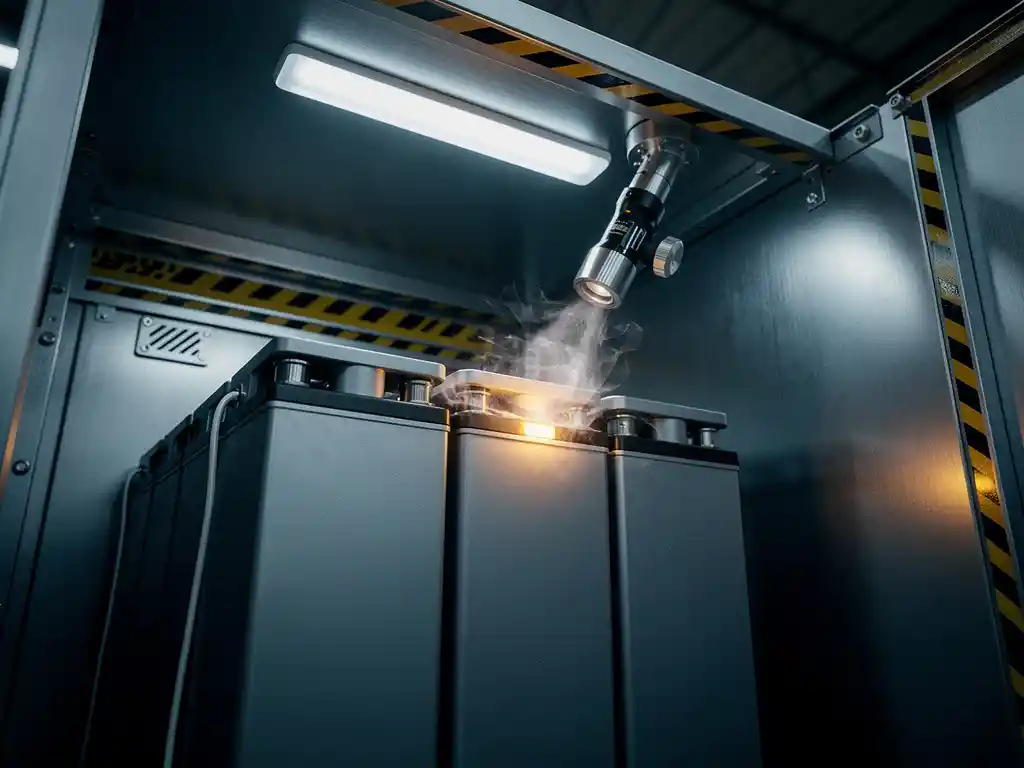
Lithium-ion battery fire prevention starts with controlling the conditions that trigger thermal runaway, the chain reaction at the root of most battery fires. Effective prevention combines proper system design, temperature monitoring, early smoke detection, and fast-acting suppression before a small fault becomes a catastrophic failure. The sections below address the most common questions about lithium-ion battery fire risk, causes, detection, and suppression.
What makes lithium-ion batteries a fire risk?
Lithium-ion batteries are a fire risk because they store large amounts of electrochemical energy in a compact form, and under certain conditions they can enter a self-sustaining exothermic reaction called thermal runaway. Once triggered, this process generates intense heat, flammable gases, and in some cases open flames that are extremely difficult to suppress with conventional methods.
The core danger lies in the battery’s chemistry. Lithium-ion cells contain a flammable electrolyte that, when exposed to high temperatures or physical damage, can ignite. Unlike many other fires, a battery fire can reignite hours after it appears extinguished because the internal reaction may continue even after the external flame is gone.
For organizations operating Battery Energy Storage Systems (BESS), the fire risk is amplified by scale. Large battery arrays store enormous amounts of energy in enclosed spaces, meaning a single failing cell can cascade across an entire system. This makes BESS fire safety a critical engineering and operational challenge, not simply a compliance checkbox.
What are the most common causes of lithium-ion battery fires?
The most common causes of lithium-ion battery fires are overcharging, physical damage, manufacturing defects, and excessive heat exposure. Each of these triggers can initiate thermal runaway, the internal failure mode that turns a battery fault into a fire event.
- Overcharging: When a cell is charged beyond its rated voltage, it generates excess heat and can cause internal short circuits.
- Physical damage: Punctures, crushing, or deformation of a cell can breach the separator between electrodes, causing an immediate short circuit and heat spike.
- Manufacturing defects: Contamination or imperfections during production can create internal weak points that fail under normal operating conditions.
- Thermal stress: Operating or storing batteries in environments that are too hot accelerates chemical degradation and raises the risk of runaway.
- Aging and deep discharge: Older cells or cells that have been repeatedly deep-discharged develop increased internal resistance, generating more heat during charge cycles.
Understanding these lithium battery fire causes is essential for anyone designing or managing a battery system. Many incidents are preventable through proper battery management systems, correct installation, and regular maintenance checks. However, even well-maintained systems carry residual risk, which is why suppression planning must accompany preventive measures.
How can you detect a lithium-ion battery fire early?
Early detection of a lithium-ion battery fire relies on identifying the gases and aerosols that batteries emit before visible flames or significant heat develop. The most effective approach is aspirating smoke detection, which actively draws air from inside an enclosure and analyzes it for the earliest signs of combustion byproducts.
Standard heat detectors are poorly suited to battery fire detection because they respond only after temperatures have already reached dangerous levels. By that point, thermal runaway may already be underway. Optical smoke detectors improve on this, but aspirating systems go further by sampling air continuously and detecting sub-visible aerosol particles at concentrations far below what triggers conventional detectors.
For enclosed battery systems such as BESS cabinets or server-adjacent battery backup units, detection must happen inside the enclosure itself, not in the surrounding room. A fire that starts inside a sealed cabinet can develop significantly before any external sensor registers a change. Placing detection at the source dramatically shortens response time and gives suppression systems the window they need to act before damage spreads.
What fire suppression methods work best for lithium-ion batteries?
The fire suppression methods that work best for lithium-ion batteries are those that can rapidly reduce oxygen levels or absorb heat inside a confined enclosure without causing secondary damage to sensitive electronics. Inert gas suppression, particularly nitrogen, is widely considered the most effective and clean option for enclosed battery systems.
Inert gas suppression
Nitrogen and other inert gases suppress fire by displacing oxygen within a protected space, starving the combustion reaction without introducing water, foam, or chemical residues. This is especially valuable for battery installations housed in electrical cabinets or enclosed racks, where residue from other agents would damage the equipment even if the fire is extinguished.
Water mist and cooling systems
Water mist systems can be effective at cooling battery cells during thermal runaway, but they introduce moisture into environments where electronics are present, which creates its own set of damage and safety risks. They are more commonly used in large-scale outdoor BESS installations where electronics are separated from the battery cells and cooling takes priority over residue concerns.
Chemical agents such as dry powder or CO2 can extinguish flames but often fail to address the underlying thermal runaway reaction. A battery that has been chemically suppressed can reignite if the internal temperature remains elevated. This limitation makes inert gas approaches more reliable for enclosed, high-value battery environments.
How does nitrogen gas suppression protect battery energy storage systems?
Nitrogen gas suppression protects battery energy storage systems by flooding the interior of a protected enclosure with inert gas the moment detection triggers an alarm, rapidly reducing the oxygen concentration below the threshold needed to sustain combustion. Because nitrogen is chemically inert, it leaves no residue and causes no corrosion or damage to battery components or associated electronics.
The key advantage of nitrogen in BESS fire safety is its compatibility with sensitive environments. Unlike halon-replacement chemical agents or PFAS-containing gases, nitrogen is completely clean and poses no environmental or health hazard. It is also non-pressurized in its stored state when delivered through solid-state gas generator technology, eliminating the maintenance burden and safety risks associated with high-pressure cylinders.
In practical terms, a nitrogen suppression system paired with aspirating smoke detection can act within seconds of detecting early combustion signals. This response speed is critical for battery fires because thermal runaway accelerates rapidly. Suppressing the fire in its earliest stage, before full runaway develops, significantly reduces hardware damage, prevents cascading cell failures, and protects the broader installation from fire spread.
Nitrogen suppression also aligns with growing regulatory and sustainability requirements. As organizations phase out PFAS-containing agents in response to environmental legislation, nitrogen-based systems offer a compliant, future-proof alternative for battery energy storage fire protection.
What standards and regulations apply to lithium-ion battery fire safety?
Lithium-ion battery fire safety is governed by a combination of international standards, national building codes, and industry-specific regulations that address installation, testing, and suppression requirements. The applicable framework depends on the type of installation, its scale, and the jurisdiction in which it operates.
Key standards and frameworks relevant to battery fire safety include:
- IEC 62619: An international standard covering safety requirements for secondary lithium cells and batteries used in industrial applications, including requirements for thermal management and fire protection.
- NFPA 855: The US standard for the installation of stationary energy storage systems, which specifies fire protection requirements including suppression system design for BESS installations.
- UL 9540 and UL 9540A: Standards for energy storage systems and equipment, with UL 9540A specifically addressing fire propagation testing for battery arrays.
- EN 54 series: European standards governing fire detection and alarm systems, relevant to the detection components of any integrated fire safety solution.
- Local building and fire codes: National and municipal regulations often impose additional requirements on battery storage installations, particularly regarding suppression system certification and inspection intervals.
In 2026, regulatory pressure around BESS fire safety is intensifying as large-scale battery deployments multiply across the energy sector. Organizations planning new installations or upgrading existing systems should verify compliance with both international standards and local requirements early in the design process, as retrofitting suppression systems after installation is significantly more costly than integrating them from the outset.
How ExxFire protects battery energy storage systems from fire
ExxFire provides a fully integrated solution for lithium-ion battery fire prevention, combining aspirating smoke detection with fast-acting nitrogen gas suppression in a single, pre-engineered system. Designed specifically for enclosed environments such as BESS cabinets, switchgear enclosures, and ICT infrastructure, ExxFire’s systems address the core challenges of battery fire safety directly:
- Early detection: Aspirating smoke detection continuously samples air from inside the protected enclosure, identifying combustion aerosols before visible smoke or heat develops.
- Rapid suppression: The patented Cool Gas Generator technology releases nitrogen gas instantly upon alarm, displacing oxygen and halting combustion at the source without residue or damage to electronics.
- Clean and compliant: Nitrogen suppression is entirely PFAS-free and leaves no chemical residue, protecting sensitive battery components and meeting evolving environmental regulations.
- Easy installation: Systems are pre-engineered for self-installation without specialist certification, reducing installation cost and time.
- Scalable protection: Units cover enclosures up to 4.5 m³ and can be interconnected to protect larger battery arrays, with built-in relays for integration with existing fire panels.
- Certified and tested: ExxFire systems are validated by CNPP in France and DMT/TÜV Nord in Germany, giving procurement and safety teams confidence in performance under real fire conditions.
If you are responsible for protecting a battery energy storage system or any high-value electrical enclosure, contact ExxFire to discuss the right fire detection and suppression configuration for your installation.
Related Articles
- What is meant by prescribed burning in fire management?
- When should you upgrade your fire suppression system to meet new standards?
- How do fire safety regulations differ across industries in Europe?
- What is fire safety compliance for electrical cabinets?
- How does fire prevention differ for apartments vs. Houses?