

How does clutter contribute to fire risk?
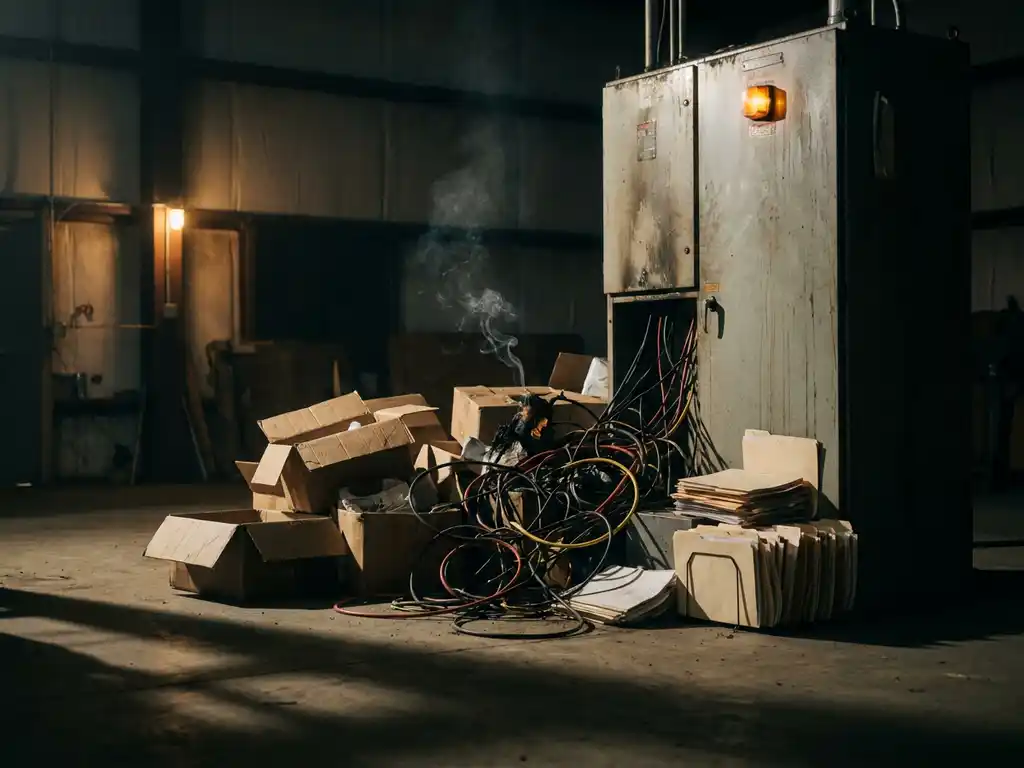
Clutter contributes to fire risk by providing fuel that allows fires to start more easily, spread more rapidly, and burn more intensely. Accumulated materials such as paper, cardboard, fabric, and combustible packaging create conditions where a small ignition source can escalate into a serious fire far faster than in a tidy environment. The sections below address the most common questions about clutter and fire hazards in commercial and industrial settings.
What makes clutter a fire hazard in the first place?
Clutter creates a fire hazard because it increases the volume of combustible material available to fuel a fire, reduces airflow in ways that can concentrate heat, and obstructs the pathways that people and emergency responders need to access and exit a space. The more material present near an ignition source, the faster a fire can establish itself and grow beyond control.
Every fire requires three elements: heat, oxygen, and fuel. In a clean, well-organized environment, the fuel component is minimized and controlled. Clutter disrupts this balance by introducing large quantities of unmanaged fuel. Paper stacked near electrical outlets, cardboard boxes piled against heating equipment, or fabric draped over machinery all dramatically lower the threshold at which a fire can ignite and sustain itself.
Beyond the fuel factor, clutter also traps heat. Dense accumulations of material can insulate heat sources, preventing normal dissipation and allowing temperatures to rise to the point of spontaneous ignition. This is particularly relevant in enclosed spaces such as storage rooms, server rooms, and electrical cabinets where heat already builds up as part of normal operation.
What types of clutter pose the greatest fire risk?
The types of clutter that pose the greatest fire risk are those that are highly combustible, located close to heat or electrical sources, or difficult to extinguish once ignited. Paper and cardboard rank among the most dangerous because they ignite at relatively low temperatures and burn quickly. Flammable liquids, aerosols, and packaging materials amplify the risk further.
In commercial and industrial environments, the following categories of clutter are consistently identified as high-risk:
- Paper and cardboard: Documents, boxes, and packaging materials ignite easily and burn fast, making them among the most common contributors to workplace fires.
- Electrical cables and equipment: Tangled or improperly stored cables generate heat through friction and poor ventilation, increasing the likelihood of electrical faults.
- Flammable liquids and aerosols: Cleaning products, lubricants, and solvents stored carelessly near heat sources present a serious ignition risk.
- Textiles and soft materials: Rags, uniforms, upholstery, and similar items are highly combustible and can smolder undetected before bursting into flame.
- Waste and recycling bins: Overfull or unmanaged waste containers, especially near electrical equipment, concentrate combustible material in one location.
The proximity of any clutter to electrical panels, switchgear, server racks, or battery systems significantly elevates the risk. These are environments where heat generation is inherent and where even a modest accumulation of combustible material can trigger a damaging fire event.
How does clutter affect fire detection and suppression systems?
Clutter impairs fire detection and suppression systems by physically blocking sensors, obstructing the discharge path of suppression agents, and delaying the point at which smoke or heat reaches detectors. In practical terms, this means a fire can grow significantly larger before it is detected or effectively suppressed, increasing both damage and recovery time.
Smoke detectors and heat sensors rely on unobstructed airflow to function correctly. When clutter fills a room or cabinet, it can channel smoke away from sensors or create dead zones where detection is delayed. In enclosed equipment environments such as server racks and electrical cabinets, even modest internal clutter, such as unused cables, spare parts, or packaging left inside the enclosure, can disrupt the airflow patterns that aspirating smoke detection systems depend on.
Suppression systems face a similar challenge. Sprinklers and gas-based suppression agents need a clear path to reach the seat of a fire. Dense clutter can shield burning material from suppression, allowing the fire to continue even after a system has activated. This is one reason why object-level fire protection is increasingly valued in critical environments: by placing detection and suppression directly inside or adjacent to the equipment being protected, the impact of surrounding clutter is minimized.
Where does dangerous clutter most commonly accumulate in commercial buildings?
In commercial buildings, dangerous clutter most commonly accumulates in storage rooms, server and electrical rooms, loading bays, under staircases, and in maintenance areas. These locations share a common characteristic: they are out of daily sight, which means clutter builds up gradually and often goes unnoticed until a formal inspection or incident occurs.
Electrical and ICT rooms deserve particular attention. These spaces often become informal storage areas for spare equipment, old hardware, packing materials, and unused cabling. The combination of heat-generating equipment and accumulated combustible material makes these rooms a disproportionate fire risk relative to their size. The same applies to battery energy storage areas and switchgear rooms, where the electrical infrastructure itself is a potential ignition source.
Loading docks and goods-in areas are another frequent problem. Cardboard, pallets, and packaging accumulate rapidly in these zones, and they are often located adjacent to the building’s main structure rather than isolated in a separate fire compartment. Maintenance workshops, where rags, lubricants, and chemical products are used and stored, also represent a consistently high-risk zone for clutter-related fire hazards.
How can businesses reduce fire risk from clutter?
Businesses can reduce fire risk from clutter by implementing regular housekeeping routines, establishing clear storage policies, conducting periodic fire risk assessments, and ensuring that high-risk equipment areas are kept free of combustible material at all times. Prevention is far more cost-effective than recovery after a fire event.
Practical steps that make a measurable difference include:
- Schedule regular decluttering audits: Assign responsibility for inspecting storage areas, server rooms, and electrical cabinets on a set schedule, not only before formal safety inspections.
- Establish a clear desk and clear floor policy: Ensure workspaces and corridors remain free of accumulated material at the end of each working day.
- Control waste at source: Remove packaging materials, cardboard, and paper waste promptly rather than allowing them to accumulate near equipment or in high-risk zones.
- Label and manage storage zones: Clearly designate storage areas and enforce limits on what can be stored there, particularly in rooms containing electrical infrastructure.
- Train staff on fire safety clutter risks: Many employees are unaware that seemingly harmless accumulations of paper or cable represent a genuine fire hazard. Regular training changes behavior over time.
- Conduct a formal fire risk assessment: A qualified fire risk assessor will identify clutter-related hazards that internal teams may overlook, particularly in less-visited areas of the building.
For equipment-critical environments, reducing clutter inside and around server racks, switchgear, and battery systems should be treated as a maintenance priority rather than a housekeeping task. The consequences of a fire in these areas extend far beyond physical damage to include operational downtime and data loss.
Does clutter affect fire insurance and compliance requirements?
Yes, clutter can directly affect fire insurance coverage and compliance status. Insurers assess fire risk as part of their underwriting process, and a poorly maintained, cluttered environment may result in higher premiums, reduced coverage, or policy invalidation in the event of a claim. Regulatory frameworks in most jurisdictions also require businesses to maintain fire-safe premises as a legal obligation.
In many countries, workplace fire safety legislation requires employers to carry out and regularly review fire risk assessments. A cluttered environment that increases fire risk without corresponding mitigation measures can be cited as a compliance failure during inspections. In serious cases, this can result in enforcement notices, fines, or operational shutdowns.
From an insurance perspective, clutter that is found to have contributed to a fire may give insurers grounds to contest or reduce a claim. This is particularly relevant where clutter was present in proximity to known ignition sources such as electrical panels or heating equipment, and where the business had not taken reasonable steps to address it. Maintaining documented housekeeping records and fire risk assessments provides important evidence that a business has met its duty of care.
How ExxFire helps protect high-risk equipment environments
While good housekeeping reduces fire risk, it cannot eliminate it entirely, particularly in environments where electrical equipment generates heat continuously. ExxFire’s integrated fire detection and suppression systems provide an additional layer of protection precisely where clutter-related fire risk is hardest to manage: inside and immediately around mission-critical enclosures.
- Early smoke detection: ExxFire systems use aspirating smoke detection to identify fire at the earliest possible stage, before flames develop.
- Clean nitrogen suppression: The patented Cool Gas Generator suppresses fire using non-pressurized nitrogen gas, leaving no chemical residue and causing no secondary damage to sensitive electronics.
- Object-level protection: Systems are installed directly inside or adjacent to server racks, switchgear, and electrical cabinets, protecting the asset closest to the ignition source regardless of conditions in the surrounding space.
- Easy installation, no ongoing maintenance: Once commissioned, ExxFire systems require no further check-ups, making them practical for environments where access is limited or maintenance resources are stretched.
- PFAS-free and environmentally responsible: ExxFire technology is a certified alternative to PFAS-containing suppression systems, supporting both compliance and sustainability goals.
For organizations looking to strengthen fire protection in their critical equipment areas, explore ExxFire’s solutions to find the right system for your environment.
Related Articles
- What is the role of heat detection in early fire prevention?
- What is fire safety compliance for electrical cabinets?
- How do you select a fire detection system for a regulated environment?
- What is defensible space and how does it prevent wildfire damage?
- How does fire prevention work in residential buildings?