

What are the fire risks in data centres?
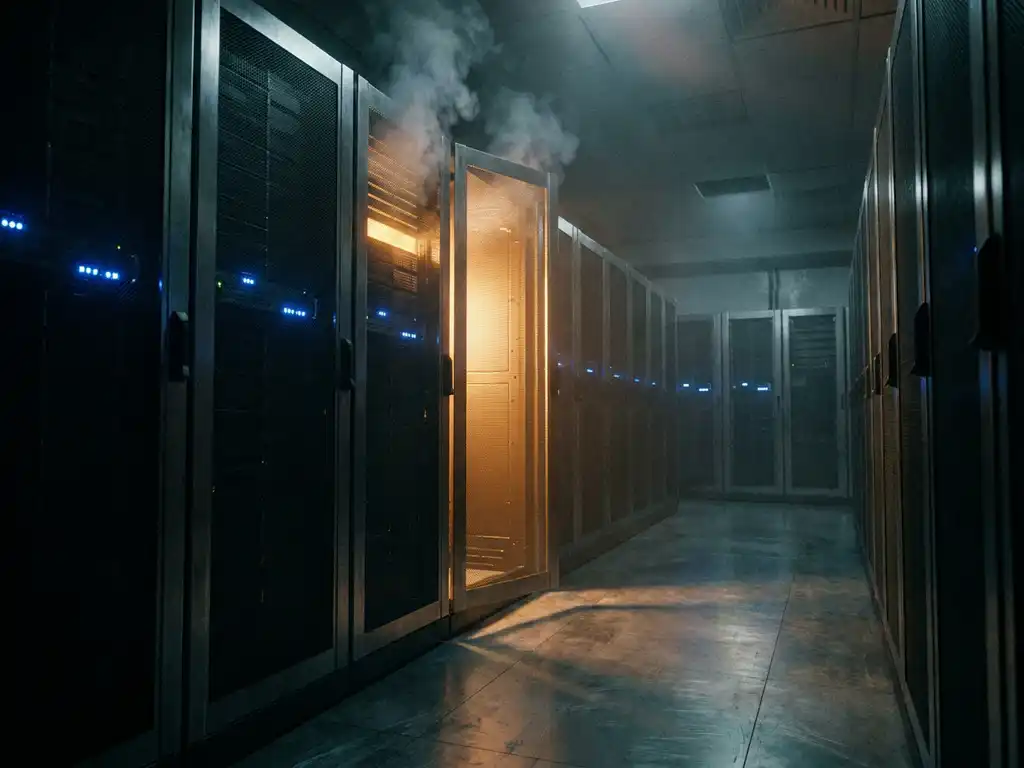
Data centres face fire risks from electrical faults, overheating equipment, power surges, and human error. These hazards are especially serious because data centres run continuously, house densely packed electronics, and depend on stable power infrastructure. Understanding the specific fire risks in data centres is the first step toward protecting the equipment, data, and operations housed inside them.
What causes fires in data centres?
The most common causes of fires in data centres are electrical faults, overheating hardware, and failures in power distribution equipment. Uninterruptible power supplies (UPS), battery systems, and switchgear are frequent ignition sources, along with server hardware that generates sustained heat during operation. Human error during maintenance or cabling work also contributes to data centre fire hazards.
More specifically, the causes typically fall into a few recurring categories:
- Electrical arcing and short circuits in power distribution units, busways, or switchgear
- Overheating batteries, particularly in UPS systems and Battery Energy Storage Systems (BESS), which can enter thermal runaway
- Cooling failures that allow server hardware to overheat beyond safe operating thresholds
- Cable faults caused by damaged insulation, overloaded circuits, or improper cable management
- Human error during maintenance, including accidental disconnections or improper equipment handling
Most data centre fires originate inside or directly adjacent to electrical enclosures rather than in open floor space. This makes object-level protection, focused on the equipment itself, a critical layer of any fire safety strategy.
Why are data centres particularly vulnerable to fire damage?
Data centres are particularly vulnerable to fire damage because of their combination of continuous high electrical loads, densely packed heat-generating hardware, and the presence of combustible materials like insulation and cable jackets. The same design features that make data centres efficient also make fire containment more difficult once ignition occurs.
Several structural and operational factors increase this vulnerability:
- 24/7 operation means equipment runs constantly with no scheduled downtime for cooling or inspection
- High power density in modern server racks creates concentrated heat in small physical spaces
- Raised floor systems and cable trays can allow smoke and heat to travel through hidden pathways before a fire becomes visible
- Interdependency of systems means a fire in one cabinet can cascade to adjacent equipment through shared power or cooling infrastructure
- Sensitive electronics can be permanently damaged not only by flames but also by smoke, heat, and the chemical residues left by some suppression agents
This last point is particularly important. Even a small, contained fire event can render servers, storage arrays, or networking equipment unusable if the suppression response introduces corrosive agents or moisture into the enclosure.
How quickly can a fire spread inside a data centre?
A fire can spread inside a data centre within minutes, particularly when it starts inside an electrical cabinet or server rack where heat builds rapidly in a confined space. Cable insulation, printed circuit boards, and plastic components are all combustible, and the airflow systems designed to cool equipment can accelerate flame and smoke propagation if a fire is not detected and suppressed at the source.
The speed of spread depends on several factors, including the density of combustible materials, the effectiveness of compartmentalization, and whether fire suppression is focused at the object level or only at the room level. A room-level suppression system may respond only after heat and smoke have already moved beyond the original enclosure. Early detection at the source, before flames develop, is what determines whether a fire event becomes a minor incident or a major operational disruption.
What are the consequences of a data centre fire?
The consequences of a data centre fire range from hardware destruction and data loss to prolonged operational downtime and significant financial costs. Even a fire that is physically contained to a single cabinet can force a facility offline for hours or days while safety assessments, equipment replacement, and system restoration take place.
The most serious consequences include:
- Hardware loss: Servers, storage systems, and networking equipment destroyed or damaged beyond repair
- Data loss: Corrupted or unrecoverable data if systems are not backed up or if backup infrastructure is also affected
- Operational downtime: Service interruptions that affect customers, partners, and internal operations
- Regulatory and compliance exposure: Failure to maintain uptime or protect data can trigger contractual penalties or regulatory scrutiny
- Reputational damage: Clients and stakeholders lose confidence in a facility that has experienced a fire incident
- Environmental liability: Suppression agents containing PFAS or other harmful chemicals can create cleanup obligations and environmental risk
For organisations where uptime is a contractual or operational requirement, the cost of a single fire event can far exceed the investment required to prevent it.
How can data centre fires be detected early?
Data centre fires can be detected early through aspirating smoke detection systems, which draw air samples continuously from inside cabinets and enclosures to identify smoke particles before visible flames develop. This approach detects fire at the pre-combustion stage, giving suppression systems time to respond before hardware is damaged.
Standard point detectors mounted on ceilings are often insufficient for data centre environments because they only respond once smoke has escaped an enclosure and risen to ceiling level. By that point, the equipment inside the cabinet may already be damaged. Aspirating detection integrated directly into server racks or electrical cabinets monitors the air at the exact location where ignition is most likely to begin.
Effective early detection systems for data centres share several characteristics:
- Continuous air sampling rather than passive waiting for smoke to reach a sensor
- Detection sensitivity calibrated to the specific environment inside electrical enclosures
- Integration with suppression systems so that detection triggers an immediate response
- Status reporting to a central fire panel so operators are alerted in real time
What fire suppression methods are used in data centres?
Fire suppression methods used in data centres include gaseous suppression systems, clean agent systems, and inert gas systems, all designed to extinguish fires without damaging sensitive electronics. The most suitable approach for a given facility depends on the equipment being protected, the enclosure type, and environmental and regulatory requirements.
Common suppression approaches include:
- Room-level gaseous suppression: Floods an entire data hall with a suppression agent, effective for large-scale fires but slow to respond to localised ignition inside cabinets
- Clean agent systems: Use chemical agents such as FM-200 or Novec, though many of these contain PFAS compounds that are increasingly restricted under environmental regulations
- Inert gas systems: Use gases such as nitrogen to reduce oxygen levels and extinguish fire without leaving chemical residues, making them safe for sensitive electronics
- Object-level suppression: Targets individual cabinets or enclosures directly, suppressing fire at the source rather than relying on room-level coverage
The direction of travel in data centre fire suppression is toward solutions that combine early detection with object-level suppression, are free from PFAS and harmful chemical residues, and can be maintained with minimal operational overhead.
How ExxFire helps protect data centres against fire
ExxFire provides integrated fire detection and suppression systems purpose-built for the environments where data centre fires are most likely to start: inside the cabinet itself.
- Aspirating smoke detection continuously samples air inside the enclosure, catching fire at the pre-combustion stage before hardware is damaged
- Non-pressurized nitrogen suppression extinguishes fire without leaving chemical residues, protecting sensitive electronics and avoiding the environmental liabilities associated with PFAS-containing agents
- Object-level protection secures individual server racks and electrical cabinets up to 4.5 m³, with multiple units interconnectable for larger volumes
- Easy installation and zero ongoing maintenance keep the Total Cost of Ownership low, with no specialist certification required for installation
- Built-in relays report system status directly to an existing fire panel, integrating seamlessly with your facility’s broader fire safety infrastructure
- Tested and certified by CNPP in France and DMT (TÜV Nord) in Germany, providing independent validation of performance
For data centre operators, facility managers, and IT infrastructure directors looking to address fire risks at the source, ExxFire offers a clean, certified, and low-maintenance solution. Contact ExxFire to discuss the right fire protection approach for your facility.
Related Articles
- How do seasonal conditions influence fire management planning?
- How does a fire suppression system work in an E-cabinet?
- What are the fire safety requirements for lithium-ion battery cabinets?
- What fire suppression standards apply to data centers in 2026?
- What fire suppression options meet EU environmental standards in 2026?