

What are the fire safety requirements for lithium-ion battery cabinets?
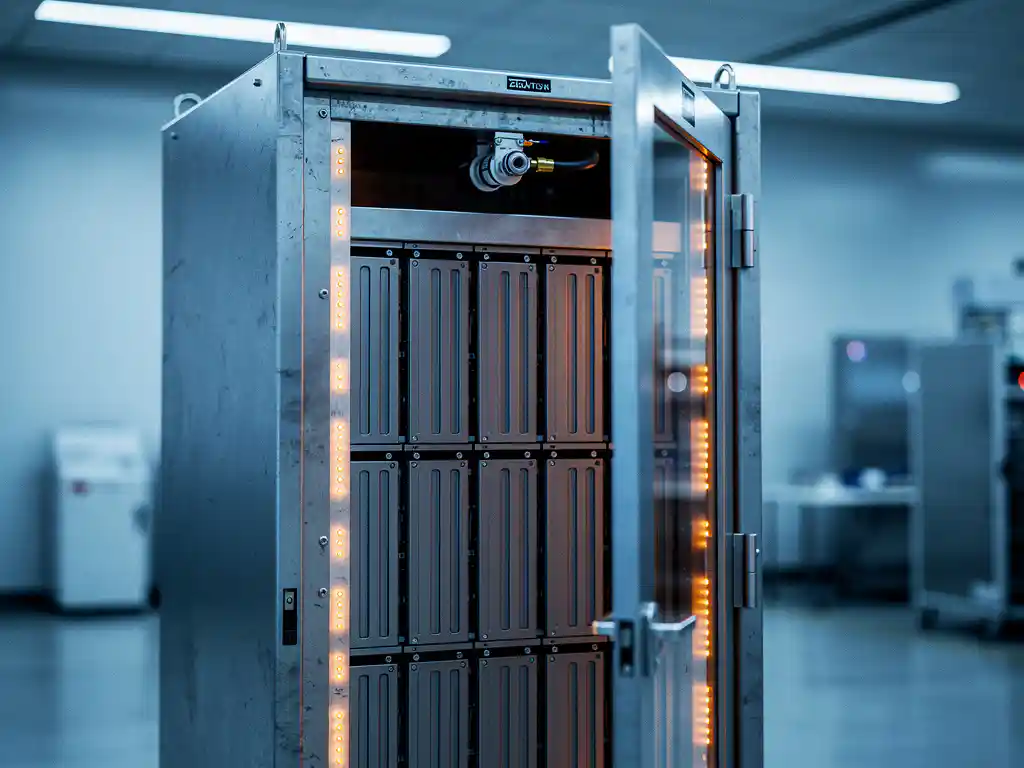
Lithium-ion battery cabinets require a combination of early smoke or gas detection and a fast-acting suppression system capable of managing thermal runaway. The core standards that apply include IEC 62619, NFPA 855, and regional building and fire codes, all of which set minimum requirements for detection, suppression, ventilation, and installation. The sections below address each of these requirements in detail, from applicable standards to maintenance obligations.
Which fire safety standards apply to lithium-ion battery cabinets?
The primary fire safety standards for lithium-ion battery cabinets are IEC 62619, which covers safety requirements for secondary lithium cells and batteries in industrial applications, and NFPA 855, the Standard for the Installation of Stationary Energy Storage Systems. Together, these define how battery energy storage systems must be designed, installed, and protected against fire.
IEC 62619 sets requirements for the safe design and operation of lithium-ion batteries, including thermal management and protection against overcharge, over-discharge, and short circuits. NFPA 855 goes further by specifying fire protection measures at the installation level, including suppression system requirements, spacing, and detection thresholds for battery energy storage fire safety.
Additional standards that may apply depending on location and application include:
- UL 9540 and UL 9540A: Test methods for evaluating thermal runaway propagation in battery energy storage systems
- IEC 62933: Covers electrical energy storage system requirements, including safety aspects
- EN 50272 and regional equivalents: Address ventilation and gas management for battery installations
- Local building codes: Many jurisdictions layer additional requirements on top of international standards, particularly for indoor BESS installations
For industrial facility safety managers, compliance typically requires meeting the most stringent applicable standard. In practice, this means designing lithium-ion battery cabinet fire protection to satisfy both IEC 62619 and NFPA 855 simultaneously, while verifying whether local authorities having jurisdiction (AHJ) impose additional conditions.
What fire risks are specific to lithium-ion battery cabinets?
The defining fire risk in lithium-ion battery cabinets is thermal runaway, a self-reinforcing exothermic reaction in which a failing cell generates heat that triggers failure in neighboring cells. Unlike conventional electrical fires, thermal runaway can occur even after the battery appears to have cooled, making early detection and sustained suppression critical.
Thermal runaway is typically initiated by one of three root causes: mechanical damage, electrical faults such as overcharging or short circuits, or manufacturing defects. Once triggered, the reaction releases flammable gases including hydrogen and carbon monoxide, which can ignite or explode if they accumulate inside the cabinet.
Several factors make lithium-ion battery cabinet fires particularly difficult to manage:
- Fires can reignite hours or days after initial suppression due to residual heat in the cell stack
- Toxic and flammable off-gases are released before visible flames appear, creating an invisible hazard window
- High energy density means a small number of cells can release a significant amount of heat rapidly
- Conventional water-based suppression may cause electrical damage or, in some designs, accelerate the reaction
These characteristics mean that battery energy storage fire safety cannot rely on the same suppression strategies used for general electrical fires. Detection must happen earlier, and suppression agents must be matched specifically to the chemistry of lithium-ion cells.
What detection methods are required inside battery cabinets?
Battery cabinet fire detection must be capable of identifying thermal runaway in its earliest stages, before flames or significant heat develop. Aspirating smoke detection (ASD) and gas detection for carbon monoxide and hydrogen are the most effective methods for this purpose, and NFPA 855 and IEC 62619 both emphasize early-warning detection as a core requirement.
Aspirating smoke detectors work by continuously drawing air samples from inside the cabinet through a pipe network, analyzing the sample at a central detection unit. This approach is significantly more sensitive than point-type smoke detectors and can identify combustion particles at concentrations far below what triggers a conventional detector. For enclosed battery cabinets, this sensitivity is essential.
Gas detection adds a complementary layer. Because lithium-ion cells off-gas hydrogen and carbon monoxide during early thermal runaway, a gas sensor can trigger an alarm before smoke particles are even present. Combining smoke and gas detection inside the cabinet creates a redundant detection architecture that reduces the risk of a delayed response.
Optical flame detectors or heat detectors alone are generally insufficient as primary detection methods for battery cabinets because they respond too late in the thermal runaway sequence. Detection systems must also be integrated with the suppression system so that an alarm triggers automatic suppression without requiring manual intervention.
What suppression agents are approved for lithium-ion battery fires?
The suppression agents most commonly used and evaluated for lithium-ion battery cabinet fires include inert gases (primarily nitrogen and argon), clean agents such as FK-5-1-12 and HFC-227ea, and water mist systems. Each has different effectiveness profiles, and no single agent fully stops thermal runaway once it is underway in a large cell stack.
Inert gas suppression, particularly nitrogen, works by reducing the oxygen concentration inside the cabinet below the level needed to sustain combustion. Nitrogen is non-conductive, leaves no residue, and does not damage sensitive electronics or battery management systems. It is also PFAS-free, which is increasingly important as regulations phase out fluorinated suppression agents.
Clean agents such as FK-5-1-12 suppress fire through a combination of heat absorption and chemical interference with the combustion process. They are fast-acting and electrically non-conductive, but some variants are subject to regulatory restrictions due to their global warming potential. Facilities specifying BESS fire suppression systems should verify current environmental compliance requirements before selecting a fluorinated clean agent.
Water mist is effective at cooling cells and absorbing heat, which can slow thermal runaway propagation. However, it introduces moisture into the cabinet, which may damage electronics and battery management systems. Its use is generally better suited to larger BESS installations with dedicated containment rather than individual battery cabinets.
For enclosed battery cabinets specifically, inert gas suppression is widely regarded as the most practical combination of effectiveness, residue-free operation, and compatibility with sensitive electronics.
How should fire suppression systems be installed in battery cabinets?
Fire suppression systems for lithium-ion battery cabinets should be installed as integrated, self-contained units that combine detection and suppression within or directly adjacent to the protected enclosure. NFPA 855 requires suppression systems to be designed by qualified personnel and installed in accordance with the system manufacturer’s specifications and the listing or approval documentation.
Key installation requirements include:
- Enclosure integrity: The cabinet must be sufficiently sealed to retain the suppression agent at effective concentration for the required holding time. Gaps around cable entries, ventilation openings, and door seals must be assessed and addressed.
- Agent distribution: Nozzles or discharge points must be positioned to ensure even distribution of the suppression agent throughout the protected volume, including around battery modules and busbars.
- Detection placement: Sensors must be positioned to sample air from inside the battery compartment, not from the general room environment, to detect off-gases and smoke at the source.
- Automatic actuation: The system must be capable of activating without human intervention when detection thresholds are reached. Manual override capability is also required for maintenance and testing.
- Integration with fire panels: The system should be connected to the facility fire alarm system via relays or protocol interfaces so that events are logged, alarms are escalated, and appropriate responses are coordinated.
For indoor BESS installations, NFPA 855 also specifies maximum storage quantities and separation distances between battery systems, which influence how suppression zones are designed and whether individual cabinet-level protection must be supplemented by room-level systems.
What maintenance and inspection requirements apply to battery cabinet fire systems?
Fire suppression systems protecting lithium-ion battery cabinets must be inspected and maintained on a regular schedule to ensure they remain operational. NFPA 72 and NFPA 2001 provide baseline inspection frequencies for detection and clean agent systems, respectively, while the system manufacturer’s documentation specifies component-level maintenance intervals.
Typical maintenance obligations include:
- Annual functional testing of detection sensors, including sensitivity verification for aspirating smoke detectors and gas sensors
- Regular visual inspection of nozzles, pipe connections, and discharge heads for obstruction, corrosion, or physical damage
- Suppression agent quantity verification at intervals specified by the manufacturer, particularly for pressurized systems where agent loss through leakage is possible
- Enclosure integrity checks to confirm that seals, cable penetrations, and ventilation dampers remain effective
- Battery management system review to verify that detection thresholds and alarm setpoints remain correctly calibrated as battery systems age
Non-pressurized suppression systems, such as those based on solid-state nitrogen generators, generally have lower maintenance burdens than pressurized cylinder-based systems because there is no stored pressure to monitor and no risk of gradual agent loss between inspections. This can reduce the total cost of ownership over the life of the installation.
Documentation of all inspections, tests, and maintenance activities is a regulatory requirement in most jurisdictions and is essential for demonstrating compliance during audits or following an incident.
How ExxFire helps protect lithium-ion battery cabinets
ExxFire’s integrated fire detection and suppression systems are purpose-built for enclosed equipment like battery energy storage systems, addressing the specific challenges of thermal runaway detection and suppression in a single, pre-engineered solution. The system combines aspirating smoke detection with non-pressurized nitrogen gas suppression delivered through ExxFire’s patented Cool Gas Generator technology, making it directly applicable to the fire safety requirements described in this article.
Key features relevant to lithium-ion battery cabinet fire protection include:
- Aspirating smoke detection that identifies combustion particles at the earliest possible stage, before thermal runaway escalates
- Nitrogen suppression that is electrically non-conductive, residue-free, and PFAS-free, protecting battery management systems and sensitive electronics without secondary damage
- Non-pressurized storage, which eliminates the maintenance requirements associated with pressurized cylinder systems and reduces total cost of ownership
- Pre-engineered design for self-installation in enclosures up to 4.5 m³, with multiple units interconnectable for larger volumes
- Built-in relays for integration with existing fire panels, supporting the alarm escalation and documentation requirements described above
- Testing and certification by CNPP France, providing independent verification of system performance
If you are specifying fire protection for lithium-ion battery cabinets and need a system that meets current standards without complex installation or ongoing pressurized maintenance, contact ExxFire to discuss your application and receive technical documentation.