
What is a fire risk assessment?
A fire risk assessment is a structured evaluation of a premises or environment to identify potential fire hazards, determine who may be at risk, and establish measures to reduce or eliminate that risk. It is both a legal requirement in most jurisdictions and a practical tool for protecting people, property, and operations. The sections below answer the most common questions about how fire risk assessments work, what they cover, and how they connect to your broader fire safety strategy.
Who is legally required to carry out a fire risk assessment?
Any person responsible for a non-domestic premises is legally required to carry out a fire risk assessment. This includes employers, building owners, landlords, and occupiers of commercial, industrial, or public buildings. In most countries, the legal duty falls on the “responsible person” – typically whoever has control over the premises or the activities carried out within it.
In the United Kingdom, the Regulatory Reform (Fire Safety) Order 2005 places this obligation on the responsible person for all non-domestic premises. Similar legislation exists across the European Union, where national fire safety laws generally require employers and building operators to conduct and document formal fire safety risk assessments. In the United States, fire codes enforced by local authorities having jurisdiction (AHJ) impose comparable requirements, particularly for commercial and industrial occupancies.
The key principle across most regulatory frameworks is straightforward: if you employ five or more people, or if your premises are licensed or subject to an alterations notice, the assessment must be recorded in writing. Even where written documentation is not strictly mandated, maintaining a written record is considered best practice and provides evidence of compliance in the event of an inspection or incident.
What does a fire risk assessment include?
A fire risk assessment includes five core steps: identifying fire hazards, determining who is at risk, evaluating and reducing those risks, recording findings and implementing an emergency plan, and reviewing the assessment regularly. Together, these steps form a complete picture of fire risk within a given environment and the actions needed to manage it.
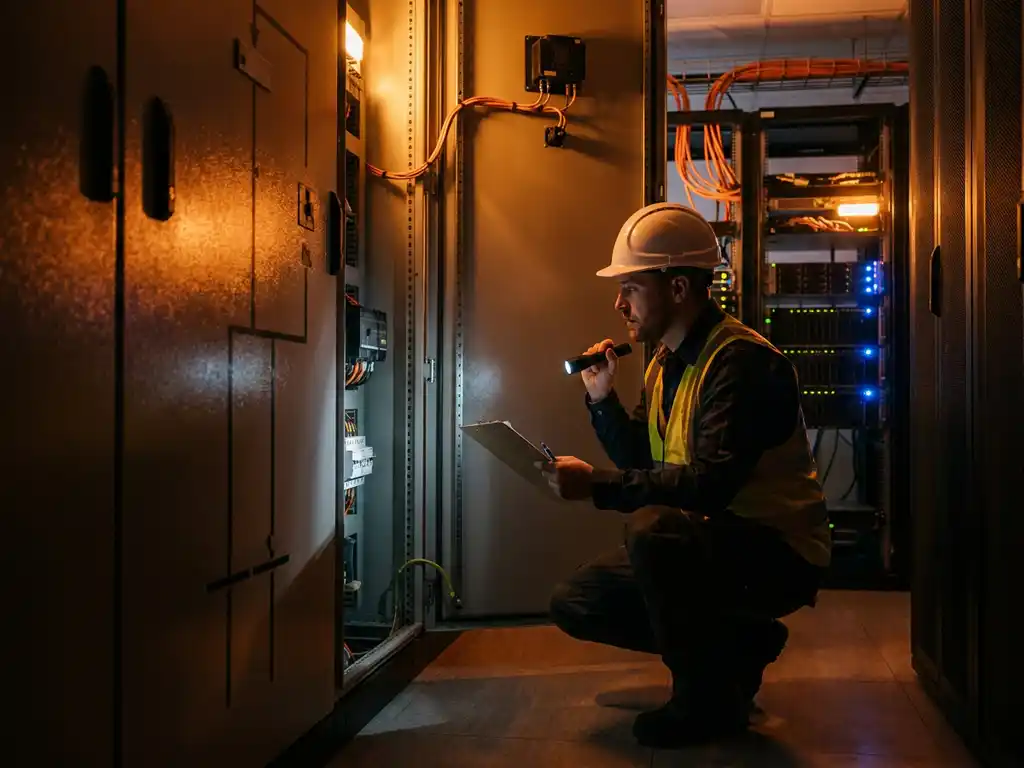
The process begins with a thorough walk-through of the premises to identify ignition sources, fuel sources, and oxygen supplies that could combine to start or sustain a fire. From there, the assessor identifies the people most at risk, including employees, visitors, contractors, and any individuals with mobility or sensory impairments who may have greater difficulty evacuating.
The evaluation phase involves weighing the likelihood of a fire starting against the potential consequences, then identifying practical control measures. These might include removing unnecessary combustible materials, improving compartmentation, upgrading detection systems, or installing suppression equipment near high-risk assets. The assessment concludes with a documented action plan, an emergency evacuation procedure, and a schedule for future review.
How often should a fire risk assessment be reviewed?
A fire risk assessment should be reviewed at least annually, and immediately following any significant change to the premises, its use, or its occupancy. Changes that trigger an immediate review include structural alterations, the introduction of new processes or equipment, a change in the number of occupants, or a near-miss or fire incident on site.
There is no universal legal requirement specifying an exact review interval in most jurisdictions, but annual review is the widely accepted standard across fire safety guidance in Europe and beyond. For higher-risk environments such as industrial facilities, data centres, or buildings housing hazardous materials, more frequent reviews may be appropriate.
The underlying principle is that a fire risk assessment must remain current and relevant. An assessment completed three years ago for a warehouse that has since been converted into a server room is no longer fit for purpose. Keeping the assessment up to date is not just a compliance issue – it is the only way to ensure that the measures in place genuinely reflect the risks present today.
What are the most common fire hazards identified in risk assessments?
The most common fire hazards identified during a fire risk assessment fall into three categories: ignition sources, fuel sources, and failures in detection or suppression. Electrical faults consistently rank as the leading ignition source in commercial and industrial environments, followed by human error, overheating equipment, and inadequate housekeeping.
Common hazards identified across different types of premises include:
- Electrical equipment and wiring: Overloaded circuits, faulty cables, and ageing switchgear or electrical cabinets are frequent ignition points, particularly in industrial and ICT environments.
- Combustible materials stored near heat sources: Paper, packaging, and other flammable materials left close to heating equipment or electrical panels significantly increase fire risk.
- Battery systems: Battery energy storage systems (BESS) and lithium-ion batteries present a growing hazard due to the risk of thermal runaway, which can be difficult to detect and suppress using conventional methods.
- Inadequate compartmentation: Gaps in fire doors, unsealed cable penetrations, and missing fire-stopping materials allow fire and smoke to spread far beyond the point of origin.
- Insufficient or poorly maintained detection systems: Detection systems that are outdated, poorly positioned, or not tested regularly may fail to provide early warning when it matters most.
Understanding which hazards are most prevalent in your specific environment is one of the most valuable outcomes of a thorough fire safety risk assessment. It allows resources and protective measures to be directed where they will have the greatest impact.
What’s the difference between a fire risk assessment and a fire safety inspection?
A fire risk assessment is a proactive, internally driven process in which the responsible person evaluates hazards and implements controls. A fire safety inspection is an external audit carried out by a fire authority or regulatory body to verify compliance with fire safety legislation. The two serve different purposes and are not interchangeable.
The fire risk assessment is something the responsible person commissions or conducts themselves, often with the help of a qualified fire safety consultant. It is forward-looking: its purpose is to identify what could go wrong and put measures in place to prevent it. The output is a documented action plan that the organisation owns and is responsible for acting on.
A fire safety inspection, by contrast, is reactive and regulatory. Inspectors from the fire and rescue service or a local authority visit the premises to check whether the responsible person has met their legal obligations. They may review the written fire risk assessment, check that fire safety equipment is in place and maintained, and verify that staff have received adequate training. Failing an inspection can result in enforcement notices, prohibition orders, or prosecution.
In short, the fire risk assessment is the work you do to manage fire safety. The inspection is the check that you have done it properly.
How does fire suppression equipment affect a fire risk assessment outcome?
Fire suppression equipment directly improves a fire risk assessment outcome by reducing both the likelihood of fire spreading and the severity of potential consequences. When suppression systems are installed and appropriate to the hazard, assessors can record a lower residual risk level, which may reduce the need for additional compensatory measures elsewhere in the building.
The type and placement of suppression equipment matters significantly. A general sprinkler system protects a broad area but may not respond quickly enough to contain a fire that starts inside a closed electrical cabinet or server rack. Object-level suppression systems, designed to act at the source of ignition within enclosed equipment, offer a more targeted layer of protection that a fire risk assessment can recognise as a meaningful risk reduction control.
Assessors also consider whether suppression systems are appropriate for the assets they protect. In environments containing sensitive electronics, high-value hardware, or mission-critical infrastructure, the suppression agent itself matters. Systems that use water or chemically active agents may extinguish a fire but cause secondary damage to the equipment they were meant to protect. Inert gas suppression, which leaves no chemical residues, is increasingly recognised in fire risk assessments as a preferred solution for these environments because it eliminates fire without damaging the assets inside.
Documented evidence that suppression systems are tested, certified, and maintained is an important part of the assessment record. Systems validated by recognised bodies such as TÜV Nord or CNPP carry greater weight in demonstrating that the installed protection meets the required standard.
How ExxFire supports your fire risk assessment strategy
Once a fire risk assessment identifies high-value or mission-critical equipment as a priority hazard, the next step is selecting suppression technology that genuinely reduces that risk. ExxFire’s integrated fire detection and suppression systems are purpose-built for exactly this scenario.
- Early smoke detection: Aspirating smoke detection identifies fire at the earliest possible stage, before flames develop inside server racks, switchgear, or electrical cabinets.
- Object-level suppression: Non-pressurised nitrogen gas is released directly at the source of ignition, containing the fire without spreading damage to surrounding equipment.
- No chemical residues: Nitrogen leaves no residue, protecting sensitive electronics and supporting business continuity after an event.
- PFAS-free and environmentally responsible: ExxFire’s patented Cool Gas Generator technology is a clean alternative to PFAS-containing suppression agents, supporting compliance with tightening environmental regulations.
- Easy installation and low maintenance: Systems are designed for straightforward self-installation inside or outside the protected enclosure, with no ongoing maintenance checks required after commissioning.
- Tested and certified: All systems are validated by CNPP France and DMT, part of TÜV Nord, providing the documented evidence that fire risk assessors and inspectors look for.
If your fire risk assessment has identified electrical cabinets, server racks, battery storage systems, or other enclosed high-value assets as priority hazards, explore ExxFire’s suppression systems to find the right object protection solution for your environment.
Related Articles
- How does smoking increase fire risk indoors?
- What are the fire risks associated with lithium-ion batteries?
- What is VdS certification and why does it matter?
- Should facility managers choose a modular or fixed fire suppression system?
- What is the EU REACH regulation and how does it affect fire protection?