

What is off-gas detection and how does it prevent fires?
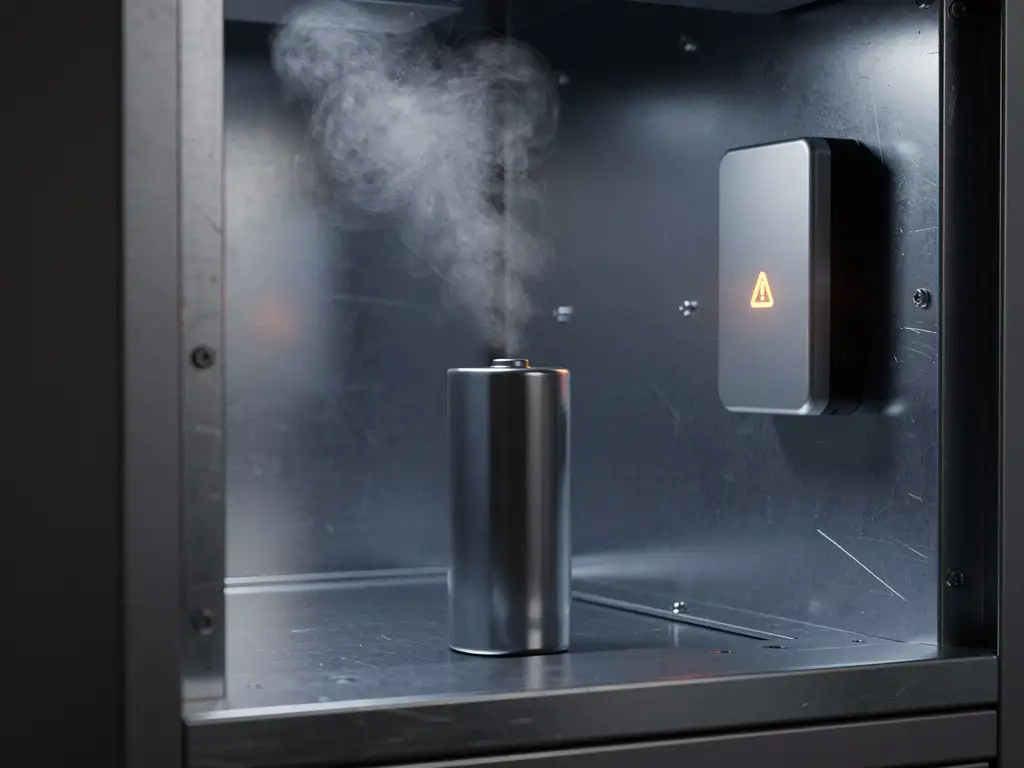
Off-gas detection is the process of identifying hazardous gases released by batteries or other equipment before a fire or explosion occurs. By detecting these chemical warning signals at the earliest possible stage, off-gas detection systems give facility operators time to intervene, isolate the hazard, or trigger suppression before thermal runaway escalates into an uncontrollable fire. The sections below address the most important questions about how this technology works, where it applies, and how it connects to broader fire prevention strategies.
How does off-gas detection work in practice?
Off-gas detection works by continuously sampling the air inside or around an enclosure for trace concentrations of gases that batteries and electrical components release during early-stage degradation. Specialized sensors identify these chemical markers at parts-per-million concentrations, triggering an alert long before any visible smoke, flame, or heat is present.
Most off-gas detection systems use electrochemical sensors, photoionization detectors, or infrared absorption technology to identify specific gas compounds. The sensor array is typically installed inside the protected enclosure, as close as possible to the cells or components most likely to degrade first. When gas concentrations exceed a defined threshold, the system sends an alarm signal to a control panel, initiates a ventilation response, or directly activates a suppression system.
The detection cycle is continuous and automatic. Unlike periodic manual inspections, off-gas monitoring provides real-time data on the chemical state of the protected asset. This is especially valuable in unattended or remote installations where human observation is not practical around the clock.
What gases are released before a battery fire starts?
Before a lithium-ion battery fire starts, the cells release a distinct mixture of gases during the early stages of thermal runaway. The most commonly detected compounds include hydrogen, carbon monoxide, methane, ethylene, and various volatile organic compounds. These gases are produced as the electrolyte begins to decompose under heat or mechanical stress, well before any visible sign of fire.
Hydrogen is often the earliest and most reliable indicator. It is released at relatively low temperatures, making it a practical target for early warning sensors. Carbon monoxide follows as internal cell temperatures continue to rise. Ethylene and other hydrocarbons are produced as the separator and electrolyte break down further, signaling that thermal runaway is progressing toward an irreversible stage.
The specific gas profile varies depending on battery chemistry. Lithium iron phosphate cells produce a different mixture than nickel manganese cobalt cells, for example. Well-designed off-gas detection systems are calibrated to the battery chemistry present in the installation to minimize false alarms and maximize detection sensitivity.
Why is smoke detection not enough for battery fire risks?
Smoke detection is not enough for battery fire risks because smoke is produced at a much later stage in the thermal runaway sequence than off-gases. By the time smoke particles are present in detectable concentrations, the battery degradation process is already advanced, leaving little time for safe intervention or suppression.
Traditional smoke detectors are designed to respond to combustion byproducts. In a battery fire scenario, the most dangerous phase begins with gas venting, not combustion. A cell can vent toxic and flammable gases for several minutes before ignition occurs. During that window, off-gas detection provides actionable warning. Smoke detection does not.
There is also a practical limitation in enclosed environments such as battery cabinets and BESS containers. Smoke may not migrate quickly enough from the interior of a tightly packed enclosure to reach an external smoke detector. Off-gas sensors installed inside the enclosure detect the gases at the source, eliminating this detection gap entirely.
This does not mean smoke detection has no role. In a layered fire safety strategy, smoke detection and off-gas detection serve complementary functions. Off-gas detection provides early warning, and smoke and heat detection provide confirmation and backup. Relying on smoke detection alone leaves a significant and well-documented gap in battery fire safety.
Where is off-gas detection most critical in industrial facilities?
Off-gas detection is most critical in any industrial location where lithium-ion batteries, lead-acid battery banks, or electrochemical energy storage systems are installed in enclosed spaces. The highest-risk locations include battery energy storage systems, uninterruptible power supply rooms, electric vehicle charging infrastructure, and large-scale electrical switchgear installations.
Battery Energy Storage Systems represent the most acute risk. Large BESS installations contain hundreds or thousands of individual cells in a confined enclosure. A single cell failure can trigger a cascade of thermal runaway events across neighboring cells. Off-gas detection at the module or rack level provides the earliest possible warning and supports targeted suppression before the failure propagates.
Industrial UPS rooms and data center power infrastructure are also high-priority locations. These environments often run continuously, are frequently unmanned, and house aging battery banks that are statistically more prone to degradation. Early gas detection in these spaces directly supports business continuity by enabling intervention before equipment damage occurs.
Beyond energy storage, industrial processes that involve electrochemical reactions, such as electroplating or chlor-alkali production, also benefit from off-gas monitoring. In these settings, hydrogen accumulation is a persistent explosion risk that conventional fire detection cannot adequately address.
How does off-gas detection integrate with fire suppression systems?
Off-gas detection integrates with fire suppression systems by serving as the trigger that initiates a suppression response before a fire has fully developed. When the gas sensor detects a threshold concentration, it sends a signal to the suppression controller, which activates the extinguishing agent inside the protected enclosure within seconds.
This integration is most effective in closed-enclosure suppression systems, where the suppression agent is delivered directly inside the cabinet, rack, or battery module rather than into the surrounding room. The detection-to-suppression sequence is fast enough to interrupt thermal runaway before it reaches ignition temperature, protecting the asset and preventing fire spread to adjacent equipment.
The integration can be configured in several ways depending on the facility’s existing infrastructure. Standalone systems combine detection and suppression in a single self-contained unit. In larger installations, off-gas sensors feed into a central fire panel via relay outputs, allowing facility managers to monitor multiple zones from a single interface and coordinate suppression across several enclosures simultaneously.
How ExxFire addresses off-gas and early fire detection
ExxFire’s integrated fire detection and suppression systems are designed specifically for the enclosed environments where off-gas and early fire risks are most severe. The systems combine aspirating smoke detection with non-pressurized nitrogen gas suppression, delivered through the patented Cool Gas Generator technology. Key features include:
- Enclosure-level protection: Systems are engineered for closed enclosures such as battery cabinets, server racks, and electrical switchgear up to 4.5 m³, with multiple units interconnectable for larger volumes.
- Early detection at the source: Aspirating detection samples air directly from inside the protected enclosure, identifying combustion indicators before they can spread.
- Clean, residue-free suppression: Nitrogen gas leaves no chemical residue, protecting sensitive electronics and battery components from secondary damage.
- Seamless integration: Built-in relays allow the system to report status to an existing fire panel, making it compatible with established facility safety infrastructure.
- Low installation burden: Systems are pre-engineered for self-installation without special certification, reducing deployment time and total cost of ownership.
If you are responsible for BESS fire safety or protecting high-value electrical assets in your facility, contact ExxFire to discuss which integrated detection and suppression configuration is right for your application.
What standards and certifications apply to off-gas detection systems?
Off-gas detection systems used in industrial and energy storage applications are subject to a range of standards depending on the installation environment, the gases being detected, and the geographic market. The most relevant frameworks include IEC and EN standards for gas detection equipment, ATEX and IECEx directives for use in explosive atmospheres, and application-specific standards such as NFPA 855 for stationary energy storage systems.
IEC 60079 and the associated EN 60079 series govern equipment intended for use in potentially explosive atmospheres. Where hydrogen or other flammable gases may accumulate, ATEX certification is typically mandatory in European markets, and IECEx certification applies in international contexts. These certifications confirm that the detection equipment will not itself become an ignition source.
For battery energy storage applications specifically, NFPA 855 in the United States and the IEC 62933 series internationally provide guidance on detection, suppression, and ventilation requirements for electrochemical energy storage systems. Many jurisdictions now require or strongly recommend off-gas detection as part of a compliant BESS fire safety design.
FM Global and other industrial insurers increasingly reference early gas detection in their property loss prevention guidelines. Facilities seeking favorable insurance terms for BESS or large UPS installations should verify that their detection systems align with the relevant FM Global data sheets. Testing and certification by recognized third-party bodies such as CNPP or TÜV Nord provides additional assurance that the system performs as specified under real-world conditions.