

What is the difference between inert gas and chemical suppression agents?
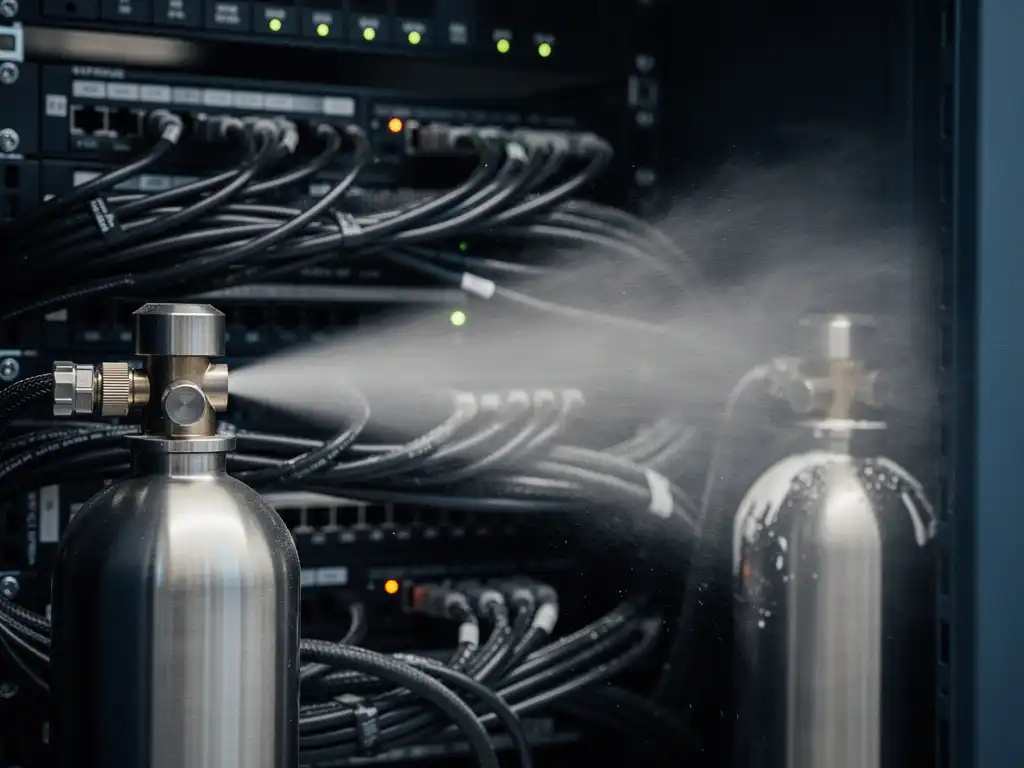
Inert gas suppression and chemical suppression agents extinguish fires through fundamentally different mechanisms. Inert gases work by reducing oxygen concentration in a protected space, while chemical agents interrupt the chemical chain reaction of combustion or coat surfaces to smother flames. The choice between them has significant consequences for equipment safety, environmental compliance, and long-term operational cost. The sections below unpack each key difference in practical terms.
How do inert gas and chemical suppression agents actually work?
Inert gas suppression works by displacing or diluting the oxygen in a protected enclosure, bringing the oxygen concentration below the level needed to sustain combustion – typically below 15%. Because the gas itself is chemically inert, it does not react with the fire or the protected equipment. Chemical suppression agents, by contrast, work either by interrupting the chemical chain reactions that sustain a flame or by forming a physical barrier that cuts off the fuel-oxygen interface.
In practical terms, inert gas systems flood a space with gases such as nitrogen, argon, or a blend of both, starving the fire of oxygen without leaving any residue. Chemical agents – including halon alternatives, dry powder, and certain foam-based agents – release compounds that actively interfere with combustion chemistry. Some chemical agents, like clean agent gases such as HFCs or HFOs, evaporate quickly and leave minimal residue, but their mode of action is still chemical rather than physical oxygen displacement.
The distinction matters because each mechanism has different implications for what happens to the protected environment after discharge. An inert gas system essentially returns the space to normal once ventilation is restored. A chemical agent may leave residues, coatings, or decomposition byproducts that require cleanup and can damage sensitive components.
What are the main types of inert gas fire suppression agents?
The main inert gas suppression agents used in fire protection are nitrogen, argon, and blended gases such as IG-541 (a mixture of nitrogen, argon, and carbon dioxide) and IG-55 (a nitrogen-argon blend). All of these work by oxygen reduction and are electrically non-conductive, leaving no residue after discharge.
- Nitrogen (IG-100): The most abundant gas in the atmosphere, nitrogen is widely used in enclosure-level suppression systems. It is non-toxic, non-reactive, and leaves absolutely no chemical residue.
- Argon (IG-01): A noble gas that is entirely inert and heavier than air, argon is effective in spaces where gas retention at lower levels is important.
- IG-541 (Inergen): A blend of 52% nitrogen, 40% argon, and 8% carbon dioxide. The small CO2 component stimulates breathing, which can help occupants evacuate more quickly in occupied spaces.
- IG-55 (Argonite): A 50/50 blend of nitrogen and argon, commonly used in total flooding applications for server rooms and archives.
All of these agents are PFAS-free and present no ozone depletion potential. Their environmental profile is one of their strongest advantages over many chemical alternatives, particularly as regulatory pressure on fluorinated compounds continues to intensify in 2026.
What are the main types of chemical fire suppression agents?
Chemical suppression agents include halon (now largely banned), HFC-based clean agents such as FM-200 (HFC-227ea), HFO-based agents, dry chemical powders, and certain foam concentrates. Each works through a different chemical mechanism and carries a different risk profile for equipment and the environment.
- FM-200 (HFC-227ea): A widely used clean agent that suppresses fire by absorbing heat and interrupting combustion chemistry. It leaves no residue but has a global warming potential many times higher than CO2.
- Novec 1230 (FK-5-1-12): A fluoroketone agent with a lower global warming potential than HFCs, though it belongs to the broader PFAS chemical family and faces increasing regulatory scrutiny.
- Dry chemical powder: Highly effective at suppression but leaves a corrosive powder residue that can destroy sensitive electronics and require extensive cleanup.
- Foam agents (AFFF): Used primarily for flammable liquid fires, but AFFF-type foams contain PFAS compounds and are subject to strict bans in many jurisdictions.
- CO2 systems: Effective and residue-free, but CO2 poses a serious asphyxiation risk to personnel and is not suitable for occupied spaces.
Which suppression agent is safer for sensitive electronics?
Inert gas suppression agents, particularly nitrogen, are the safest option for protecting sensitive electronics. They leave no chemical residue, cause no corrosion, and do not react with electronic components or circuit boards. Chemical agents – especially dry powders and foam – can cause immediate and severe damage to hardware, while even residue-free chemical clean agents may produce decomposition byproducts when exposed to heat that can coat or corrode delicate components.
For server racks, switchgear cabinets, ICT enclosures, and battery energy storage systems, the consequences of residue or chemical contamination extend beyond the fire event itself. Even if the fire is extinguished quickly, chemical residues can cause ongoing corrosion, short circuits, and long-term reliability problems. Nitrogen suppression eliminates this risk entirely because the gas is chemically neutral and disperses without leaving any trace on surfaces or components.
Speed of detection also plays a role in equipment safety. Systems that combine early-stage aspirating smoke detection with suppression can intervene before a fire develops into a full thermal event, reducing both the heat damage and the volume of suppression agent required. This is particularly relevant for enclosed equipment cabinets where a fast, clean response is critical.
Are chemical suppression agents harmful to the environment?
Many chemical suppression agents carry significant environmental risks. Halon, now banned under the Montreal Protocol, was highly destructive to the ozone layer. HFC-based agents like FM-200 have very high global warming potentials. PFAS-containing agents – including certain foam concentrates and some fluorinated clean agents – are persistent environmental pollutants that accumulate in ecosystems and are increasingly subject to regulatory bans across Europe, North America, and beyond.
In 2026, the regulatory landscape around PFAS is tightening considerably. The European Union’s PFAS restriction proposal under REACH, along with national-level bans in several countries, is pushing organizations to move away from fluorinated fire suppression agents. AFFF foams are already banned or severely restricted in many jurisdictions due to their PFAS content and documented contamination of groundwater and soil.
Inert gases such as nitrogen and argon present none of these environmental concerns. They are naturally occurring components of the atmosphere, carry no ozone depletion potential, and have negligible global warming potential. For organizations with sustainability commitments or compliance obligations, PFAS-free fire suppression using inert gas is the clear direction of travel.
When should you choose inert gas over chemical suppression?
Inert gas suppression is the preferred choice when protecting sensitive electronics, high-value equipment, or environments where chemical residue, toxicity, or environmental impact cannot be tolerated. It is particularly well-suited to enclosed spaces such as server cabinets, electrical switchgear, battery energy storage systems, and ICT infrastructure where a clean, residue-free response is essential to continuity of operations.
Choose inert gas suppression when one or more of the following conditions apply:
- The protected equipment is sensitive to chemical residue or corrosion
- Downtime after suppression discharge must be minimized
- The organization has sustainability goals or PFAS compliance obligations
- The suppression system needs to be installed in an enclosed cabinet or enclosure rather than a room
- Low total cost of ownership is a priority, including maintenance and post-discharge cleanup costs
- The system must be non-toxic and safe in proximity to personnel
Chemical agents may still be appropriate for certain applications – such as flammable liquid storage or large open industrial spaces – where inert gas retention is impractical. However, for the protection of business-critical equipment in enclosed environments, the combination of safety, cleanliness, and environmental compliance makes inert gas the technically and commercially superior choice.
How ExxFire protects mission-critical equipment with nitrogen suppression
ExxFire’s integrated fire detection and suppression systems bring together aspirating smoke detection and nitrogen-based suppression into a single, pre-engineered solution designed specifically for enclosed equipment environments. Using patented Cool Gas Generator technology, the systems deploy non-pressurized nitrogen gas directly at the source of a potential fire, intervening at the earliest possible stage before heat and flame can cause hardware damage.
Key features of ExxFire’s approach include:
- PFAS-free nitrogen suppression that leaves zero chemical residue on electronics or components
- Early aspirating smoke detection that identifies combustion particles before visible smoke or flame develops
- Non-pressurized gas storage in a solid state, eliminating the safety and maintenance concerns of pressurized cylinder systems
- Self-installation without special certification, reducing installation cost and complexity
- Compatibility with existing fire panels via built-in relays, enabling seamless integration into current infrastructure
- Tested and certified by CNPP France and TÜV Nord (DMT), providing independent validation of performance
Whether you are protecting server racks, switchgear cabinets, BESS installations, or telecom enclosures, ExxFire’s fire detection and suppression systems deliver a clean, sustainable, and operationally sound alternative to chemical agents. Contact ExxFire to discuss the right configuration for your specific equipment and environment.
Related Articles
- What does fire management involve?
- When should you upgrade your fire suppression system to meet new standards?
- What is patented suppression technology and how does it differ from standard systems?
- What is the role of standards bodies in shaping fire safety regulations?
- What is the future of fire suppression technology in a low-carbon economy?