

What is a total fire protection solution for industrial hardware?
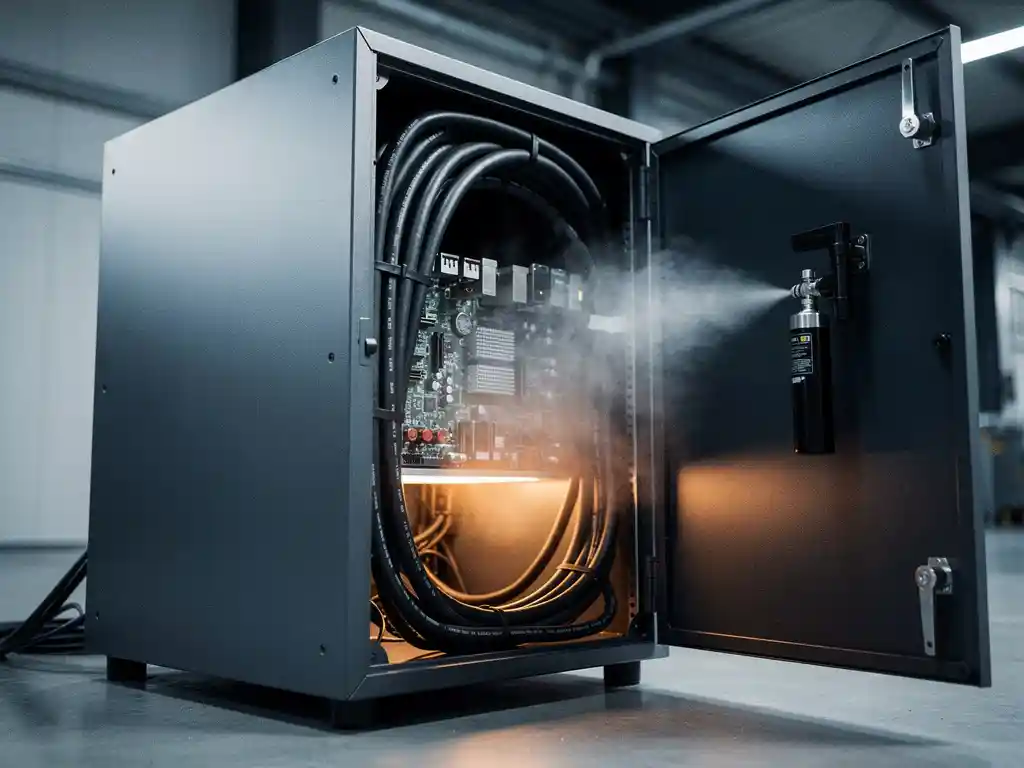
A total fire protection solution for industrial hardware combines early-stage smoke detection with targeted suppression, applied directly at the asset level rather than at the room or building level. For industrial hardware, this means the system detects a fire event in its earliest stages and suppresses it before it can spread, minimizing damage to equipment and avoiding costly downtime. The sections below unpack each component of that approach and how to evaluate the right solution for your facility.
What components make up a complete industrial fire protection system?
A complete industrial fire protection system consists of four core components: early detection, suppression delivery, a control interface, and integration with existing fire safety infrastructure. Each layer serves a distinct function, and the system only performs reliably when all four work together as a coordinated unit rather than as independent elements.
Detection is the foundation. In industrial environments, aspirating smoke detection systems draw air samples continuously from within or around an enclosure, identifying combustion particles far earlier than conventional point detectors. This early warning is critical because industrial hardware fires often begin as slow, smoldering events inside sealed cabinets before breaking into open flame.
Suppression delivery refers to the agent, the storage mechanism, and the distribution method used to extinguish the fire once detected. For hardware-level protection, this means suppression targeted at the object itself, not the surrounding room. The agent must be appropriate for the specific hazard, whether electrical, chemical, or thermal.
The control interface manages the relationship between detection and suppression, setting activation thresholds, managing delays, and triggering alerts. Finally, integration with a building fire panel ensures the object-level system communicates with broader site safety infrastructure, so a suppression event triggers evacuation protocols, alarms, and emergency response without requiring manual intervention.
Why does industrial hardware need dedicated fire suppression rather than general building systems?
Industrial hardware needs dedicated fire suppression because general building systems are designed to protect occupants and structures, not sensitive equipment inside closed enclosures. By the time a room-level sprinkler or gaseous suppression system activates, the hardware inside a cabinet has often already sustained irreversible damage from heat, smoke, or the suppression agent itself.
Building-level systems also respond to fire conditions in the ambient environment, which means detection is delayed. A fire that originates inside a sealed electrical cabinet or battery enclosure can smolder for an extended period before the heat or smoke reaches a ceiling-mounted detector. During that window, critical components are being destroyed.
There is also the question of collateral damage. Water-based sprinkler systems will destroy electronics on contact. Many conventional gaseous systems require room-level sealing and discharge volumes that are impractical or unsafe in occupied industrial spaces. A dedicated object-level system avoids these problems by acting early, acting precisely, and using an agent that is safe for the hardware it protects.
What suppression agents are safe to use on sensitive industrial electronics?
The suppression agents safest for sensitive industrial electronics are inert gases, particularly nitrogen and argon, because they extinguish fire by reducing oxygen concentration without leaving chemical residues, moisture, or conductive particles that could damage components. Among these, nitrogen is the most widely used due to its availability, low cost, and complete chemical neutrality.
Nitrogen suppresses fire by displacing oxygen within a protected enclosure to a level that cannot sustain combustion, typically below 15 percent by volume. Because it is a dry, clean gas, it leaves no residue on circuit boards, connectors, or storage media. Equipment can often be inspected and returned to service without the cleaning process required after chemical agent discharge.
In contrast, agents containing PFAS compounds, which include many traditional fluorinated gases, present growing regulatory and environmental concerns. Several jurisdictions have moved to restrict or ban PFAS-containing suppression agents, and industrial operators specifying systems in 2026 should account for this trajectory when making procurement decisions. A PFAS-free fire suppression approach using inert gas is not only safer for hardware, it is also more defensible from a compliance and environmental standpoint.
CO2 is effective at suppression but carries serious risks in occupied or semi-occupied industrial spaces due to its asphyxiation hazard at suppression concentrations. For object-level protection of industrial hardware, nitrogen remains the preferred choice when both safety and hardware integrity are priorities.
How does a combined detection and suppression system actually work?
A combined fire detection and suppression system works by continuously sampling air from within a protected enclosure, analyzing that air for combustion particles, and automatically discharging a suppression agent when smoke is confirmed above a set threshold. The entire sequence, from detection to suppression, can complete in seconds, well before open flame develops.
The detection stage in a combined system typically uses aspirating smoke detection, which actively draws air through a sampling pipe network rather than waiting for smoke to drift to a sensor. This approach is significantly more sensitive than passive point detection and is well suited to enclosed industrial hardware where air circulation is limited.
When the detector confirms a smoke event, it signals the suppression module. In nitrogen-based systems, the agent is stored in a solid, non-pressurized state within a gas generator, which converts to nitrogen gas upon activation. This non-pressurized storage eliminates the pressure vessel maintenance requirements associated with conventional cylinder-based systems and reduces installation complexity.
The suppression agent discharges directly into the protected enclosure, reducing oxygen concentration to a level that extinguishes the fire. Simultaneously, the system sends an alert signal via built-in relays to the site fire panel, triggering broader alarm and response protocols. The entire process is automated and requires no manual intervention once the system is armed.
What industrial applications require object-level fire protection?
Object-level fire protection is required wherever high-value or mission-critical hardware is housed in enclosed spaces where a localized fire could cause disproportionate operational, financial, or safety consequences. The most common industrial applications include electrical switchgear, ICT and server cabinets, battery energy storage systems, high-voltage cabinets, and control room enclosures.
- Switchgear and MV/LV electrical cabinets: Arc faults and insulation failures in switchgear generate intense localized heat. A fire in a switchgear room can take an entire facility offline. Object-level suppression limits the damage to a single cabinet and prevents propagation.
- Battery energy storage systems (BESS): Lithium-ion battery fires involve thermal runaway, a self-sustaining exothermic process that is extremely difficult to extinguish once established. Early detection and immediate suppression at the cell or module level are the most effective mitigation strategy.
- Server racks and ICT enclosures: Data centers and industrial control rooms house hardware with high replacement costs and critical operational functions. A fire event that destroys a server rack can trigger days or weeks of downtime. Object-level protection limits loss to the affected unit.
- High-voltage cabinets and power distribution units: These enclosures combine high energy density with complex wiring that is difficult to inspect visually. Early smoke detection inside the cabinet provides warning that conventional room detectors would miss entirely.
- Industrial control and automation equipment: PLCs, SCADA terminals, and process control hardware in manufacturing and oil and gas facilities represent both high replacement cost and significant process risk if lost to fire.
How do you evaluate and specify the right fire protection system for industrial hardware?
To evaluate and specify the right fire protection system for industrial hardware, assess five factors: the volume and configuration of the protected enclosure, the suppression agent’s compatibility with the hardware, the detection sensitivity required, the installation and maintenance demands, and the system’s compliance with relevant standards and certifications.
Start with the physical characteristics of the enclosure. Object-level suppression systems are designed around specific volume ranges, and the suppression agent quantity must be matched to the enclosure size to achieve the oxygen displacement needed for effective extinguishment. Systems that can be interconnected to protect larger volumes offer flexibility as infrastructure grows.
Agent selection follows from the hardware type. For sensitive electronics, inert gas is the appropriate choice. Confirm that the agent leaves no residue, poses no corrosion risk, and is free from regulated substances such as PFAS compounds. This is increasingly a procurement requirement, not just a preference.
Detection sensitivity matters significantly for enclosed hardware. Aspirating smoke detection, which draws air samples actively from inside the enclosure, provides earlier warning than passive sensors. Confirm the detection threshold is appropriate for the smoldering signature of the specific hardware type being protected.
Evaluate installation requirements carefully. Systems that require specialist certification to install add cost and delay. Pre-engineered systems designed for self-installation reduce both the time to deployment and the ongoing dependency on specialist contractors. Low-maintenance designs, such as those using non-pressurized agent storage, reduce the total cost of ownership over the system’s operational life.
Finally, verify certification. Systems tested and certified by recognized independent bodies, such as CNPP in France or TÜV Nord in Germany, provide the documentary evidence needed for insurance, regulatory compliance, and internal procurement approval.
How ExxFire delivers a total fire protection solution for industrial hardware
ExxFire’s integrated fire detection and suppression systems are purpose-built to address every specification criterion outlined above. The systems combine aspirating smoke detection with nitrogen suppression delivered through ExxFire’s patented Cool Gas Generator technology, providing a complete, coordinated response from first smoke to full suppression within a single pre-engineered unit.
- Early detection: Aspirating smoke detection continuously samples air from inside the protected enclosure, identifying combustion particles at the earliest possible stage.
- Clean nitrogen suppression: The Cool Gas Generator stores nitrogen in a solid, non-pressurized state, eliminating pressure vessel maintenance and discharging a clean, PFAS-free inert gas that leaves no residue on sensitive hardware.
- Scalable coverage: Systems protect enclosures up to 4.5 m³, with multiple units interconnectable for larger volumes, covering switchgear, server racks, BESS installations, and high-voltage cabinets.
- Simple installation: Pre-engineered for self-installation without specialist certification, reducing deployment time and total cost of ownership.
- Seamless integration: Built-in relays report system status directly to existing fire panels, ensuring object-level protection fits within broader site fire safety infrastructure.
- Independent certification: Tested and certified by CNPP France, providing the documented evidence required for compliance and procurement approval.
If you are specifying fire protection for industrial hardware and need a technically detailed solution overview, contact ExxFire to discuss your application requirements with a specialist.