
How do you communicate fire risks to employees effectively?
Communicating fire risks to employees effectively means delivering clear, role-specific messages through repeated, varied channels so that awareness translates into consistent safe behavior. Generic briefings rarely work on their own. The most effective fire safety communication combines targeted messaging, practical demonstrations, and regular reinforcement tailored to how different employees actually work. This article answers the key questions behind building a communication strategy that genuinely reduces risk.
What are the most common fire risks employees overlook?
The fire risks employees most commonly overlook are not dramatic or obvious. They are the everyday hazards that become invisible through familiarity: overloaded power strips, blocked emergency exits, improperly stored flammable materials, and electrical cabinets left open or poorly maintained. Because these risks are present constantly, employees stop registering them as threats.
In office and industrial environments alike, electrical equipment is a leading source of ignition. Server rooms, switchgear cabinets, battery storage systems, and high-voltage enclosures generate heat and can develop faults without producing visible warning signs until a fire has already started. Employees working near this equipment often assume that because it looks normal, it is safe.
Other commonly overlooked risks include:
- Dust accumulation inside electrical enclosures, which accelerates overheating
- Cables routed across walkways or near heat sources
- Fire doors propped open for convenience
- Charging devices left unattended overnight
- Waste materials stored too close to electrical panels
Effective fire risk awareness starts by making the invisible visible. When employees understand why these specific hazards are dangerous, not just that they are dangerous, they are far more likely to act on what they see.
Why do standard fire safety briefings fail to change behavior?
Standard fire safety briefings fail to change behavior because they are designed to deliver information, not to build habits. A one-time presentation or annual e-learning module may satisfy a compliance requirement, but it does not create the kind of repeated exposure and practical reinforcement that changes how people act under pressure or during routine work.
Several structural weaknesses make traditional briefings ineffective. First, they are typically generic. A single presentation covering all fire risks for all employees in all roles treats a data center technician the same as a warehouse operative, even though their environments and responsibilities are entirely different. When the content does not feel relevant, people disengage.
Second, briefings are usually passive. Employees sit, listen, and move on. There is no opportunity to practice, question, or apply what they have heard. Research in behavioral psychology consistently shows that passive information transfer produces low retention, particularly when the topic feels abstract or unlikely.
Third, the timing is wrong. Annual training cycles mean that by the time the next briefing arrives, most of the detail from the previous one has faded. Fire safety communication needs to be woven into working life, not scheduled as a standalone event.
How do you tailor fire risk messages for different employee roles?
Tailoring fire risk messages for different employee roles means identifying the specific hazards each role encounters, the decisions each person is responsible for, and the language and context that will resonate with them. A facilities manager, a warehouse operative, and an IT engineer face different risks and need different guidance.
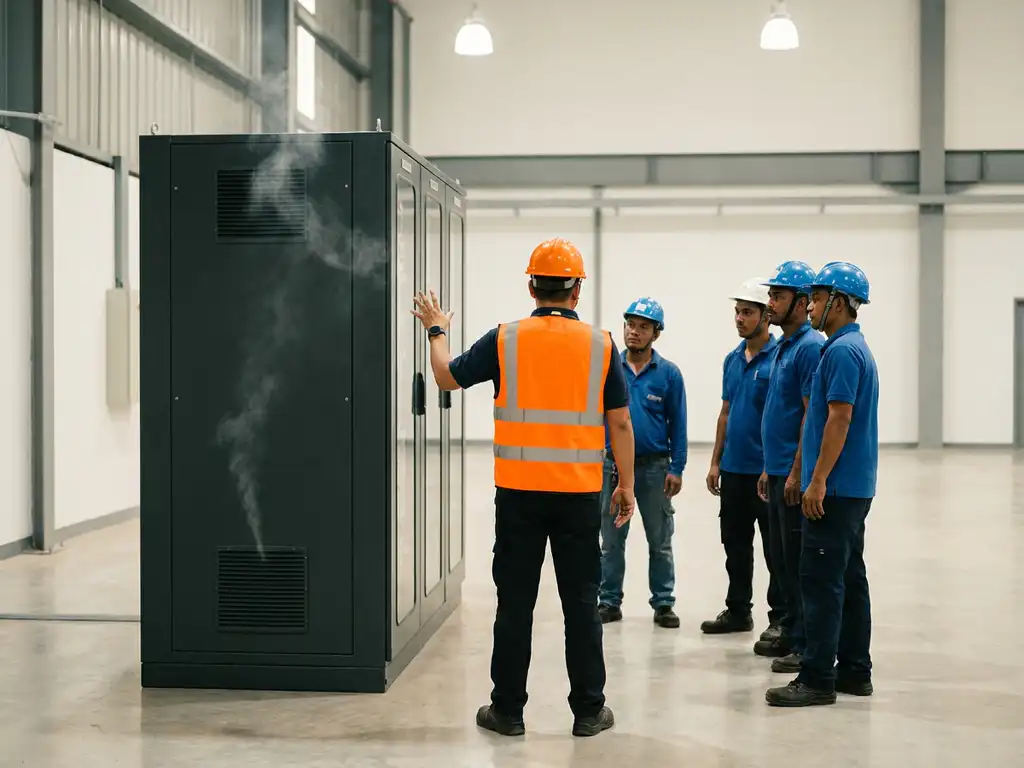
Start by mapping roles to environments. Employees who work near electrical infrastructure, such as IT staff managing server racks or technicians maintaining switchgear cabinets, need detailed guidance on recognizing early warning signs of electrical fire, such as unusual smells, heat, or smoke from enclosures. They should also understand the limitations of general fire extinguishers near live electrical equipment and the value of built-in suppression systems.
For management and safety officers, the focus should be on risk assessment responsibilities, reporting procedures, and how to evaluate whether existing protection measures are adequate for the equipment in their area.
For general staff, the priority is practical awareness: knowing where fire exits are, understanding the evacuation procedure, and recognizing which everyday behaviors, like propping fire doors or overloading sockets, create risk.
Role-specific messaging also improves credibility. When employees see that the guidance they receive reflects their actual working environment, they take it more seriously. Generic messages signal that fire safety communication is a box-ticking exercise rather than a genuine attempt to protect them.
What communication channels work best for fire safety messages?
The communication channels that work best for fire safety messages are those that combine visibility, repetition, and practical engagement. No single channel is sufficient. Effective workplace fire safety communication uses a layered approach that keeps risk awareness present across multiple touchpoints throughout the working day.
High-performing channels for fire risk communication include:
- Visual signage and floor markings: Persistent reminders at the point of risk, such as near electrical cabinets, charging stations, or storage areas
- Team briefings and toolbox talks: Short, role-specific conversations that address current or seasonal risks in context
- Digital screens and intranets: Rotating safety messages in communal areas or on internal platforms to maintain awareness without requiring active participation
- Practical drills and walkthroughs: Hands-on exercises that build muscle memory for evacuation procedures and hazard identification
- Email and messaging platforms: Targeted reminders after incidents, near-misses, or seasonal risk periods
The channel mix should reflect how employees actually consume information. In environments where workers are rarely at a desk, digital communications have limited reach. In knowledge-worker environments, well-timed internal messages can be highly effective. The goal is to make fire safety communication feel like a natural part of working life rather than an interruption to it.
How often should fire risk communication be repeated?
Fire risk communication should be repeated frequently enough that fire safety awareness remains active rather than theoretical. Annual training is a regulatory baseline, not a communication strategy. Industry experience shows that safety behaviors erode within weeks of a single briefing, making regular reinforcement essential for sustaining genuine awareness.
A practical cadence for most organizations includes:
- Annual formal training: A structured session covering procedures, responsibilities, and any updates to fire safety policy or equipment
- Quarterly reminders: Brief, targeted messages tied to specific risks, such as increased electrical load during winter months or changes to building layout
- Monthly micro-communications: Short visual or digital prompts that keep fire safety visible without demanding significant time
- Immediate communication after incidents or near-misses: Timely, specific messages that connect real events to behavior change
Repetition is most effective when it varies in format and focus. Repeating the same message in the same way produces diminishing returns. Varying the channel, the specific risk highlighted, and the framing keeps the content fresh and prevents employees from filtering it out as background noise.
How do you measure whether fire risk communication is working?
You measure whether fire risk communication is working by tracking both behavioral indicators and outcome metrics. Awareness alone is not enough. The goal of fire safety communication is to change how employees behave, so measurement must go beyond testing whether people remember what they were told.
Behavioral indicators to monitor include:
- Near-miss reporting rates, which increase when employees feel confident identifying and flagging hazards
- Compliance with fire door, exit clearance, and equipment storage procedures observed during audits
- Participation and engagement levels in drills and training sessions
- Time taken to evacuate during practice drills compared to previous exercises
Outcome metrics to track include the number and severity of fire-related incidents over time, insurance claim frequency, and the results of formal fire risk assessments. A reduction in hazards identified during audits is a strong signal that communication is producing genuine behavior change.
Qualitative feedback from employees also matters. If workers can accurately describe the specific risks in their area and explain what they would do in response, communication is working. If they can only repeat generic procedures, the messaging has not been tailored or reinforced effectively.
How ExxFire supports fire risk management in the workplace
Effective fire risk communication prepares employees to recognize and respond to fire hazards. But in environments where high-value equipment is at risk, communication alone is not enough. ExxFire provides an additional layer of protection that works independently of human response time.
- Early smoke detection: Aspirating smoke detection identifies fire at the earliest possible stage, before flames or significant heat develop
- Automatic suppression: Non-pressurized nitrogen gas suppression activates directly within the protected enclosure, extinguishing fire at the source without chemical residues that could damage sensitive electronics
- Easy installation and zero maintenance: Systems are designed for straightforward self-installation inside or outside server racks, switchgear cabinets, and electrical enclosures, with no ongoing maintenance required after commissioning
- Integration with existing fire panels: Built-in relays allow the system to report status to your existing fire safety infrastructure
- PFAS-free and environmentally responsible: ExxFire’s technology is a clean alternative to legacy gas suppression systems containing harmful substances
For organizations protecting mission-critical equipment, ExxFire’s integrated fire detection and suppression systems complement a strong fire safety communication strategy by ensuring that even when human awareness falls short, the equipment itself is protected. Contact ExxFire to find out how its certified systems can be integrated into your fire safety approach.