

Should you use a fire blanket or an extinguisher to put out a kitchen fire?
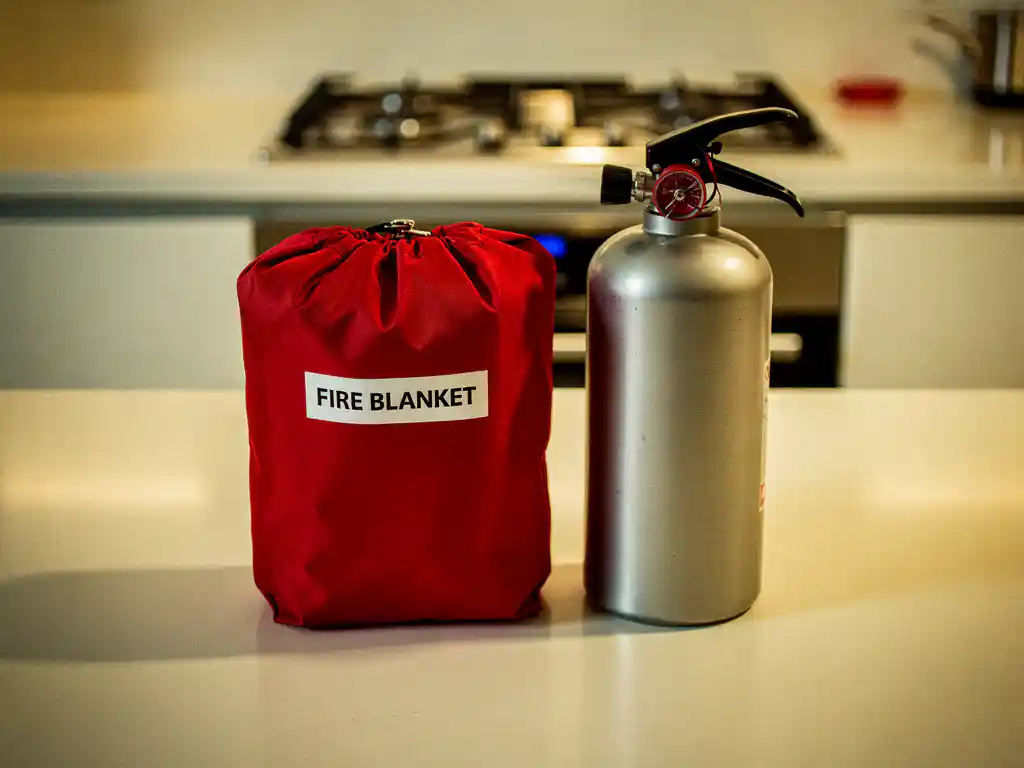
For a small, contained kitchen fire, a fire blanket is usually the better first choice. It smothers flames quickly and cleanly without making a mess or risking chemical damage. A fire extinguisher is the right tool when a fire blanket cannot contain the fire or when flames have spread beyond a single pan or appliance. The sections below cover exactly when to use each, how to use them safely, and what to do after a kitchen fire.
Which kitchen fires can a fire blanket actually smother?
A fire blanket is most effective on small, contained fires involving cooking oils, fats, or a single burning pan. It works by cutting off the oxygen supply to the fire, smothering it before it can spread. This makes it ideal for chip pan fires, burning frying pans, and small appliance fires where the source is localized and the flames have not yet escaped the vessel.
The key word is contained. If the fire is still within the boundaries of a pan or a small appliance, a fire blanket can handle it. Kitchen fires that respond well to a fire blanket include:
- Frying pan fires where oil or fat has ignited
- Chip pan fires before the oil overflows
- Small toaster or microwave fires in their early stages
- A person whose clothing has caught fire
Fire blankets are not effective once flames have spread to surrounding surfaces, cabinets, or multiple items. At that point, the fire is no longer something you can smother with a single blanket.
When should you reach for a fire extinguisher instead?
Reach for a fire extinguisher when the fire has grown beyond a single pan, when a fire blanket cannot safely cover the source, or when the fire involves materials other than cooking oil. An extinguisher delivers a suppression agent at a distance, which is important when getting close enough to place a blanket would put you in danger.
Specific situations where an extinguisher is the right choice include:
- The fire has spread to a countertop, cabinet, or wall
- There are multiple ignition points
- Electrical equipment is involved and you are not certain the power is off
- The pan fire is too large or too violent to approach safely with a blanket
If you have any doubt about your ability to control the fire safely, do not attempt to fight it yourself. Leave the room, close the door behind you, and call emergency services immediately.
What’s the difference between a fire blanket and a fire extinguisher?
The key difference between a fire blanket and a fire extinguisher is the method of suppression. A fire blanket smothers a fire by blocking oxygen, while a fire extinguisher suppresses a fire by discharging a chemical, gas, or powder agent onto the flames. Each tool suits different fire scenarios and requires a different approach to use safely.
Fire blankets
Fire blankets are made from fire-resistant materials, typically woven fibreglass. They are single-use in most cases, compact, easy to store, and require no training to deploy. They leave no residue and cause no secondary damage. Their limitation is reach and coverage. You must get close enough to drape the blanket over the fire source, which is only practical when the fire is small and accessible.
Fire extinguishers
Fire extinguishers allow you to fight a fire from a safe distance, which is a significant advantage when flames are larger or more aggressive. They are available in multiple types suited to different fire classes, and they can cover a wider area. The trade-off is that some types leave residue or cause damage to sensitive equipment, and they require a basic understanding of how to operate them correctly under pressure.
What type of fire extinguisher is safe to use in a kitchen?
In a kitchen, the safest and most appropriate fire extinguisher types are wet chemical extinguishers and CO2 extinguishers. Wet chemical extinguishers are specifically designed for Class F fires involving cooking oils and fats, making them the preferred choice for domestic and commercial kitchens. CO2 extinguishers are suitable for electrical fires and leave no residue.
What you should never use in a kitchen:
- Water extinguishers on oil fires: Water causes burning oil to explode outward in a fireball, dramatically worsening the situation.
- Dry powder extinguishers indoors: The powder cloud reduces visibility, contaminates food preparation surfaces, and can be harmful if inhaled in an enclosed space.
If you are equipping a kitchen, a wet chemical extinguisher rated for Class F fires is the most versatile and safest option. For kitchens with electrical appliances, having a CO2 extinguisher as a secondary option is a sensible precaution.
How do you safely use a fire blanket on a pan fire?
To safely use a fire blanket on a pan fire, turn off the heat source first if it is safe to do so, then unfold the blanket and hold it in front of you as a shield. Approach the pan calmly, drape the blanket over it completely, and do not remove it for at least 30 minutes to ensure the oil has cooled. Never lift the blanket to check progress.
Follow these steps in order:
- Turn off the hob or heat source if you can reach the control without going near the flames.
- Take the fire blanket from its container using the pull tabs or handles.
- Hold the blanket in front of your face and hands as a protective shield as you approach.
- Place the blanket gently over the pan, covering it completely. Do not throw it or drop it, as this can disturb the flames.
- Leave the blanket in place for at least 30 minutes. Hot cooking oil retains heat for a long time and can reignite if uncovered too soon.
- Do not move the pan while it is covered or while the oil is still hot.
If at any point the fire grows while you are attempting to cover it, abandon the effort, leave the kitchen, close the door, and call emergency services.
Should you always call emergency services after a kitchen fire?
You should call emergency services after any kitchen fire that you could not fully control, that involved structural elements of the kitchen, or where you are uncertain whether the fire is completely out. Even a fire that appears extinguished can smoulder inside walls, cabinets, or insulation. When in doubt, call the fire service and let them confirm the area is safe.
You should always call emergency services if:
- The fire spread beyond the pan or appliance where it started
- There is visible smoke damage or charring on walls or surfaces
- Anyone was exposed to smoke or suffered burns
- You used an extinguisher and are unsure whether the fire is fully out
- The fire involved electrical wiring or built-in appliances
If the fire was very small, fully smothered with a blanket, and showed no signs of spread, a call to the fire service is still a sensible precaution. Fire crews can inspect the area quickly and give you certainty that there is no hidden risk. There is no penalty for calling when you are unsure.
How ExxFire helps protect against fire in critical environments
While the guidance above covers residential kitchen safety, fire risk in professional and industrial environments demands a more systematic approach. ExxFire’s integrated fire detection and suppression systems are purpose-built for closed enclosures where a fire starting inside mission-critical equipment can cause severe operational and financial damage before anyone notices smoke.
ExxFire’s systems combine aspirating smoke detection with non-pressurized nitrogen gas suppression, delivering early intervention at the source of the fire rather than after it has spread. Key features include:
- Early smoke detection that identifies a fire threat before visible flames develop
- Nitrogen-based suppression that leaves no chemical residue and causes no secondary damage to sensitive electronics
- PFAS-free technology that meets growing environmental and compliance requirements
- Pre-engineered installation requiring no special certification, keeping total cost of ownership low
- Built-in relay reporting for seamless integration with existing fire panels and safety infrastructure
Whether you manage server racks, switchgear cabinets, battery energy storage systems, or high-voltage enclosures, ExxFire’s systems provide the kind of object-level protection that a blanket or handheld extinguisher simply cannot deliver. Contact ExxFire to find out which system is right for your environment.
Related Articles
- How does climate change affect fire management strategies?
- What is the difference between a wildfire and a managed fire?
- What happens if your fire suppression system is not certified?
- How do you ensure a fire suppression system stays compliant after installation?
- How does fire prevention training reduce workplace injuries?