

What happens to fire suppression agents after discharge?
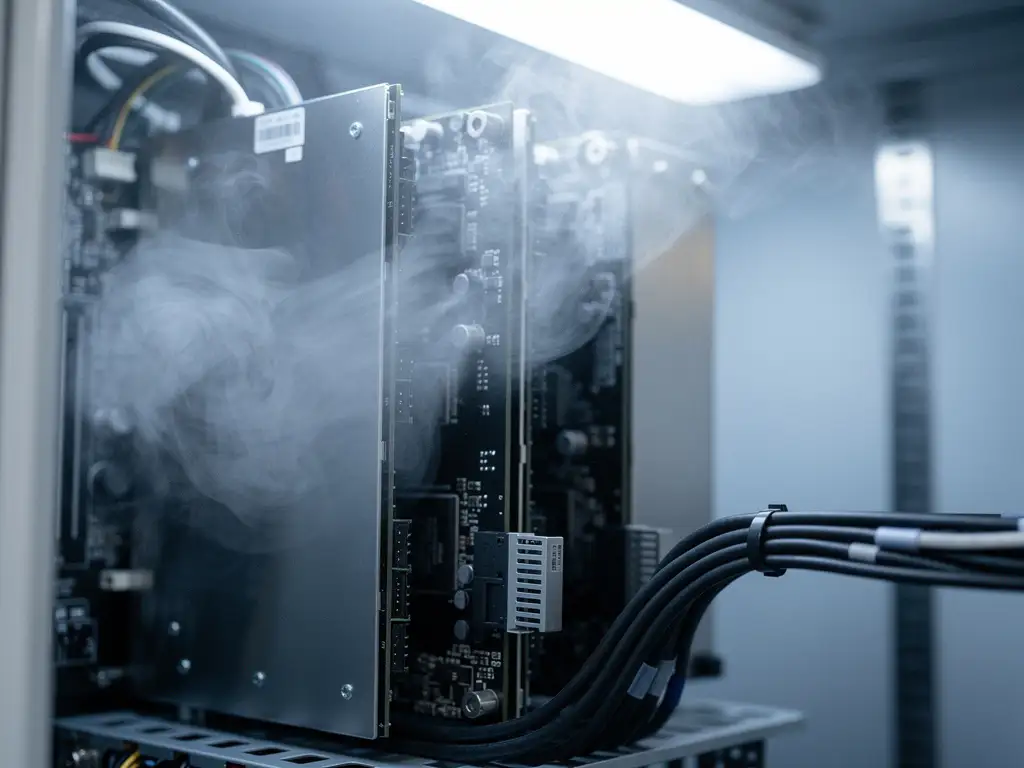
After a fire suppression system discharges, the agent disperses into the protected space and either settles as residue, evaporates, or dissipates, depending on its chemical composition. The type of agent used determines whether cleanup is straightforward or extensive, and whether sensitive equipment survives the event intact. The sections below answer the most common questions about what happens to fire suppression agents once they are released.
Where do fire suppression agents go after they’re released?
When a fire suppression agent discharges, it enters the protected enclosure or space and interacts with the fire, the air, and any surfaces present. What happens next depends entirely on the agent’s physical and chemical properties. Gaseous agents disperse through the air and eventually vent out of the space. Liquid or powder agents settle on surfaces, equipment, and floors, where they remain until physically removed.
Inert gas agents such as nitrogen, argon, and CO2 behave like the atmospheric gases already present in a room. They dilute the oxygen concentration below the threshold that supports combustion, then gradually mix back into the surrounding air as the space ventilates. Because they are true gases with no residual mass, they leave nothing behind once the space returns to normal atmospheric conditions.
Chemical agents, including halon alternatives and fluorinated compounds, follow a different path. Some partially decompose when exposed to heat and flame, producing breakdown products that can coat surfaces. Others remain chemically stable but still deposit a fine film across everything in the protected area. Dry chemical powder agents are the most visible offenders, leaving dense, corrosive particulate matter across every exposed surface.
What residue does each type of fire suppression agent leave behind?
The residue left by a fire suppression agent ranges from nothing at all to a heavy, equipment-damaging deposit, depending on the agent type. Inert gases leave zero residue. Clean chemical agents leave minimal residue. Dry chemical and foam agents leave substantial, often damaging deposits that require immediate and thorough cleanup.
Here is how the main agent categories compare:
- Inert gases (nitrogen, argon, IG-541): No residue. These agents are pure gas and leave no physical trace on surfaces or equipment after discharge.
- Hydrofluorocarbons (HFCs) and HFOs: Minimal residue under normal conditions, but thermal decomposition during active fire suppression can produce acidic byproducts that settle on surfaces.
- PFAS-based agents (AFFF foam, some fluorinated gases): Persistent chemical residue that binds to surfaces and is extremely difficult to remove. These compounds do not break down naturally.
- Dry chemical powder (ABC powder, BC powder): Heavy particulate residue that is abrasive, mildly corrosive, and highly invasive. It penetrates fans, circuit boards, connectors, and cooling systems.
- CO2: No solid residue, but discharge at high pressure can cause thermal shock and condensation, and the oxygen displacement creates a serious safety hazard for personnel.
- Water mist: Moisture residue that can cause corrosion and short circuits if electrical equipment is exposed.
How do PFAS-based agents affect equipment and the environment after discharge?
PFAS-based fire suppression agents cause persistent contamination both on equipment and in the surrounding environment after discharge. On equipment, these compounds leave a chemical film that is chemically bonded to surfaces and nearly impossible to fully remove. In the environment, PFAS compounds do not biodegrade, accumulate in soil and water systems, and have been linked to serious ecological and human health concerns.
Aqueous Film Forming Foam (AFFF), the most widely used PFAS-containing suppression agent, was historically common in industrial, aviation, and military applications. When discharged, it saturates surfaces with perfluoroalkyl and polyfluoroalkyl substances. These chemicals resist heat, water, and most cleaning agents, which is precisely what made them effective for suppression but also what makes them so environmentally problematic.
For sensitive electronic equipment, PFAS residue creates a secondary risk after the fire event itself. The residue can degrade insulation, interfere with electrical contacts, and accelerate corrosion over time. Even equipment that survives a fire may fail weeks or months later due to ongoing chemical interaction with PFAS deposits. For organizations protecting high-value assets, this means a suppression event using PFAS agents can result in equipment losses that extend well beyond the immediate fire damage.
Does nitrogen leave any damage after a fire suppression discharge?
Nitrogen leaves no chemical residue, no physical deposits, and no lasting damage to equipment after a fire suppression discharge. As a naturally occurring inert gas that makes up approximately 78% of the air we breathe, nitrogen is chemically non-reactive with electronics, metals, plastics, and other materials found in protected enclosures. Once the protected space ventilates, conditions return entirely to normal.
This is one of the most significant practical advantages of nitrogen-based suppression for environments containing sensitive electronics, server hardware, switchgear, or battery systems. A discharge event does not create a secondary cleanup or replacement problem. Equipment can be inspected, the cause of the fire investigated, and operations resumed without the additional burden of chemical decontamination.
There is one important operational consideration: nitrogen suppression works by reducing oxygen concentration within a closed enclosure. This is effective and safe for equipment, but any personnel must evacuate before discharge and must not re-enter until oxygen levels have been confirmed safe. This is a standard safety protocol for all inert gas suppression systems, not unique to nitrogen.
What cleanup is required after a fire suppression system activates?
The cleanup required after a fire suppression discharge depends entirely on the agent used. Inert gas systems require virtually no cleanup from the agent itself. Chemical and powder systems can require extensive decontamination that takes hours or days and may cause additional equipment losses beyond those caused by the fire.
Minimal cleanup scenarios
Inert gas systems, including nitrogen, argon, and IG-541, require only ventilation of the protected space after discharge. There are no chemical deposits to remove, no surfaces to wipe down, and no specialist decontamination needed. The primary post-event tasks are investigating the fire cause, assessing any fire damage, and resetting or replacing the suppression system components.
Extensive cleanup scenarios
Dry chemical powder systems require immediate and thorough physical removal of powder from every surface, including internal components, ventilation paths, and cable runs. The powder is mildly corrosive and abrasive, and if left in place, it accelerates equipment degradation. Professional cleaning is typically required, and some equipment may be written off entirely due to powder ingress.
PFAS-based foam systems require specialized hazardous waste procedures. The contaminated foam cannot simply be washed away, as doing so risks spreading PFAS contamination into drainage systems and groundwater. Remediation must comply with environmental regulations, and in some jurisdictions, discharge of PFAS agents triggers mandatory reporting obligations.
Which fire suppression agents are being banned or restricted?
Several categories of fire suppression agents are currently subject to bans, phase-outs, or significant regulatory restrictions across the European Union, the United Kingdom, and other jurisdictions. The primary targets are PFAS-containing agents and certain high-global-warming-potential fluorinated gases. As of 2026, regulatory pressure on these substances is intensifying.
The most significant restrictions include:
- AFFF (Aqueous Film Forming Foam): Banned or heavily restricted in the EU and several other regions due to PFAS content. The EU’s PFAS restriction under REACH is among the broadest regulatory actions targeting these substances.
- Halon: Phased out globally under the Montreal Protocol due to ozone-depleting properties. Halon 1301 and 1211 are no longer manufactured for new applications in most countries.
- High-GWP HFCs: Subject to phase-down under the EU F-Gas Regulation and the Kigali Amendment to the Montreal Protocol. Some HFC-based clean agents face restrictions as a result.
- PFAS-based fluorinated gases: The EU’s proposed universal PFAS restriction, if adopted in its broadest form, could affect a range of fluorinated suppression agents currently marketed as halon alternatives.
Organizations that have installed systems using any of these agents face not only compliance risk but also practical operational risk: if a restricted agent cannot be legally replenished after a discharge, the suppression system becomes non-functional. Transitioning to inert gas or other non-PFAS alternatives before a forced phase-out avoids this operational gap.
How ExxFire addresses fire suppression residue and environmental impact
ExxFire’s integrated fire detection and suppression systems are built around non-pressurized nitrogen gas, delivering a suppression solution that leaves zero chemical residue, causes no secondary damage to equipment, and introduces no PFAS or fluorinated compounds into the environment. For organizations protecting mission-critical assets, this means a suppression event does not compound the problem with cleanup costs, equipment write-offs, or environmental liability.
The key features of ExxFire’s approach include:
- Zero residue discharge: Nitrogen is chemically inert and leaves no deposits on electronics, switchgear, battery systems, or any other protected equipment.
- PFAS-free technology: ExxFire systems contain no fluorinated compounds, making them fully aligned with current and anticipated EU PFAS restrictions.
- Early detection before suppression: Aspirating smoke detection identifies a developing fire at the earliest possible stage, allowing suppression to activate before significant fire damage occurs, further reducing post-event recovery needs.
- Patented Cool Gas Generator technology: Nitrogen is stored in a solid, non-pressurized state and converted to gas on activation, eliminating the risks associated with pressurized cylinder systems.
- Certified and tested: Systems are independently tested and certified by CNPP in France and DMT, part of TÜV Nord in Germany, providing verified performance assurance.
If your organization is evaluating fire suppression for electrical cabinets or other critical enclosures, and wants a solution that protects equipment without the residue, cleanup burden, or regulatory exposure of legacy agents, contact ExxFire to discuss the right system for your environment.
Related Articles
- What are the main goals of fire management?
- What is the future of fire management in a changing climate?
- What fire risks are specific to E-cabinets in industrial settings?
- What is the ozone depletion potential of common fire suppression agents?
- What is the environmental cost of a single fire suppression system discharge?