
Should you use gas or aerosol suppression in an E-cabinet?
For electrical cabinets, **nitrogen gas suppression is generally the safer and more effective choice** compared to aerosol-based systems. Aerosol suppression releases fine chemical particles that can coat and damage sensitive electronics, making it poorly suited for enclosed E-cabinets containing circuit boards, relays, and control systems. The sections below break down the key differences, the specific fire risks involved, and what to consider when specifying a suppression system for your electrical enclosures.
What are the main differences between gas and aerosol suppression systems?
Gas suppression systems extinguish fires by displacing or reducing oxygen using an inert gas such as nitrogen, while aerosol suppression systems release a fine cloud of solid chemical particles that interrupt the combustion chain reaction. The core difference lies in what they leave behind: gas suppression is clean and residue-free, while aerosol systems deposit chemical condensate on surfaces and components.
Gas suppression works by flooding an enclosed space with an agent that either reduces oxygen concentration below the level needed to sustain combustion or chemically interferes with the flame. Inert gases like nitrogen are particularly straightforward in their mechanism: they simply displace enough oxygen to extinguish the fire without introducing any foreign substance into the protected space.
Aerosol systems generate their extinguishing agent through a pyrotechnic reaction, producing a mixture of solid micro-particles and gas. This approach can be effective in open or semi-open environments, but the particles settle on every surface inside the cabinet, including circuit boards, connectors, and cooling components. Cleaning or replacing contaminated equipment after an aerosol discharge is often unavoidable.
From a storage and installation perspective, gas suppression systems typically require a pressurized cylinder or, in the case of solid-state nitrogen generators, a non-pressurized unit that converts a solid compound into nitrogen gas on activation. Aerosol generators are generally compact and require no pressure vessel, which can make them attractive for space-constrained retrofits, but that advantage rarely outweighs the residue problem in sensitive electrical environments.
What fire risks are specific to electrical cabinets?
Electrical cabinets face a distinct set of fire risks driven by the combination of heat-generating components, flammable insulation materials, and enclosed airflow. The most common ignition sources inside E-cabinets include overloaded cables, faulty connections, failing capacitors, arc flash events, and overheating bus bars or switchgear components.
Because cabinets are enclosed, a small ignition event can escalate quickly. Restricted airflow traps heat, and the plastic housings, cable insulation, and PCB substrates inside provide ready fuel. Smoldering fires can develop undetected for minutes or even hours before producing visible flame, which is why early smoke detection is critical in any electrical cabinet fire safety strategy.
High-voltage cabinets and switchgear introduce additional risk. Arc flash can release enormous amounts of energy in milliseconds, creating pressure waves and intense heat that conventional detection systems may not respond quickly enough to prevent serious damage. Battery Energy Storage Systems (BESS) add the complication of thermal runaway, a self-sustaining electrochemical reaction that can reignite even after an initial suppression event.
Does aerosol suppression damage sensitive electronics?
Yes, aerosol suppression can damage sensitive electronics. The extinguishing agent in aerosol systems consists of fine solid particles, typically potassium-based compounds, that settle on every internal surface after discharge. These particles are electrically conductive and hygroscopic, meaning they attract moisture, which accelerates corrosion and can cause short circuits on exposed circuit boards and connectors.
Even when the fire itself causes limited damage, the aftermath of an aerosol discharge often requires a full inspection and cleaning of all components inside the cabinet. In many cases, control boards, relays, and communication modules must be replaced entirely because the residue cannot be fully removed without risking further damage during the cleaning process.
For environments where business continuity is a priority and where the equipment inside the cabinet is expensive or difficult to replace, the post-discharge damage from aerosol systems represents a significant hidden cost. This is a key reason why fire safety engineers increasingly specify clean agent or inert gas systems for ICT cabinet fire suppression and other sensitive enclosures.
How does nitrogen gas suppression work inside an E-cabinet?
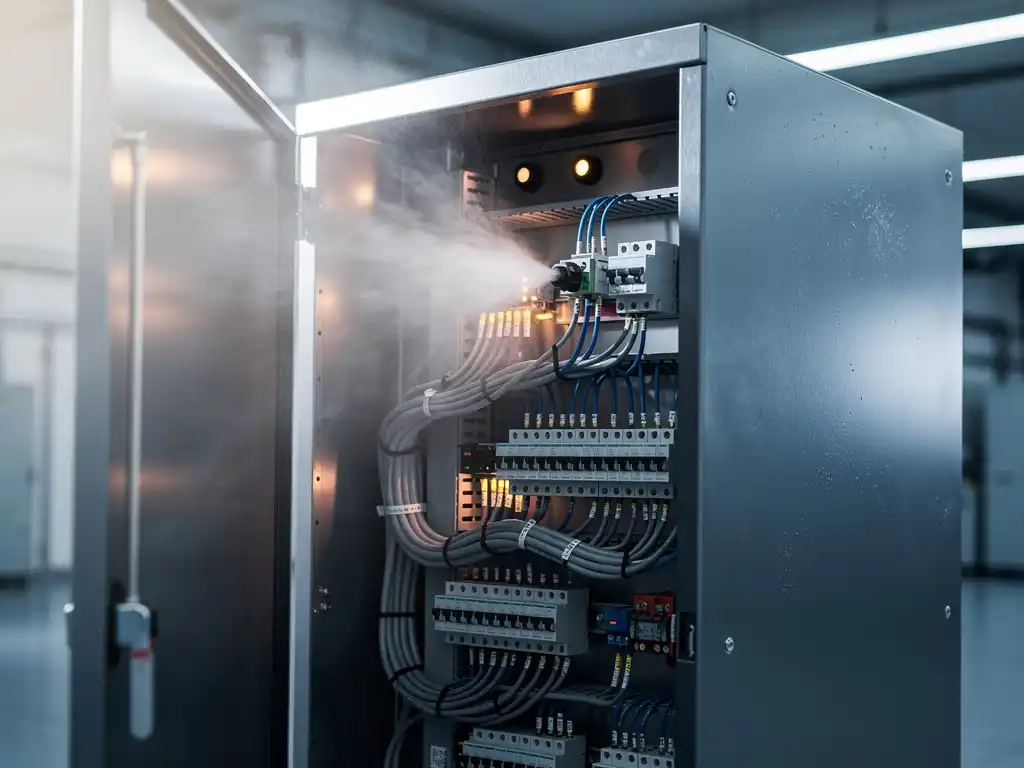
Nitrogen gas suppression works by flooding the interior of an electrical cabinet with nitrogen, reducing the oxygen concentration inside the enclosure to a level that cannot sustain combustion, typically below 15 percent by volume. Because nitrogen is an inert gas that makes up roughly 78 percent of normal air, it introduces no chemical contamination and leaves no residue on components after discharge.
In a closed cabinet environment, nitrogen suppression is highly efficient. The enclosed space limits the volume of gas needed, and the sealed construction of most E-cabinets helps maintain the reduced-oxygen atmosphere long enough to fully extinguish the fire and prevent reignition. Detection is integrated into the system: aspirating smoke detectors continuously sample air from inside the cabinet and trigger gas release at the earliest sign of smoldering, well before open flame develops.
Non-pressurized nitrogen generation systems, where nitrogen is produced from a solid compound rather than stored in a high-pressure cylinder, offer an additional safety advantage in electrical environments. There is no pressure vessel that could become a hazard in the event of an arc flash or explosion, and the system does not require the same level of regulatory oversight as pressurized gas storage. After discharge, the cabinet can be ventilated, inspected, and returned to service without the cleanup burden associated with chemical agents.
Which suppression method is safer for BESS and high-voltage cabinets?
For Battery Energy Storage Systems and high-voltage cabinets, nitrogen gas suppression is the safer choice. BESS installations carry the specific risk of thermal runaway, where a failing cell generates heat that triggers adjacent cells in a cascading reaction. Aerosol suppression cannot interrupt thermal runaway once it has started, and the chemical residue it leaves behind can complicate the inspection and recovery process significantly.
High-voltage cabinets present similar challenges. Arc flash events can destroy aerosol generators before they fully activate, and the conductive residue from an aerosol discharge is particularly dangerous in a high-voltage environment where any surface contamination can create new fault paths. Nitrogen gas, by contrast, is non-conductive, non-corrosive, and does not interact with live electrical components.
For BESS specifically, early detection is as important as the suppression method. Thermal runaway typically begins with a slow heat buildup and off-gassing before it becomes a fire, which means aspirating smoke detection systems that can identify combustion byproducts at very low concentrations provide the best chance of intervening before the situation becomes uncontrollable. Pairing early detection with clean nitrogen suppression gives operators the response window they need.
What should you check before specifying a suppression system for an E-cabinet?
Before specifying a suppression system for an electrical cabinet, you need to assess the cabinet volume, the sensitivity of the equipment inside, the operating environment, and the applicable standards and certifications. Getting these factors right at the specification stage prevents costly redesigns and ensures the system will perform as intended when it is needed.
Key factors to evaluate include:
- Cabinet volume and sealing: Suppression systems are designed for specific enclosure volumes. Confirm the internal volume of the cabinet and assess how well sealed it is, as gaps and ventilation openings affect how long the suppression agent remains effective after discharge.
- Equipment sensitivity: Identify whether the cabinet contains circuit boards, communication modules, or other components that would be damaged by chemical residue. If so, only clean agent or inert gas systems should be considered.
- Voltage and arc flash risk: High-voltage environments require suppression agents that are non-conductive. Verify that the chosen agent is rated safe for the voltage levels present.
- Detection integration: Check whether the suppression system includes integrated detection or whether it needs to interface with an existing fire panel. Systems with built-in aspirating smoke detection and relay outputs simplify installation and reduce the number of separate components to maintain.
- Certification and testing: Confirm that the system has been tested and certified by a recognized body such as CNPP or a TÜV-affiliated laboratory. Certifications validate performance claims and are often required for insurance and regulatory compliance.
- Maintenance requirements: Assess the ongoing maintenance burden. Non-pressurized systems and those with minimal consumable components typically have lower total cost of ownership over the system’s lifetime.
- Environmental compliance: Verify that the suppression agent is PFAS-free and compliant with current and anticipated environmental regulations, particularly if the installation is in a jurisdiction with strict chemical use restrictions.
How ExxFire protects electrical cabinets from fire
ExxFire’s integrated fire detection and suppression systems are purpose-built for the challenges described throughout this article. The systems combine aspirating smoke detection with non-pressurized nitrogen gas suppression in a single, pre-engineered unit designed specifically for closed enclosures such as electrical cabinets, switchgear, and BESS installations.
Key features of the ExxFire system include:
- Aspirating smoke detection that samples air continuously from inside the cabinet, triggering suppression at the earliest sign of smoldering
- Non-pressurized Cool Gas Generator technology that produces nitrogen from a solid compound, eliminating pressure vessel risks and simplifying installation
- Zero chemical residue after discharge, protecting sensitive electronics and minimizing downtime
- Coverage for enclosures up to 4.5 m³, with multiple units interconnectable for larger volumes
- Built-in relay outputs for seamless integration with existing fire panels
- Self-installation without special certification requirements, reducing installation costs
- Testing and certification by CNPP France and DMT, part of TÜV Nord, validating performance in real-world conditions
- PFAS-free nitrogen suppression, meeting current environmental standards and future-proofing against tightening chemical regulations
If you are specifying fire suppression for BESS or other high-value electrical enclosures and want to understand which configuration is right for your application, contact ExxFire directly to discuss your requirements with a specialist.