

What are the fire safety compliance requirements for renewable energy installations?
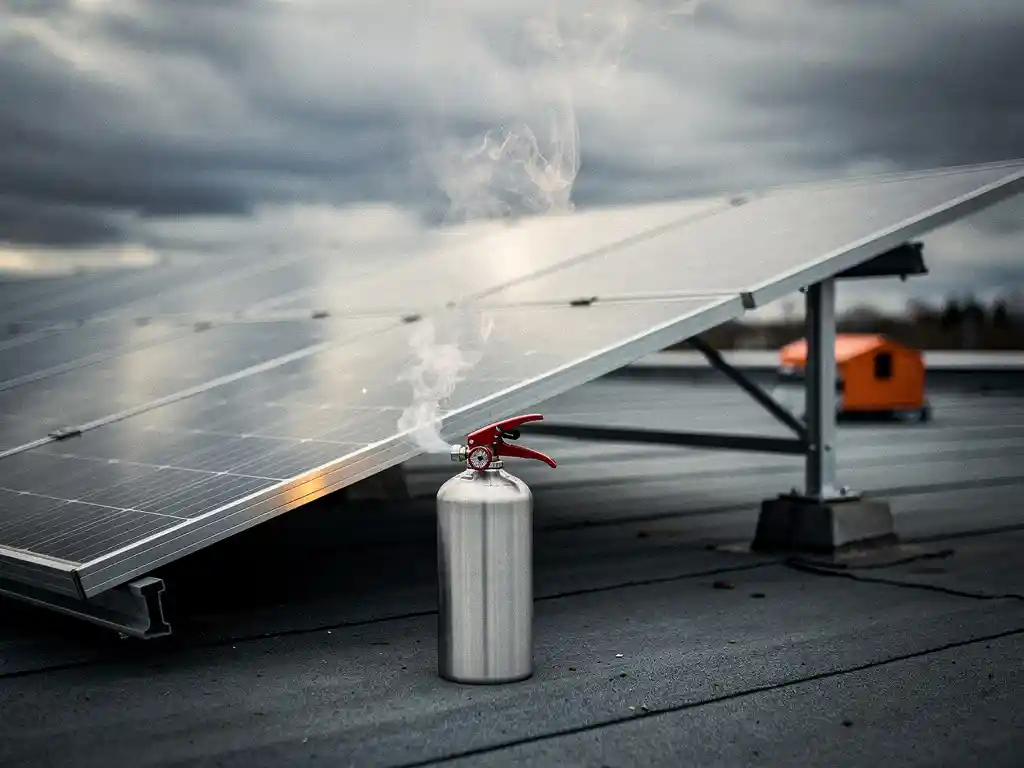
Renewable energy installations are subject to a range of fire safety compliance requirements that vary by technology type, jurisdiction, and system scale. At a minimum, operators must comply with national fire codes, international standards such as NFPA 855 for battery energy storage, and site-specific risk assessments covering detection, suppression, and emergency response. The specific obligations depend on whether the installation involves solar photovoltaic arrays, wind turbines, battery storage, or a combination of all three. The sections below break down the most important compliance questions that safety and facility managers face when planning or auditing a renewable energy site.
Which fire safety standards apply to renewable energy installations?
Renewable energy installations must comply with a combination of international fire safety standards, national building and electrical codes, and insurance-driven guidelines. The most widely referenced frameworks include NFPA 855 for battery energy storage systems, IEC 62305 for lightning and surge protection on wind and solar sites, and IEC 62619 for lithium-ion battery safety. FM Global Property Loss Prevention Data Sheets also set influential benchmarks for insured sites.
In Europe, the EN 54 series governs fire detection and alarm systems, while the ATEX directive applies wherever flammable gases or dust may be present, such as in transformer vaults or battery rooms. In the United States, the International Fire Code (IFC) and NFPA 70 (National Electrical Code) provide the baseline for electrical fire safety at solar and wind facilities. Operators working across multiple countries must map each jurisdiction’s requirements separately, since there is no single global standard that covers all renewable energy fire safety compliance in one document.
Insurance requirements from providers such as FM Global often go further than local codes. Meeting the minimum legal standard is not always sufficient to maintain coverage or avoid premium increases after an incident.
What are the biggest fire risks in solar and wind energy systems?
The biggest fire risks in solar energy systems are electrical faults, arc flash events, and thermal runaway in battery storage components. In wind turbines, the primary hazards are mechanical friction, hydraulic fluid ignition, and electrical failures in the nacelle, which sits hundreds of feet off the ground and is extremely difficult to reach with conventional suppression equipment.
Solar farm fire risks
Solar photovoltaic installations generate DC current, which cannot be easily interrupted in the way AC circuits can. This creates a persistent arc flash risk even when the system appears to be isolated. Inverter rooms and combiner boxes are particularly vulnerable because they concentrate electrical connections in enclosed spaces. Overheating connectors, insulation breakdown, and rodent damage to cabling are common ignition sources identified during fire investigations at solar farms.
Wind turbine fire risks
Wind turbines present a unique challenge because the nacelle housing the generator, gearbox, and electrical systems is effectively a remote, enclosed space with limited ventilation. Hydraulic oil leaks onto hot mechanical components, brake system friction, and transformer faults are the most frequently cited causes of turbine fires. Once a nacelle fire ignites, it is almost impossible to suppress from the ground, making early detection and automatic suppression inside the nacelle the only practical line of defense.
How does NFPA 855 regulate battery energy storage fire safety?
NFPA 855 is the primary standard governing the installation of stationary energy storage systems in the United States. It sets maximum energy capacity thresholds for battery installations in different occupancy types, mandates specific separation distances between battery modules, and requires automatic fire detection and suppression systems above defined capacity limits. It also specifies ventilation requirements to manage off-gassing from lithium-ion cells during thermal runaway events.
Under NFPA 855, battery energy storage systems above 20 kWh in certain occupancies must be equipped with a listed fire detection system. Larger utility-scale BESS installations face additional requirements, including emergency response pre-planning, signage for first responders, and documentation of the battery chemistry in use. The 2023 edition of the standard introduced more detailed guidance on thermal runaway propagation and the use of clean agent or inert gas suppression inside battery enclosures.
Compliance with NFPA 855 is increasingly being adopted as a baseline by local authorities having jurisdiction (AHJs) outside the United States, making it a globally relevant benchmark for BESS fire safety compliance planning even where it is not legally mandated.
What fire detection and suppression systems are required for renewable energy sites?
The required fire detection and suppression systems for renewable energy sites depend on the specific installation type, the energy capacity involved, and the applicable standard. At minimum, most codes require smoke or heat detection in enclosed electrical spaces, automatic suppression in battery rooms above defined capacity thresholds, and manual suppression access for outdoor equipment. Early warning detection is strongly recommended for all enclosed electrical enclosures, regardless of whether it is explicitly mandated.
For solar inverter rooms and electrical cabinets, aspirating smoke detection systems offer the earliest possible warning by continuously sampling air from inside the enclosure. This is critical in renewable energy applications because a smoldering fault inside a sealed cabinet can develop for minutes or hours before conventional point detectors respond.
For battery energy storage systems, inert gas suppression is increasingly preferred over chemical agents because it leaves no residue on sensitive electronics and does not introduce secondary contamination risks. NFPA 855 and FM Global guidelines both recognize inert gas systems as appropriate for BESS enclosures. Wind turbine nacelles typically require self-contained automatic suppression systems specifically listed for that application, since external intervention is not feasible during an active fire event.
What happens if a renewable energy site fails a fire safety inspection?
If a renewable energy site fails a fire safety inspection, the authority having jurisdiction can issue a notice of violation, require immediate corrective action, and in serious cases order a partial or full shutdown of the installation until deficiencies are resolved. Insurance coverage may also be suspended or voided if the site is found to be non-compliant with the conditions of the policy.
Beyond the immediate operational impact, a failed inspection creates legal liability exposure. If a fire occurs after a known deficiency was identified but not corrected, the operator faces a significantly greater risk of regulatory penalties and civil claims. For grid-connected renewable installations, the network operator may also have contractual rights to disconnect a site that fails to maintain required safety standards.
Proactive compliance is far less costly than reactive remediation. Correcting a detection gap before an inspection is straightforward. Retrofitting suppression systems under enforcement pressure, while managing insurance complications and potential downtime, is substantially more expensive and disruptive.
How do you build a fire safety compliance plan for a renewable energy project?
Building a fire safety compliance plan for a renewable energy project starts with a systematic fire risk assessment that identifies all ignition sources, fuel loads, and potential fire spread pathways specific to the installation. From that baseline, the plan maps applicable standards and local code requirements to each identified risk, specifies the detection and suppression measures needed to meet those requirements, and defines inspection, testing, and maintenance schedules to sustain compliance over the system’s operational life.
A practical compliance plan for a renewable energy site should address the following core elements:
- Hazard identification: Document all electrical, mechanical, and chemical fire risks by location and equipment type
- Standard mapping: Identify which NFPA, IEC, EN, or local code requirements apply to each hazard category
- System specification: Select listed fire detection and suppression systems appropriate to each enclosed space and equipment type
- Emergency response planning: Develop site-specific procedures for first responders, including battery chemistry documentation and isolation protocols
- Inspection and testing schedule: Establish regular intervals for system testing in line with manufacturer recommendations and applicable standards
- Documentation and recordkeeping: Maintain records of all inspections, test results, and corrective actions to demonstrate compliance to AHJs and insurers
The plan should be reviewed whenever the site undergoes significant changes, such as the addition of battery storage capacity, a change in battery chemistry, or modifications to electrical infrastructure. Regulatory requirements for solar farm fire safety and energy storage continue to evolve, and a compliance plan that was current at commissioning may need updating within a few years of operation.
How ExxFire supports fire safety compliance for renewable energy installations
ExxFire’s integrated fire detection and suppression systems are purpose-built for the enclosed electrical enclosures that present the greatest fire risk on renewable energy sites, including inverter cabinets, battery management enclosures, switchgear, and high-voltage control panels. The systems combine aspirating smoke detection with non-pressurized nitrogen gas suppression in a single pre-engineered unit, enabling early intervention before a fault escalates into a full fire event.
Key features that directly support renewable energy fire safety compliance include:
- PFAS-free inert gas suppression: Nitrogen leaves no chemical residue on sensitive electronics, making it suitable for battery enclosures and inverter rooms where contamination would cause secondary damage
- Non-pressurized storage: Eliminates the safety and regulatory complications associated with high-pressure gas cylinders in enclosed or remote installations
- Early aspirating smoke detection: Detects combustion products at the earliest stage, providing the response time needed to prevent thermal runaway propagation in BESS applications
- Fire panel integration: Built-in relays allow the system to report status to an existing site fire alarm panel, supporting centralized monitoring requirements under NFPA 855 and EN 54
- Self-installation without special certification: Pre-engineered design reduces commissioning complexity and cost, which is particularly valuable for distributed solar and storage sites
- Third-party tested and certified: Systems are tested and certified by CNPP in France and DMT (part of TÜV Nord) in Germany, providing the documented evidence that AHJs and insurers require
If you are specifying or auditing fire protection for a renewable energy installation, contact ExxFire to discuss which system configuration is appropriate for your enclosure types and applicable compliance requirements.